htop vs vtop

Professional comparison and analysis to help you choose the right software solution for your needs. Compare features, pricing, pros & cons, and make an informed decision.

htop icon
htop
vtop icon
vtop

Expert Analysis & Comparison

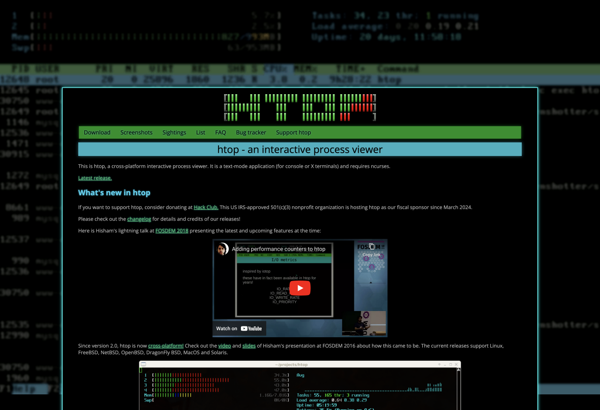
htop — htop is an interactive process viewer for Linux. It is similar to the default top command but with a customizable interface, additional features, and improved usability.

vtop — vtop is an open-source, cross-platform interactive monitoring tool for Linux/Unix systems. It provides a real-time view of system resources like CPU, memory, disks, network usage, and active processes

htop offers Interactive interface with ability to scroll, sort processes, kill processes, change priority, Color-coded meters for CPU, memory, swap usage, Ability to monitor multiple processes and system resource usage, Tree view to see parent-child process relationships, Search and filter processes, while vtop provides Real-time system monitoring, Resource utilization metrics for CPU, memory, disks, network, Process monitoring and management, Interactive terminal interface, Cross-platform support for Linux, Unix, macOS.

htop stands out for More intuitive and user-friendly than top, Additional features for analyzing processes, Improved visibility into system resource usage; vtop is known for Lightweight and low resource usage, Easy to use terminal UI, Good for quickly diagnosing system or resource issues.

Pricing: htop (Free) vs vtop (Open Source).

Why Compare htop and vtop?

When evaluating htop versus vtop, both solutions serve different needs within the os & utilities ecosystem. This comparison helps determine which solution aligns with your specific requirements and technical approach.

Market Position & Industry Recognition

htop and vtop have established themselves in the os & utilities market. Key areas include process-viewer, task-manager, linux.

Technical Architecture & Implementation

The architectural differences between htop and vtop significantly impact implementation and maintenance approaches. Related technologies include process-viewer, task-manager, linux.

Integration & Ecosystem

Both solutions integrate with various tools and platforms. Common integration points include process-viewer, task-manager and monitoring, system.

Decision Framework

Consider your technical requirements, team expertise, and integration needs when choosing between htop and vtop. You might also explore process-viewer, task-manager, linux for alternative approaches.

Feature htop vtop
Overall Score N/A N/A
Primary Category Os & Utilities System & Hardware
Target Users Developers, QA Engineers QA Teams, Non-technical Users
Deployment Self-hosted, Cloud Cloud-based, SaaS
Learning Curve Moderate to Steep Easy to Moderate

Product Overview

htop
htop

Description: htop is an interactive process viewer for Linux. It is similar to the default top command but with a customizable interface, additional features, and improved usability.

Type: Open Source Test Automation Framework

Founded: 2011

Primary Use: Mobile app testing automation

Supported Platforms: iOS, Android, Windows

vtop
vtop

Description: vtop is an open-source, cross-platform interactive monitoring tool for Linux/Unix systems. It provides a real-time view of system resources like CPU, memory, disks, network usage, and active processes.

Type: Cloud-based Test Automation Platform

Founded: 2015

Primary Use: Web, mobile, and API testing

Supported Platforms: Web, iOS, Android, API

Key Features Comparison

htop
htop Features
  • Interactive interface with ability to scroll, sort processes, kill processes, change priority
  • Color-coded meters for CPU, memory, swap usage
  • Ability to monitor multiple processes and system resource usage
  • Tree view to see parent-child process relationships
  • Search and filter processes
  • Customizable interface and color schemes
  • Mouse support
vtop
vtop Features
  • Real-time system monitoring
  • Resource utilization metrics for CPU, memory, disks, network
  • Process monitoring and management
  • Interactive terminal interface
  • Cross-platform support for Linux, Unix, macOS
  • Open source and free

Pros & Cons Analysis

htop
htop
Pros
  • More intuitive and user-friendly than top
  • Additional features for analyzing processes
  • Improved visibility into system resource usage
  • Easy to kill processes or change priority
  • Customizable layout and colors
Cons
  • Requires familiarity with Linux/Unix systems
  • Steeper learning curve than top
  • Configuration can be complex for new users
vtop
vtop
Pros
  • Lightweight and low resource usage
  • Easy to use terminal UI
  • Good for quickly diagnosing system or resource issues
  • Cross-platform support
  • Free and open source
Cons
  • Less comprehensive than full-featured monitoring tools
  • Terminal interface not as robust as GUI
  • Limited configuration options
  • Not ideal for long-term monitoring and analytics

Pricing Comparison

htop
htop
  • Open Source
vtop
vtop
  • Open Source
  • Free

Get More Information

Learn More About Each Product

Ready to Make Your Decision?

Explore more software comparisons and find the perfect solution for your needs