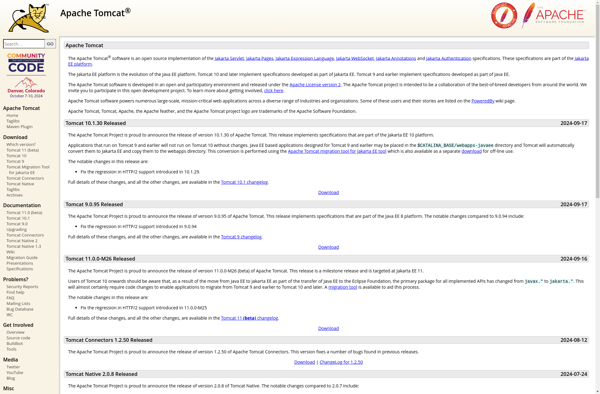
Apache Tomcat is an open source Java Servlet Container that implements specifications from Java EE and Java Servlet. It provides a web server environment to run Java code and serve web applications.
What is Apache Tomcat?
Apache Tomcat is an open source implementation of the Java Servlet, JavaServer Pages, Java Expression Language and Java WebSocket technologies. It provides a pure Java HTTP web server environment in which Java code can run.
Tomcat is developed and maintained by developers from the Apache Software Foundation and open source community. It implements specifications that are defined in the Java Enterprise Edition platform from Oracle.
Some of the main features and uses of Tomcat include:
Providing a basic web server that can handle HTTP request/response.
Hosting and serving Java-based web applications that follow Java EE standards like Servlets and JSPs.
Providing an environment to run and test Java code.
Enabling development of web apps without needing a separate web server like Apache HTTPD or Nginx.
Lightweight and efficient implementation of Java web technologies.
Tomcat is very popular for serving Java web apps in production environments due to its stability, security and scalability. Major companies and products use Tomcat including Apache Struts, Apache Solr and Jenkins. It powers a significant portion of Java-based sites and apps on the web.
Apache Tomcat Features
Features
Servlet container
Implements Java Servlet and JavaServer Pages (JSP) specifications
Provides web server environment to run Java code
Supports HTTP connectors to serve web applications
Manages session data
Performs load balancing
Pricing
Open Source
Pros
Open source and free
Widely used and supported
High performance
Extensive configuration options
Easy to deploy web applications
Integrates well with other Java EE technologies
Cons
Steep learning curve
Not as feature rich as full Java EE application servers
Additional configuration required for advanced features
More memory intensive than basic web servers like Nginx
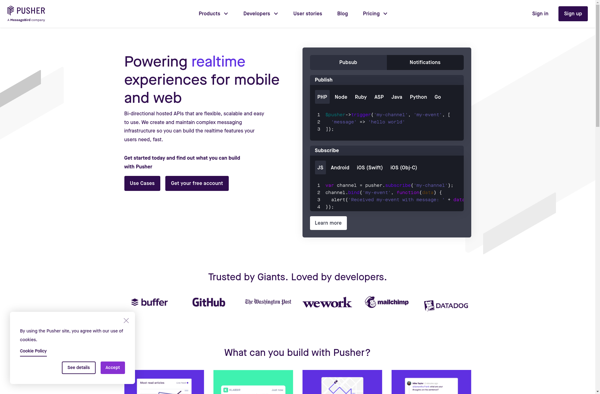
Pusher is a hosted API service that provides developers with the tools to easily build realtime features into their web and mobile applications. At its core, Pusher enables applications to communicate bidirectionally and establish persistent connections through which messages can be sent and received in real time.Some of the key...
JBoss is a widely used open source application server that implements Java Enterprise Edition (Java EE) standards. It provides a runtime platform and services for developing and deploying Java server applications, web applications, and web services.Some key features and capabilities of JBoss include:Supports Java EE web technologies like Servlets, JSPs,...
Jetty is a free, open source web server and Java Servlet container developed by the Eclipse Foundation. It provides an HTTP server and Servlet container capable of serving static and dynamic content. Some key features of Jetty include:Lightweight and high performance - Jetty has a small memory and resource footprint,...
Payara Server is an open source application server derived from GlassFish Server Open Source Edition. It is developed by Payara Services Ltd and released under the Common Development and Distribution License (CDDL).Payara Server includes various patches, bug fixes and enhancements on top of the GlassFish codebase. Some of the key...
Simperium is a real-time data synchronization service designed specifically for apps. It enables developers to build apps that sync data across multiple devices and users in real-time.Here are some key features of Simperium:Automatic data replication - Any data changes made on one device are instantly synced to all other devices.Offline...
DataKernel is an open-source extract, transform, load (ETL) and data integration tool. It provides a user-friendly graphical interface for building data pipelines without coding. Some key features and capabilities of DataKernel include:Connectivity to a wide range of data sources like databases, APIs, files, etc.Intuitive drag-and-drop interface for transforming, cleansing, and...
Mako Server is an open-source media server software that allows you to create your own personal media library. It is designed to help you store, organize, manage, and stream your media collection including movies, TV shows, music, audiobooks, photos, and more to various devices.Some key features of Mako Server include:Automatic...