Coq
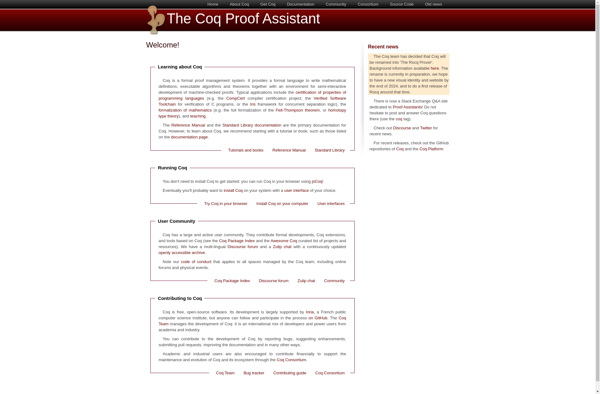
Coq: Open-Source Proof Assistant & Functional Programming Language
Formal specification, development, and proof of properties for computer systems and mathematics, with features like mathematical definitions, executable algorithms, and theorems
What is Coq?
Coq is an interactive theorem prover and functional programming language used to formally specify, develop, and prove properties about computer systems and mathematics. It facilitates writing mathematical definitions, executable algorithms, and proofs of theorems in a formal language called the Calculus of Inductive Constructions.
As an interactive theorem prover, Coq allows users to state mathematical assertions, definitions, algorithms, and properties, which can then be mechanically checked for logical correctness. Users build formal proofs by applying inference rules and previously proven theorems and lemmas. This provides a high degree of certainty that the end result is correct.
Coq also doubles as a functional programming language with a rich set of data types and functions. Users can write executable algorithms and test them on concrete inputs. The same semantics carry over to proofs about those algorithms, enabling realistic application to real-world problems.
Some key features and capabilities of Coq include:
- Formal specification and verification of properties about computer systems and languages
- Construction of mathematically certified algorithms and data structures
- Encoding of mathematical theories and proofs, including group theory, set theory, real analysis, etc.
- Extraction of executable code in languages like OCaml and Haskell from constructive proofs
- High confidence that critical software meets stringent reliability and security standards
Coq is used in major industrial and research projects to ensure correctness of mission-critical code and mathematical models. Its wide adoption stems from the expressiveness and power stemming from its theoretical foundations in the Calculus of Inductive Constructions.
Coq Features
Features
- Formal verification of mathematical proofs
- Functional programming language
- Tactics for guiding proofs
- Extraction of executable code from proofs
- Large standard library
Pricing
- Open Source
Pros
Cons
Official Links
Reviews & Ratings
Login to ReviewThe Best Coq Alternatives
View all Coq alternatives with detailed comparison →
Top Development and Proof Assistants and other similar apps like Coq
Isabelle

Agda