Flask
Flask is a popular Python web framework that provides useful tools and features for building web applications. It is lightweight, easy to get started with, and flexible allowing developers to choose extensions.
Flask: Lightweight Python Web Framework
Flask is a popular Python web framework that provides useful tools and features for building web applications. It is lightweight, easy to get started with, and flexible allowing developers to choose extensions.
What is Flask?
Flask is a lightweight Python web framework that provides useful tools and features for building web applications. Here is an overview of Flask:
- It is based on the Werkzeug WSGI toolkit and Jinja2 template engine.
- Flask has a small and easy-to-extend core but supports many extensions that add advanced functionality as needed.
- It uses a development server and debugger for easy and quick prototyping.
- Flask provides request/response objects, routing, and template engine out-of-the-box.
- The framework is flexible as everything is built into modules that can be enabled or disabled as needed.
- Flask does not include an ORM, database abstraction layer, form validation or other components by default but extensions provide all these features.
- Some key extensions include Flask-SQLAlchemy, Flask-WTF, Flask-Login, etc.
- Flask promotes the convention-over-configuration philosophy so it aims to have sensible defaults rather than requiring tons of config.
Overall, Flask is a good choice for building web apps of different complexities as it is easy to get started with but also scalable and extensible. Its sweet spot is building simple, prototype or mid-complex apps that require flexibility.
Flask Features
Features
- Lightweight
- Built-in development server
- Uses Python syntax
- Integrated support for unit testing
- RESTful request dispatching
- Uses Jinja templating
Pricing
- Open Source
Pros
Easy to get started
Minimal setup required
Flexible and extensible
Large ecosystem of extensions
Integrates with many databases/tools
Cons
Limited built-in features
Requires add-ons for advanced functionality
Not ideal for large complex applications
Can be challenging for beginners
Lacks built-in form validation
Official Links
Reviews & Ratings
Login to ReviewThe Best Flask Alternatives
View all Flask alternatives with detailed comparison →
Top Development and Web Frameworks and other similar apps like Flask
Here are some alternatives to Flask:
Suggest an alternative ❐
FastAPI
FastAPI is a modern, high-performance web framework for building APIs with Python 3.6+ based on standard Python type hints. Here are some key features of FastAPI:Very fast - benchmarks show it's one of the fastest Python frameworks available.Easy to use - designed to be easy and intuitive with minimal boilerplate...
Jam-py
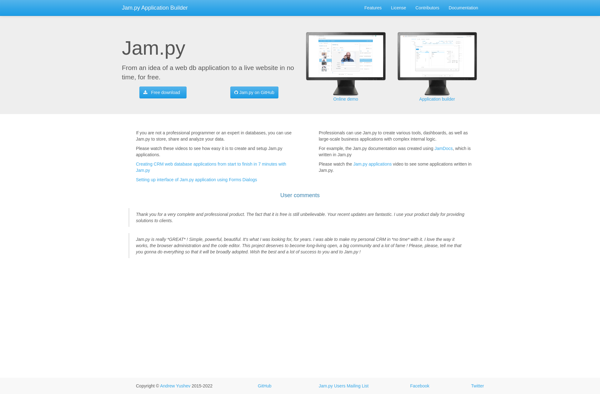
jam-py is an open-source Python library for building conversational AI assistants and chatbots. It provides a set of modular components for natural language understanding, dialogue management, knowledge representation, and integration with external services.Key features of jam-py include:Natural language processing tools for intent recognition, entity extraction, and sentiment analysisDialogue manager with...

ViUR.is
ViUR.is is an open-source content management system and web framework written in Python. It lets you build modern, database-driven websites and web applications without the need to write code.Some key features of ViUR.is:Intuitive admin interface to manage contentFlexible data models and relationships between content typesTemplate engine to customize site appearancePermissions...
Javalin
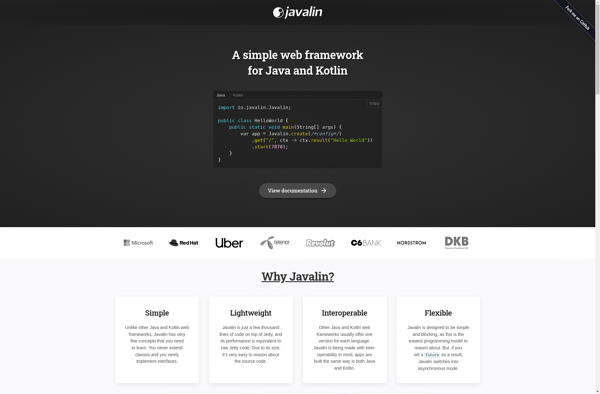
Javalin is a lightweight, fast web framework for Java and Kotlin focused on simplicity and Java/Kotlin interoperability. Key features of Javalin include:Minimal and fluent API for writing web applications and REST APIsSupport for Java 8 lambdas and Kotlin lambda syntax for route handlersEmbedded Jetty server with support for blocking and...
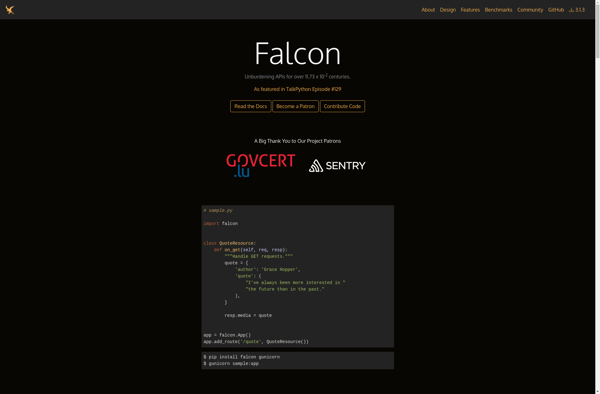
Falcon framework
Falcon is an open source, bare-metal Python web API framework designed specifically for building high performance app backends and microservices. Some key things to know about Falcon:It's extremely lightweight and fast, focused on minimizing latency and overheadProvides a simple routing interface for mapping URIs to resources for processing requestsFirst-class support...

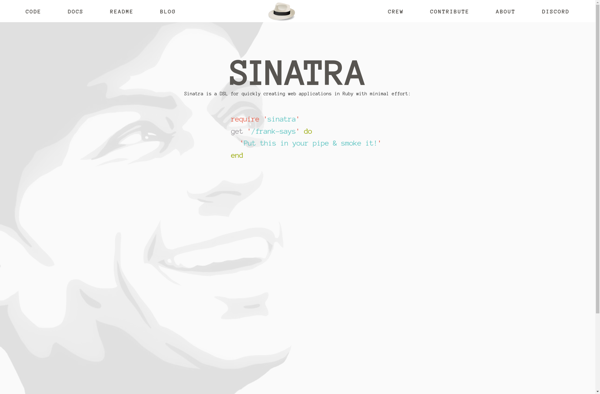
Sinatra
Sinatra is an open source web application library and domain-specific language written in the Ruby programming language. It is designed to enable quick and easy creation of small web applications and APIs.Some key features and characteristics of Sinatra:Light-weight and minimal - Sinatra has very few dependencies and a simple, intuitive...
Pylons Framework
The Pylons Framework is an open source web framework written in Python that enables developers to build web applications quickly and easily. It emphasizes flexibility, rapid development, and clean, pragmatic design.Some key features and characteristics of Pylons:Lightweight and fast - focuses on good performance out of the boxMVC architecture separates...

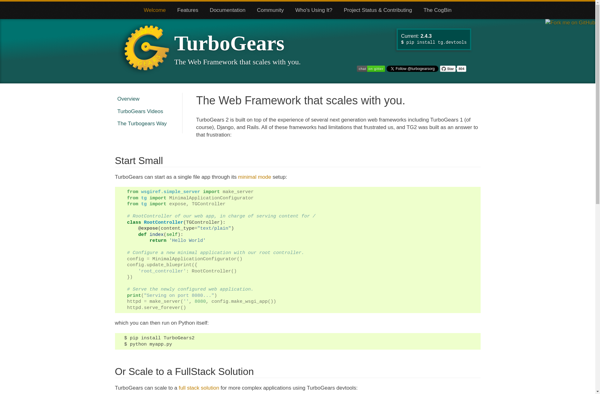
TurboGears
TurboGears is an open-source, full-stack Python web framework designed for rapid development and deployment of database-driven web applications. Some key features of TurboGears include:Builds on components like SQLAlchemy for database access, Genshi for templating, and jQuery for client-side scripting to provide an integrated framework out of commonly used Python librariesIncludes...
Bitweaver
Bitweaver is an open source content management system and web application framework written in PHP. It provides users with tools to easily create, edit, manage, and publish content on the web without needing expertise in web development or programming.Some key features of Bitweaver include:Intuitive interface and dashboard for managing content,...
Willer Framework
The Willer Framework is an open-source front-end web framework for building user interfaces and web applications. Developed by Willer Inc., it was first released in 2016 and has seen rapid adoption by developers and companies looking for a lightweight yet fully-featured framework alternative.Some key features of Willer Framework include:Modular, component-based...