gevent is a Python networking library built on top of libev event loop. It provides a high-level synchronous API on top of libev's asynchronous event loop, making it easier to write non-blocking network applications in Python.
gevent: High-Level Synchronous Networking Library for Python
A Python networking library built on top of libev event loop, providing a synchronous API for non-blocking network applications.
What is Gevent?
gevent is a Python networking library that provides a high-level synchronous API on top of libev's asynchronous event loop. This allows developers to write non-blocking network applications in Python using a synchronous coding style.
Some key features of gevent include:
Fast event loop based on libev
Lightweight execution units (greenlets) to provide pseudo-concurrency
API that resembles the Python standard library (threading, socket, ssl etc)
Cooperative sockets with ssl support
Ability to handle thousands of concurrent connections
DNS queries performed through c-ares asynchronous library
Monkey patching utility to get 3rd party libraries to become gevent-friendly
gevent is useful for writing high-performance networking apps like web servers, application servers, DNS servers, database proxies etc. It allows handling many concurrent connections easily with pseudothreads while scaling well without needing true multi-threading. Many major Python apps and frameworks use gevent internally like gevent, gunicorn, eventlet etc.
Gevent Features
Features
Coroutine-based concurrency
Fast event loop based on libev
Lightweight execution units
API that reuses concepts from the Python standard library
Cooperative multitasking
Pricing
Open Source
Pros
High performance
Easy to use API
Integrates well with existing Python code
Allows blocking calls to be non-blocking
Built-in support for common network protocols
Cons
Complex concurrency model
Debugging can be difficult
Requires application code to be written asynchronously
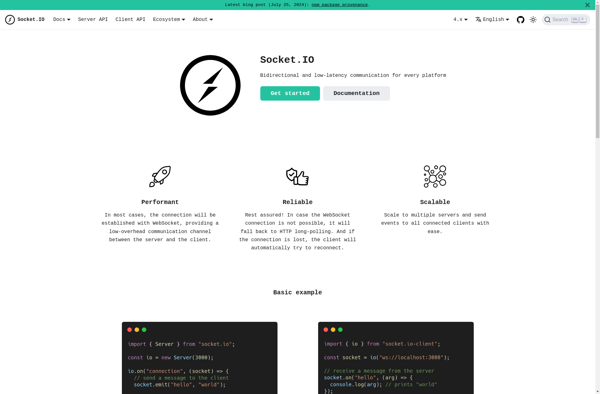
Socket.io is an open source JavaScript library that enables real-time, event-based communication between web clients and servers. It uses the WebSocket protocol to provide full-duplex, bidirectional communication channels over a single TCP connection. The key features of Socket.io include:Real-time messaging - Socket.io enables messaging between clients and servers with minimal...
JsSIP is an open source JavaScript library that enables real-time communications over the SIP protocol directly from web browsers. Developed specifically for web developers, JsSIP allows integrating voice, video, chat, and presence into web applications with just JavaScript and web APIs.Some key features of JsSIP include:Supports SIP over WebSocket, making...
WebRTC (Web Real-Time Communications) is a free, open-source project that enables web browsers and mobile applications to capture and optionally stream audio and video as well as exchange arbitrary data between browsers without requiring an intermediary. The set of standards that comprises WebRTC makes it possible to share data and...
WebSocket-Node is a popular open-source WebSocket library for Node.js applications. It provides a complete WebSocket client and server implementation for building real-time, event-based apps.Key features include:Supports the WebSocket protocol for full-duplex communicationAutomatic ping/pong handling for keepaliveFrame and message handling with support for binary dataCompatible with most WebSocket capable browsersExtensible and...
Bone.io is an open-source web-based wireframing and website mockup tool. It provides a simple drag-and-drop interface that allows users to quickly construct the basic wireframes and layouts for websites and web applications.Some key features of Bone.io include:Intuitive drag-and-drop editor for adding and arranging elements on pagesLibrary of common components like...
Eventlet is a concurrent networking library for Python that allows developers to easily write highly scalable network servers. It uses cooperative multitasking and coroutines to provide a high-level synchronous API on top of asynchronous I/O. This makes it easier for developers to write concurrent and parallel code without having to...
Greenlet is a lightweight concurrency library for Python that enables programmers to switch between several coroutines (green threads) in a similar way to yield statements. Unlike operating system threads, green threads are managed in userspace instead of kernel space, enabling non-blocking cooperative multitasking in Python programs.Some key capabilities and benefits...