GNU Common Lisp (GCL) is a free and open source implementation of the Common Lisp programming language. It features an integrated development environment, debuggers, and tools for optimization and delivery.
GNU Common Lisp: Free & Open Source Lisp Implementations
A free and open source implementation of the Common Lisp programming language with an integrated development environment, debuggers, and optimization tools.
What is GNU Common Lisp?
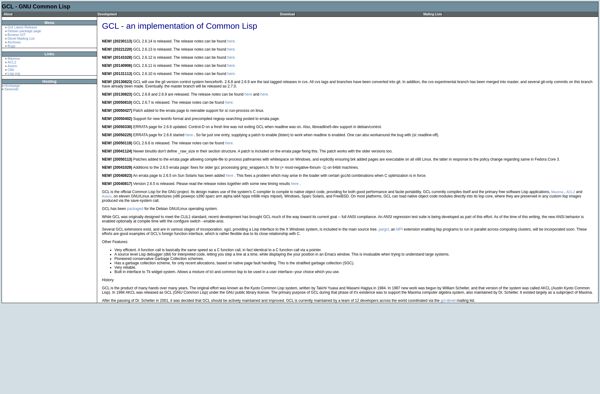
GNU Common Lisp (GCL) is a free, open source implementation of the Common Lisp programming language standard. It includes an integrated development environment (IDE) with debugging features, a native code compiler, tools for optimization and delivery, and interfaces to operating system services.
Some key features of GCL include:
Full implementation of Common Lisp, compliant with the ANSI standard
Native code compiler for performance-critical code
Interactive read-eval-print loop for rapid development
Debugger with trace and inspection capabilities
IDE for editing, compiling, and debugging Lisp code
Built-in HTTP server for web application development
FFI for calling C libraries from Lisp
Portable across many operating systems like Linux, Windows, macOS
GCL makes Common Lisp accessible for programmers on Unix-like and Windows systems. Its native compiler combined with an interactive environment enables both rapid development and good performance for real-world applications. The included IDE, debuggers, FFI, and HTTP server provide a lot of supporting functionality out of the box.
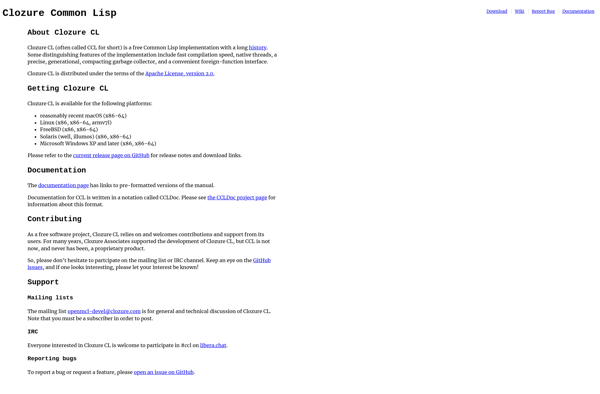
Clozure Common Lisp (CCL) is a high-quality, open-source implementation of the Common Lisp programming language. Some key features of CCL include:Runs on Mac OS X, Linux, Android, BSD, Solaris and WindowsCompiles to native code for excellent performanceStable and mature implementation with an extensive language feature setStrong integration with the C...
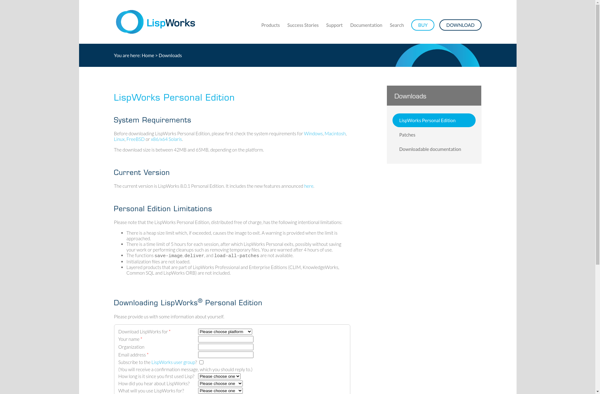
LispWorks is a full-featured commercial Common Lisp development environment produced by LispWorks Ltd. It includes the following key features:An integrated development environment (IDE) with source code editor, debugger, profiler, and other toolsA high performance native code compilerA graphical user interface (GUI) library and builderA web application development frameworkTools for creating...
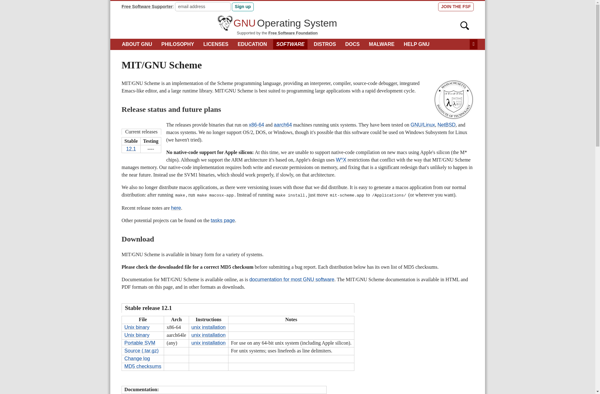
MIT Scheme is a dialect of the Lisp programming language that was developed at the Massachusetts Institute of Technology in the 1970s. It is designed to be a simple yet practical implementation of Scheme that focuses on computer science education.Some key features and characteristics of MIT Scheme include:Minimalist design and...
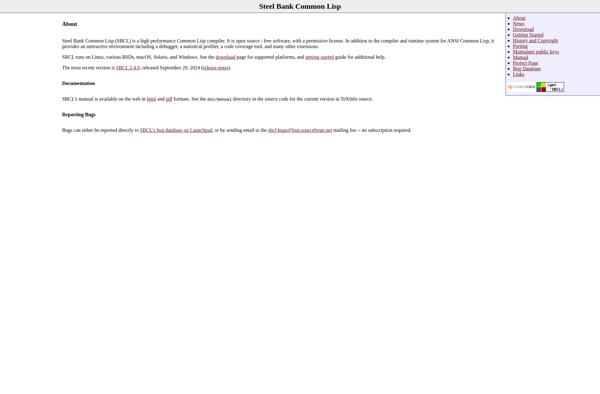
Steel Bank Common Lisp (SBCL) is a mature, open source implementation of the Common Lisp programming language standard. It is known for having excellent performance and stability compared to other Common Lisp implementations.SBCL compiles Common Lisp code to highly optimized native machine code for x86, x86-64, PowerPC, ARM, and other...
Allegro CL is a Common Lisp implementation developed by Franz Inc. that focuses on high performance and robust software delivery. Some key features of Allegro CL include:An advanced optimizing compiler that generates efficient native codeA high performance garbage collectorSupport for multiprocessing and multithreadingAn open source project called AllegroGraph that provides...
newLisp is a Lisp programming language environment designed for scripting and application development. It has a small core with lots of libraries and extensions available. newLisp is multi-paradigm, meaning it supports procedural, functional, and object-oriented programming styles.Some key features of newLisp include:Dynamically typed - variables have no predefined typeAutomatic memory...
ManKai Common Lisp (MCL) is an industrial strength Common Lisp implementation designed for high performance, stability, and compatibility. Some key features include:Advanced native compiler with multiple optimization levelsFull Unicode and multi-byte character supportPortable multi-threading and synchronization primitivesComprehensive operating system and C language interfacesEfficient CLOS object system with metaobject protocol (MOP)TCP/IP...
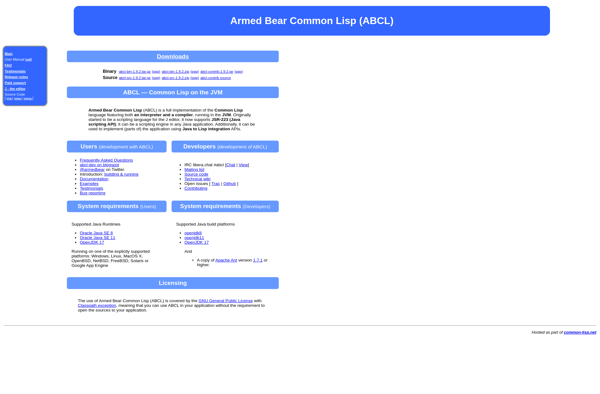
Armed Bear Common Lisp (ABCL) is an open source implementation of the Common Lisp programming language that runs on the Java Virtual Machine (JVM). It allows Lisp code to interoperate seamlessly with Java code and libraries.Some key features of ABCL include:Full implementation of Common Lisp, conforming to the ANSI standardNative...
CLISP is a free, portable, open-source implementation of the Common Lisp programming language. Developed by Bruno Haible and Michael Stoll, it provides a highly compliant Common Lisp environment, supporting most of the features defined in the ANSI Common Lisp standard.Some key features and characteristics of CLISP include:Good performance for a...
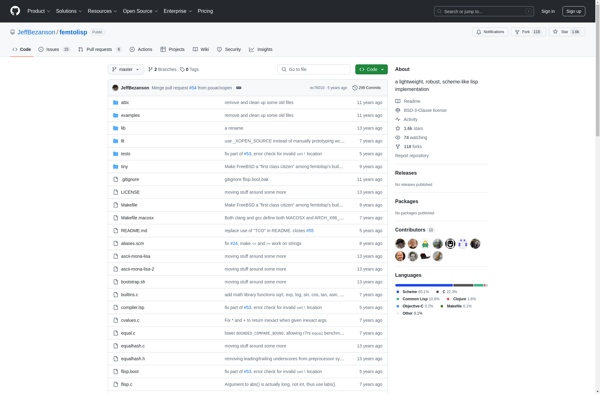
Femtolisp is a lightweight and embeddable Lisp interpreter written in C. Despite its small size, it provides all core Lisp features like a REPL, variables, functions, macros, closures, and more. It compiles to highly optimized native code via libgcc.With its minimal feature set and liberal license, Femtolisp aims to be...
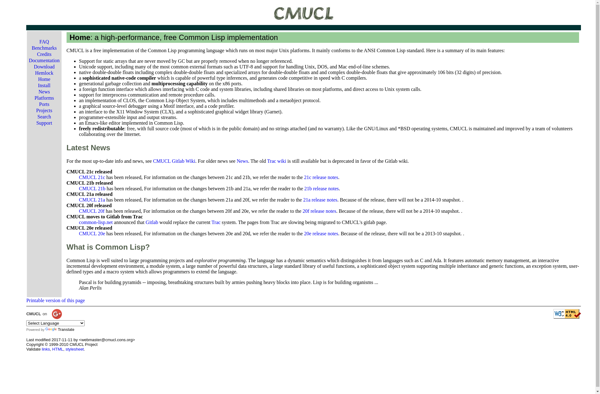
CMU Common Lisp (also known as CMUCL) is a free, open-source implementation of the Common Lisp programming language. It was originally developed at Carnegie Mellon University starting in the 1980s.Some key features of CMUCL include:An advanced native code compiler that generates highly optimized machine codeA foreign function interface for interoperating...