
Gummiboot is a simple UEFI boot manager designed to boot Linux operating systems. It is lightweight, easy to configure, and supports multiple boot entries for different kernels and operating systems.
A lightweight and easy-to-configure UEFI boot manager supporting multiple kernel and OS boot entries for Linux operating systems.
What is Gummiboot?
Gummiboot is a boot loader for Linux operating systems using UEFI (Unified Extensible Firmware Interface). It is designed to be a simple, lightweight, and easy-to-use alternative to more complex boot managers like GRUB.
Some key features of gummiboot include:
Supports booting multiple Linux kernels and operating systems from the same EFI System Partition
Very fast boot times due to simplified design and minimizing scripts/modules
Easy configuration via simple text files, no need to regenerate config files on kernel updates
Supports graphical menus for selecting boot options
Open source with active development and maintenance
Gummiboot is therefore targeted towards Linux distributions and system administrators looking for a no-frills UEFI boot manager that can handle multi-boot setups without unnecessary complexity. Its small codebase also makes it portable across many environments. The simplified text-based configuration lowers the chance of misconfiguration and breakages.
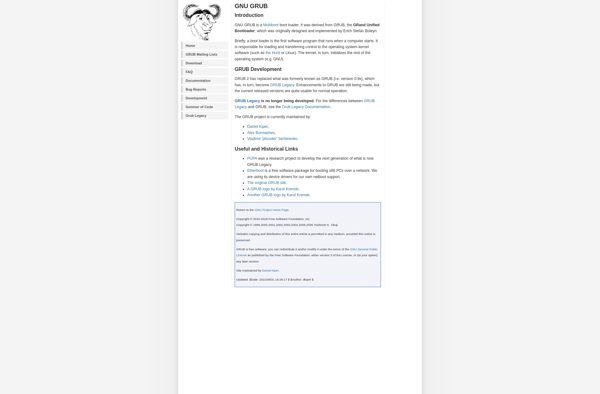
GRUB (GNU GRand Unified Bootloader) is an open source boot loader used to boot operating systems during start up. It is the default boot loader for most Linux distributions and is also available for BSD, Solaris, and other operating systems.When a computer first turns on, the BIOS initializes hardware components...
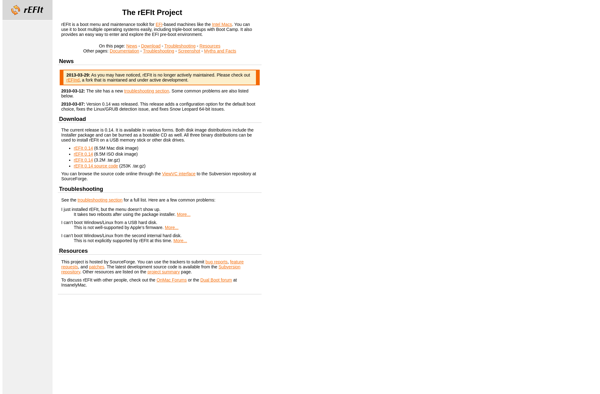
rEFIt (rEFInd Boot Manager) is an open source boot menu and system maintenance toolkit for computers that use the Extensible Firmware Interface (EFI) or Unified EFI (UEFI). It provides an alternative graphical boot menu to select operating systems or bootable tools.Some key features of rEFIt include:Graphical boot menu for EFI/UEFI...
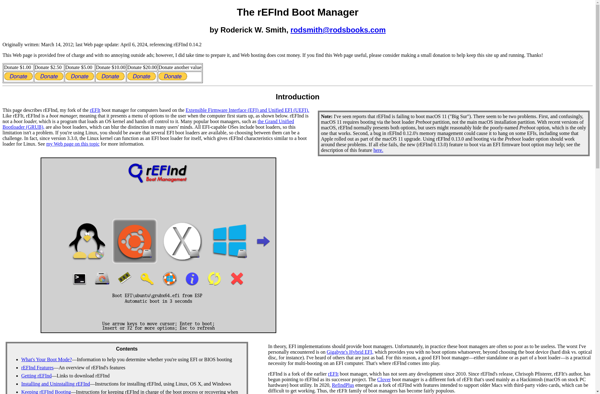
rEFInd is an open source boot manager for computers that use the Extensible Firmware Interface (EFI). It provides an alternative to the boot process used by default with EFI systems.Some of the key features of rEFInd include:Automatic detection of EFI-capable operating systems that are installed on the computerA clean graphical...
Clover is an open-source bootloader for computers using UEFI firmware. It is commonly used to boot macOS on non-Apple hardware, which is not officially supported by Apple. Clover enables users to install macOS on devices other than Macs by patching and injecting drivers at boot time to spoof compatibility with...
coreboot is an open source project that develops Linux-based firmware to replace proprietary BIOS/UEFI firmware on various computer hardware. The goal of coreboot is to initialize and test hardware components of a device and then pass control over to a bootloader that will load an operating system.Some key points about...
Libreboot is an open source boot firmware (a distribution of coreboot) that replaces proprietary BIOS/UEFI firmware found in most computers. It focuses on providing security, privacy, software freedom and fast boot times.Some key features and goals of Libreboot include:Using fully free and open source software for all firmware code, with...
Petitboot is an open-source network bootloader and discovery tool designed for PowerPC systems. It enables netbooting over common network protocols like HTTP, FTP and TFTP to load operating systems or other payloads.Some key features of petitboot include:Netbooting support for PowerPC - petitboot handles retrieving kernels, initrds and device trees over...