Hugs

Hugs: Open-Source Functional Programming Language for Academia
Learn about Hugs, an open-source functional programming language used in academia for teaching and research, with its strong static type system based on Haskell.
What is Hugs?
Hugs is an open-source functional programming language that is primarily used in academic settings for teaching and research. It is based on Haskell and shares the same underlying theory and semantics, but with a focus on simplicity and ease of use rather than performance.
Some key features of Hugs include:
- Strong static typing with type inference - The compiler can automatically determine types without explicit type declarations
- Purity and referential transparency - Functions have no side effects, only depending on their inputs to determine outputs
- Lazy evaluation - Expressions are only evaluated when their results are needed, which enables optimization and modular coding
- List comprehensions - A natural and easy way to construct new lists from existing lists
- Pattern matching - Matching data constructs against patterns is a powerful tool both for assignment and control flow
As an interpreter rather than a compiler, Hugs is slower than optimized Haskell compilers, but provides faster edit-run debug cycle development. The type system catches many logic errors that would be runtime errors in untyped languages.
While less performant than industrial Haskell, Hugs is popular for computer science education because of its simple installation, easy to understand error messages, and fast testing iterations. It allows students to grasp FP concepts without getting mired in complex compile-link-run cycles of compiled languages.
Hugs Features
Features
- Functional programming language
- Strong static type system
- Type inference
- Overloading
- Interpreted (not compiled)
- Interactive environment
- Built-in graphics and GUI libraries
Pricing
- Open Source
- Free
Pros
Cons
Official Links
Reviews & Ratings
Login to ReviewThe Best Hugs Alternatives
View all Hugs alternatives with detailed comparison →
Top Development and Programming Languages and other similar apps like Hugs
Here are some alternatives to Hugs:
Suggest an alternative ❐
Utrecht Haskell Compiler
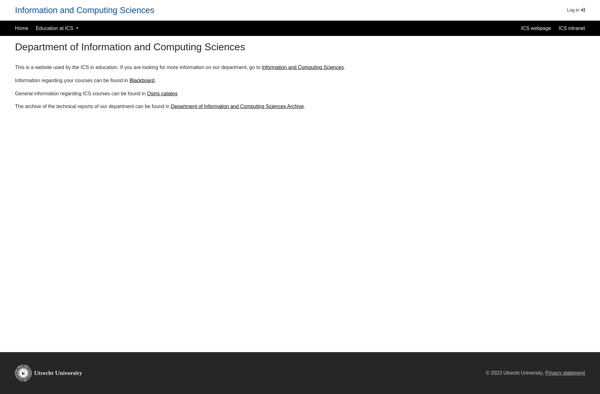

Glasgow Haskell Compiler