Minoave is an open-source, self-hosted alternative to Notion. It allows users to create wikis, documents, notes, calendars, project boards and more on their own servers. Minoave focuses on simplicity, flexibility, and security.
Open-source, customizable wiki and document management solution for self-hosting on your own servers, prioritizing simplicity, flexibility, and security.
What is Minoave?
Minoave is an open-source, self-hosted wiki and note-taking platform that can be considered an alternative to proprietary software like Notion or Confluence. Minoave allows users to create rich documents, wikis, notes, calendars, kanban boards, and more to organize both their personal and professional projects.
As open-source software, Minoave puts the control and security of your data back in your own hands rather than relying on a third-party service. Minoave can be self-hosted on your own server or devices. This allows your data to stay private while also customizing Minoave to suit your specific needs.
Some of the key features of Minoave include:
Wikis for documentation and collaboration
Rich text documents of any length
Markdown support for plain text formatting
Tags and links between internal pages
Calendars and event scheduling
Customizable kanban boards
Due dates, reminders, and priorities
Tables, embeds, code blocks, and more
As an open source project, Minoave is flexible to adapt to any workflow. Whether note-taking for personal projects, documenting software developments, tracking business operations, or just staying organized, Minoave aims to provide a simple but powerful platform for productivity and collaboration.
Minoave Features
Features
Wiki pages for documentation
Rich text documents
Markdown support
Note taking
Calendars
Kanban boards
Tasks & reminders
Tags & filters
Collaboration tools
Mobile apps
Custom theming
Plugins & extensions
Pricing
Open Source
Pros
Open source
Self-hosted
Highly customizable
Great for personal knowledge management
Strong security and privacy
Active development community
Cons
Self-hosting requires technical skills
Mobile apps lack some features
Not as user friendly as Notion
Limited integrations compared to Notion
Smaller user community than more established options
Pluto TV is a popular free, ad-supported streaming television service owned by Paramount. It offers over 250 live linear streaming channels and thousands of hours of on-demand content across a variety of categories including movies, TV shows, news, sports, comedy, viral videos, cartoons, and more.One of the main benefits of...
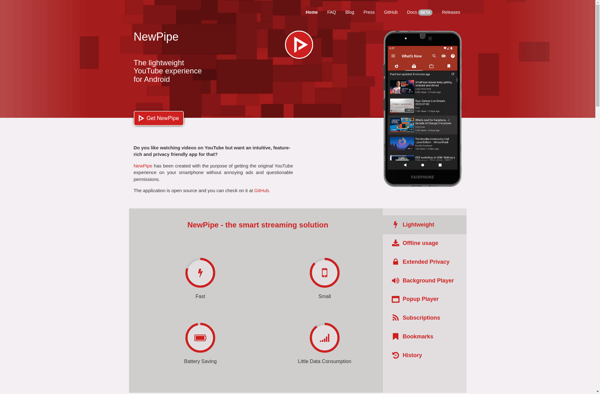
NewPipe is a free and open-source YouTube client app for Android. It provides an alternative front-end to YouTube without needing to use Google services and products.Key features of NewPipe include:Watch YouTube videos without adsListen to YouTube videos in the backgroundDownload videos or extract audioDoes not require a Google account or...
Max is a visual programming language for developing interactive, media-rich software for music and multimedia. It was created and is developed by Cycling '74.Some key features and capabilities of Max:Enables creating complex interactive software synthesizers, audio effect processors, and MIDI controllersGraphical patching interface for connecting objects and routing dataHuge library...
FreeTube is an open-source desktop application that serves as an alternative YouTube client with a focus on privacy. It allows users to access YouTube video content without being tracked or shown ads. Some key features of FreeTube include:Video streaming without ads or invasive analytics trackingSupport for YouTube features like subscriptions,...
Dailymotion is a video hosting service and sharing platform that enables users to upload, publish, and share videos worldwide. Launched in 2005, it has grown into one of the largest video platforms globally, challenging YouTube's dominance.Some key features that distinguish Dailymotion include:Support for HD-quality video uploads and adaptive bitrate streaming...
PeerTube is a free and open-source, decentralized video platform built on free/libre software. It is designed to be an alternative to video hosting services like YouTube, allowing users to host their own video streaming service.Some key features of PeerTube include:Decentralized architecture - Videos are shared across a federation of servers...
BitChute is a peer-to-peer video sharing platform launched in 2017 as an alternative to YouTube. Unlike YouTube, BitChute is decentralized and built on blockchain technology, meaning videos are distributed across multiple servers instead of a centralized platform.This decentralized nature allows BitChute to avoid censorship and removal of content that may...
DTube is a decentralized video hosting and sharing platform that runs on top of the Steem blockchain. It allows users to upload, view, comment on, and share videos without needing to rely on centralized platforms like YouTube.Some key aspects of DTube include:Videos are hosted in a decentralized manner using the...
Vimeo is an online video platform and community launched in 2004 that enables users to upload, share, and view high-quality videos. It has a clean, ad-free interface and offers high video quality playback. Vimeo is geared more towards creative professionals compared to platforms like YouTube.Some key features of Vimeo include:High...
StreamingVideoProvider is a subscription-based video streaming platform that gives users access to an extensive library of movies, TV shows, sports, documentaries, and more. It allows viewers to instantly watch video content on an internet-connected device without needing to download files.Some key features of StreamingVideoProvider include:Works across devices like smart TVs,...
MediaGoblin is a free and open source media publishing platform built on Python and GNU AGPLv3 licensed. It provides users with the ability to host their own servers to publish and share various media types including photos, videos, audio files, and documents.Some key features of MediaGoblin include:Supports common media formats...