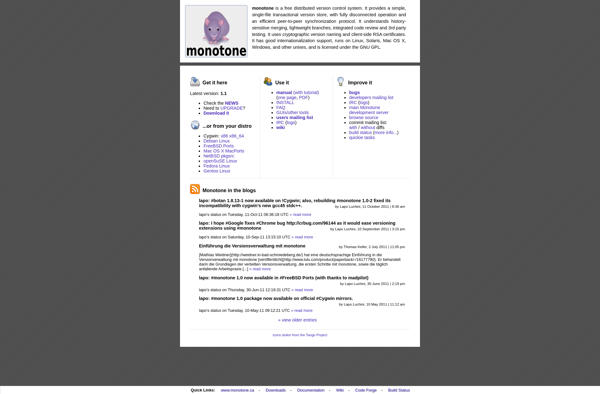
Monotone is an open-source distributed version control system. It tracks file revisions and allows groups of developers to collaborate on code by managing changes to documents and source code over time.
Monotone: Open-Source Distributed Version Control System
Monotone is an open-source distributed version control system. It tracks file revisions and allows groups of developers to collaborate on code by managing changes to documents and source code over time.
What is Monotone?
Monotone is an open-source distributed version control system for software development. It is designed to track changes to computer files and coordinate work on those files among multiple people. Some key features of Monotone include:
Distributed architecture - Each developer has a local database containing the full version history of files, allowing work offline and fast operations.
Cryptographic version naming - File versions are named by cryptographic hashes rather than sequential numbers.
Optimized network transfer - Monotone only transfers the minimum data needed when synchronizing databases across developers.
Fine-grained access control - Access to different branches and pathnames can be granularly controlled.
Independent branches - Branches are first-class, independent objects rather than just references to commits.
Overall, Monotone aims to be a lightweight, high-performance system enabling decentralized collaboration on source code. Its unique features may suit smaller development teams wanting more flexibility in their workflow compared to alternatives such as Git or Subversion.
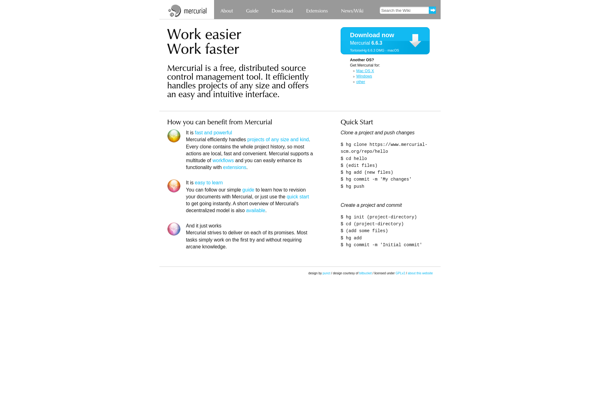
Mercurial is a free, distributed source control management system designed for efficient and reliable control of source code and other revision-controlled assets. Key features of Mercurial include:Distributed peer-to-peer architecture, allowing decentralized and collaborative developmentRobust branching and merging capabilities to support complex workflowsSecure, encrypted repositories with integrated access controlPowerful integrations with...
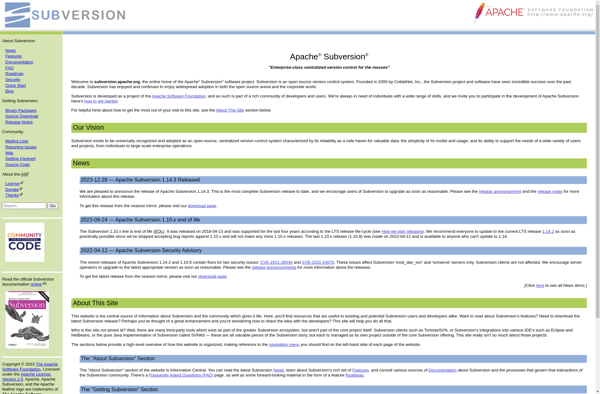
Apache Subversion (often abbreviated SVN) is a software versioning and revision control system distributed as free and open source software. Software developers use Subversion to maintain current and historical versions of files such as source code, web pages, and documentation. Its goal is to be a mostly compatible successor to...
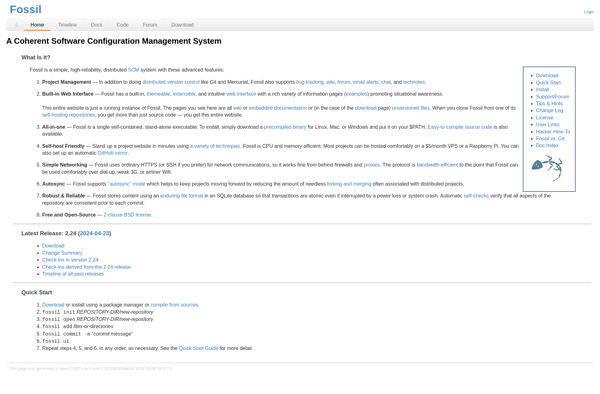
Fossil is an open-source, distributed version control system developed by D. Richard Hipp. It emphasizes simplicity, security, and data integrity over features commonly found in other version control systems.Some key features and capabilities of Fossil include:Distributed architecture - Allows geographically distributed teams to collaborate on a projectIntegrated bug tracking -...
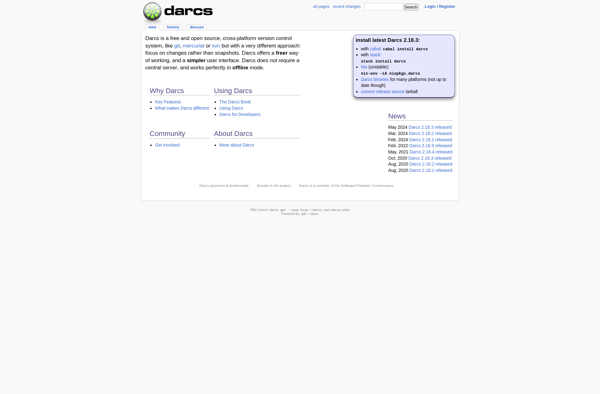
darcs is an advanced distributed revision control system that differs fundamentally from systems like Git and Mercurial in its underlying theory. While darcs shares common functionality with other version control tools like committing and branching/merging changes, it is built on a unique algebra of patches and provides innovative features like...
MKS Source is a comprehensive software configuration management and version control system designed for managing and controlling changes to source code and other artifacts during the software development lifecycle. It provides core SCM capabilities like version control, workspace management, branching and merging, change tracking, release management, and more to enable...
AccuRev is a software configuration management and version control system developed by Micro Focus. It uses a unique stream-based architecture that allows development teams to work in parallel on features or fixes without interference.Some key capabilities and benefits of AccuRev include:Stream-based architecture provides superior support for parallel and distributed development....
SpectrumSCM is a comprehensive software configuration management platform built to help development teams manage and track changes to source code, documents, multimedia assets, and any other content that is part of the software delivery lifecycle. It brings together version control, issue tracking, code review, release management, and other key capabilities...
Pijul is an open-source distributed version control system that offers an alternative approach to software like Git. Instead of Git's content-addressable storage model, Pijul is built on a theory of patches and solvers developed specifically for version control.The key difference with Pijul is in its merge capabilities. In systems like...