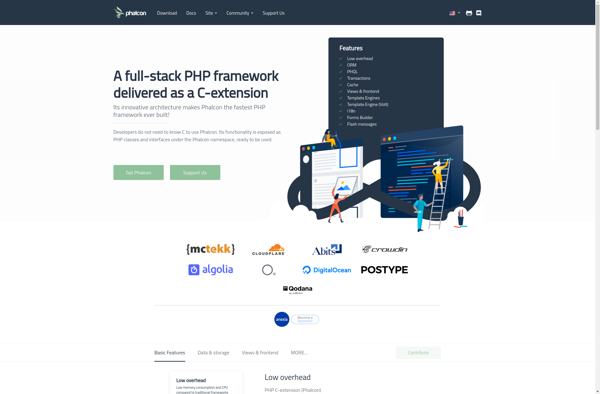
Phalcon is an open source web framework for PHP based on the model–view–controller (MVC) pattern. It is fast, secure, and can lower resource consumption.
Fast, secure, and lightweight web framework for PHP, utilizing the MVC pattern, Phalcon offers improved performance and reduced resource consumption.
What is Phalcon?
Phalcon is an open source web framework for PHP released under the BSD License. It is implemented as a C extension on PHP allowing for higher performance than traditional PHP frameworks.
Some key features of Phalcon:
MVC architecture for organizing application logic
Routing and URL generation
Templating engine for managing layouts and views
ORM for working with databases
Caching in memory or other backends
Authentication and authorization helpers
As a C extension to PHP, Phalcon provides improved performance including up to 3x faster execution speed and lower memory usage compared to frameworks like Laravel and Symfony. This helps applications handle more requests using fewer resources.
Phalcon follows PHP standards and conventions so it is easy for PHP developers to get started. It also offers powerful developer tools and IDE integration to enhance the development experience.
Phalcon Features
Features
High performance
Full stack framework
Loose coupling
Dependency injection
Event management
Volt template engine
Pricing
Open Source
Pros
Very fast execution
Low resource consumption
Easy to learn
Many components available
Active community support
Cons
Limited documentation
Steep learning curve
Not beginner friendly
Limited module ecosystem compared to other frameworks
Backdrop CMS is an open source content management system that was forked from Drupal in 2013. It retains the flexibility and power of Drupal, while aiming to be simpler and have lower overhead for small to mid-sized community websites.Some key features and characteristics of Backdrop CMS include:Lightweight codebase compared to...
Zend Framework is an open source, object-oriented web application framework implemented in PHP 7 and licensed under the New BSD License. It utilizes the model-view-controller (MVC) architecture and modular code to facilitate rapid application development and excellent performance.Some key features and benefits of Zend Framework include:Simple and streamlined object-oriented code...
Symfony is an open-source web application framework written in PHP for developing complex and enterprise-grade web applications. It utilizes and extends several existing PHP libraries to provide modular and reusable components for building modern web applications.Some key features of Symfony include:Routing system for mapping URLs to controllersTemplating engine (Twig) to...
The Yii Framework is an open source, object-oriented, model-view-controller (MVC) PHP web application framework. Since its initial release in 2008, Yii has gained a large following due to its efficient code structure, extensive documentation, and rich feature set.Some key advantages of using Yii include:Rapid application development through built-in code generation...
CakePHP is an open source web application framework written in PHP that follows the model–view–controller approach. It aims to make building web applications simpler and faster. Some key features of CakePHP include:Lightweight, extensible architecture based on the MVC patternBuilt-in libraries for commonly used tasks like database access, form validation, authentication,...
PHPixie is an open source PHP framework first released in 2009. It is designed to aid in rapid application development and help build a variety of web projects like applications, APIs, websites, and more.Some key features of PHPixie include:Database abstraction and ORM for simplified database accessTemplate engine for separating logic...
The Nette Framework is an open-source PHP web framework designed to simplify and accelerate web development. Some key features and characteristics of Nette include:Emphasis on speed and performance through caching and other optimizationsObject-oriented codebase supporting clean, reusable codeBuilt-in tools for security, validation, testing, debugging and moreEasy to learn and use,...
Silex is an open-source micro-framework for PHP based on the Symfony components. It is designed to be lightweight, fast, and simple to use for smaller web application projects.Some key features of Silex include:Routing system for mapping URLs to controllers/actionsService provider architecture to install additional functionalityUses Pimple dependency injection containerBuilt-in support...
Leaf PHP is an open-source, lightweight mini-MVC framework for building web applications and APIs with PHP. It was created to provide a simple, flexible, and efficient alternative to larger frameworks for smaller PHP projects.Some key features of Leaf PHP include:Routing with named parameters and middlewareMVC structure for separation of concernsDependency...
Laravel Boilerplate is an open-source starter kit for Laravel framework that provides a structured and well-organized foundation for building Laravel applications faster.It comes pre-packed with features like user authentication, registration, email verification, password reset, mailing, pagination, database migrations, routes, middleware, request validation, error handling, logging, API generation, etc.The goal of...
The Mako Framework is a fast, lightweight web templating system for Python. It enables developers to build dynamic web applications by writing Python code inside HTML templates to generate web content.Some key features of Mako include:Speed and performance focused - Mako compiles templates to Python code for faster executionSupport for...