Platform.sh
Platform.sh is a platform as a service for hosting web applications. It simplifies deployment, scaling, and management of applications with an automated infrastructure and workflow.

Platform.sh: PaaS for Hosting Web Applications
Platform.sh is a platform as a service for hosting web applications. It simplifies deployment, scaling, and management of applications with an automated infrastructure and workflow.
What is Platform.sh?
Platform.sh is a platform as a service designed for hosting web applications. Some key features include:
- Supports popular frameworks like PHP, Python, Ruby, Node.js, Java
- Automated infrastructure management and deployment workflows
- Integrated CI/CD to easily build, test and deploy applications
- Automatic scaling, health monitoring, and security
- Global CDN for asset acceleration with caching
- Support for custom runtimes and languages using build hooks
- Choice of container or serverless deployment
- HIPAA compliant plans available
- Platform.sh handles infrastructure management so developers can focus on building applications
By providing a fully managed platform optimized for deploying web apps, Platform.sh aims to increase developer productivity and application reliability. The automated workflows, scaling, security features and deployment options make Platform.sh a flexible cloud PaaS tailored for modern web application development.
Platform.sh Features
Features
- Automatic scaling
- Built-in caching
- Git-based deployment
- Multiple application environments
- HTTP/2 support
- Integrated SSL certificates
- Global CDN integration
Pricing
- Subscription-Based
Pros
Fast and easy deployment
Flexible scaling
High performance
Improved security
Cost efficient
Cons
Can have a steep learning curve
Limited customization options
Vendor lock-in
Official Links
Reviews & Ratings
Login to ReviewThe Best Platform.sh Alternatives
View all Platform.sh alternatives with detailed comparison →
Top Development and Web Hosting & Deployment and other similar apps like Platform.sh
Here are some alternatives to Platform.sh:
Suggest an alternative ❐
Microsoft Azure
Microsoft Azure, commonly referred to as Azure, is a robust and extensive cloud computing platform developed by Microsoft. Launched in 2010, Azure has evolved into one of the leading cloud service providers, offering a wide range of solutions for businesses, developers, and IT professionals. Azure provides a scalable and flexible...


Kubernetes
Kubernetes is an open-source system for automating deployment, scaling, and management of containerized applications. It groups containers that make up an application into logical units for easy management and discovery. Kubernetes provides a framework to run distributed systems resiliently across clusters of machines, hide the complexity of managing many different...

OpenStack
What Is OpenStack?OpenStack is an open-source cloud computing platform for building and managing public and private clouds. It provides infrastructure-as-a-service (IaaS) capabilities similar to AWS, allowing organizations to run their own cloud infrastructure on commodity hardware.Key FeaturesOpenStack consists of modular components: Nova (compute), Swift (object storage), Cinder (block storage), Neutron...


OpenShift
OpenShift is a cloud platform as a service developed by Red Hat that allows developers to quickly develop, host, and scale applications in a cloud environment. Some key things to know about OpenShift:It provides pre-configured application environments to support quick application deployment in languages like Java, Python, PHP, Ruby, Node.js...


Heroku
Heroku is a cloud platform as a service (PaaS) that streamlines the process of building, deploying, and scaling applications. Founded in 2007 and later acquired by Salesforce, Heroku has become a popular choice for developers seeking a straightforward and scalable platform for hosting web applications. Heroku abstracts much of the...


Google App Engine
Google App Engine is a platform-as-a-service (PaaS) offering from Google Cloud. It allows developers to build highly scalable web and mobile applications without having to worry about infrastructure management. Some key features of Google App Engine include:Automatic scaling - App Engine automatically scales applications up and down based on traffic...


Elestio
Elestio is an open-source website builder that makes it easy for anyone to create elegant, fully-featured websites, even without any coding knowledge. With its user-friendly drag-and-drop editor, you can add and customize a wide selection of elements like text, images, videos, contact forms, buttons, and more to build the exact...

OpenRuko
OpenRuko is an open source social networking platform built with Ruby on Rails. It allows anyone to easily create their own social network with many common features such as:User profilesNews feedsFriending/FollowingStatus updatesPhoto/Video uploadsGroupsForums/DiscussionsPrivate messagingNotificationsCustom themingAs an open source project, OpenRuko aims to provide a basic framework that developers can build...

Cycle.io
Cycle.io is a flexible, web-based project management software designed for agile development teams. It provides a variety of tools to help plan, organize, track and manage software projects of all sizes.Key features of Cycle.io include:Customizable boards to visualize workflows and track progressStory maps, epics, user stories, tasks, bugs, and custom...

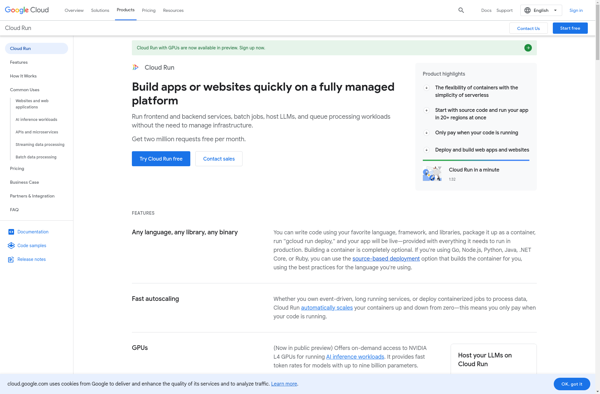
Google Cloud Run
Google Cloud Run is a managed compute platform that enables developers to run stateless containers in a serverless environment. Key features of Cloud Run include:Fully managed infrastructure - Cloud Run handles all infrastructure management and configuration behind the scenes, so developers can focus on code.Auto scaling - Cloud Run autoscales...

Includable
Includable is an open-source WordPress plugin that allows publishers to easily embed or 'include' content from other sites directly into their WordPress site. It works by retrieving content via RSS feeds from sites you specify and then displays that content natively on your site, acting as a content aggregator or...