SchemaDB

SchemaDB

SchemaDB is an open-source document-oriented database that is designed to store, query, and manage complex data structures. It utilizes a schema-less data model that makes it flexible and capable of handling frequently changing data schemas.
SchemaDB screenshot

SchemaDB: Open-Source Document-Oriented Database

SchemaDB is an open-source document-oriented database that is designed to store, query, and manage complex data structures. It utilizes a schema-less data model that makes it flexible and capable of handling frequently changing data schemas.

What is SchemaDB?

SchemaDB is an open-source document-oriented database that is built to handle complex, unstructured and constantly evolving data while eliminating impedance mismatch. It utilizes a schema-less data model that removes restrictions on the types of data that can be stored together and allows new data fields to be added without modifying existing data structures.

Some key features of SchemaDB include:

  • Schema-less design that provides flexibility to modify data schemas without migrations or impacting existing applications
  • Indexed tree structures to efficiently query nested data and scale horizontal reads
  • Multi-tenancy to manage data from multiple sources/clients within the same database
  • Tunable consistency that balances data accuracy with performance
  • Native replication for enhanced availabiity and scalability
  • APIs for Node.js, Java, C# and Go to reduce time to market for development

SchemaDB is well-suited for modern applications that rely on flexible schemas and need to optimize for developer productivity and fast iteration. Example use cases include IoT data platforms, content management systems, e-commerce sites, and real-time analytics applications.

SchemaDB Features

Features

  1. Schema-less data model
  2. Flexible handling of changing data schemas
  3. Supports complex data structures
  4. Ability to store, query, and manage data
  5. Open-source and free to use

Pricing

  • Open Source

Pros

Flexible and adaptable to changing data requirements

Efficient for handling unstructured or semi-structured data

Free and open-source, with a large community

Easy to set up and integrate into existing systems

Cons

May not have the same level of support and enterprise features as commercial databases

Limited query capabilities compared to traditional SQL databases

Potential performance issues for large-scale or high-throughput applications

Reviews & Ratings

Login to Review
No reviews yet

Be the first to share your experience with SchemaDB!

Login to Review

The Best SchemaDB Alternatives

Top Development and Databases and other similar apps like SchemaDB


Propel ORM icon

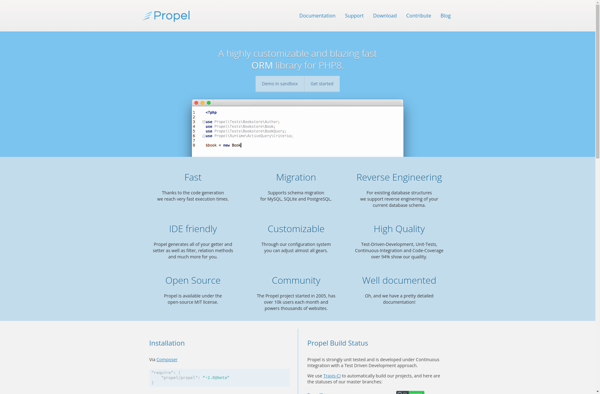
Propel ORM

Propel ORM is an open-source object-relational mapping (ORM) framework for PHP applications. It provides a set of classes that developers can use to interact with databases in an object-oriented way, eliminating the need to write SQL queries directly.Using Propel, developers create model classes that represent tables in the database. Propel...
Propel ORM image
PHP ActiveRecord icon

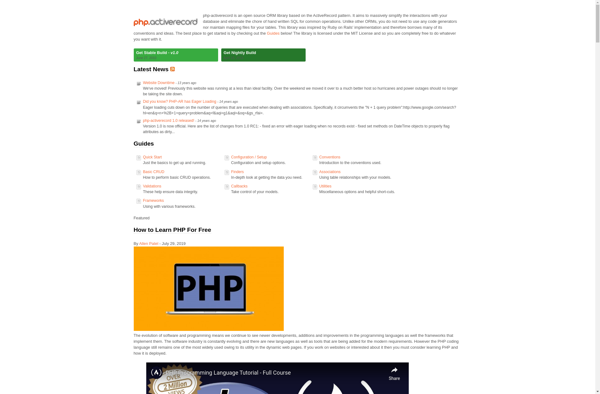
PHP ActiveRecord

PHP ActiveRecord is an open source object-relational mapping (ORM) library for PHP that implements the active record pattern. It provides an object-oriented interface to interact with databases in PHP applications.Some key features of PHP ActiveRecord include:Active record implementation for working with PHP objects mapped to database tablesSupport for relationships between...
PHP ActiveRecord image
RedBeanPHP icon

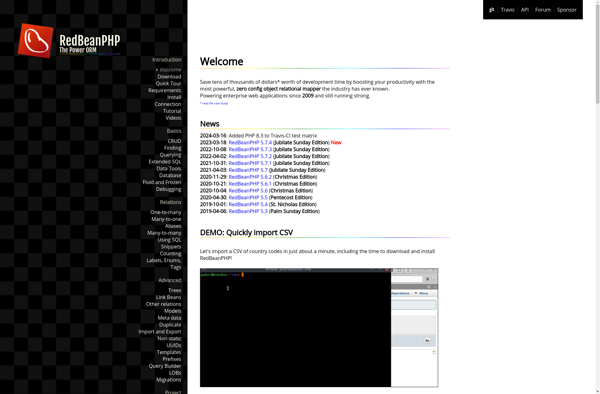
RedBeanPHP

RedBeanPHP is an open source object-relational mapping (ORM) framework for PHP that makes it easier for developers to interact with databases in their PHP applications. It abstracts away much of the data access code and allows developers to map database tables to PHP objects.Some key features of RedBeanPHP include:Automatic mapping...
RedBeanPHP image
Pork.dbObject icon

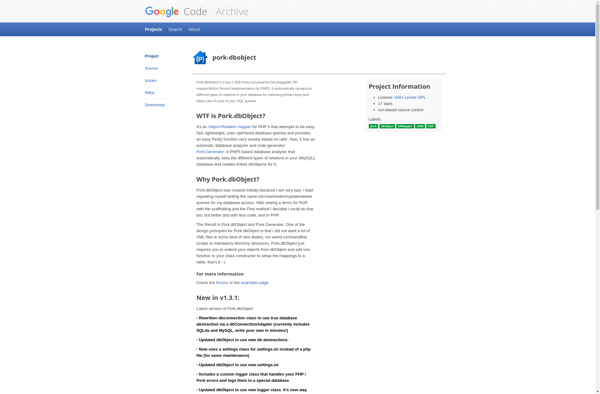
Pork.dbObject

Pork.dbObject is an open-source object-relational mapping (ORM) framework for .NET applications. It allows .NET developers to work with databases through regular .NET objects, rather than having to write SQL queries. Pork.dbObject handles mapping between objects in code and database tables behind the scenes.Some key features of Pork.dbObject include:Mapping between .NET...
Pork.dbObject image