WEBrick is a lightweight HTTP server library that is bundled with Ruby. It enables developers to easily create HTTP servers in Ruby for testing, prototyping, and development.
A lightweight HTTP server library bundled with Ruby, ideal for testing, prototyping, and development of Ruby applications.
What is WEBrick?
WEBrick is a lightweight HTTP and HTTPS server library that comes bundled with Ruby. It provides a simple, modular, and extensible web server framework for developing HTTP-based network servers in Ruby.
Configurable - options for port, bind address, logging etc.
Rack middleware support for integrating with Ruby web frameworks
SSL/TLS support for encrypted connections
WEBrick is often used for testing Ruby web apps locally during development, creating small web services to share over an internal network, and prototyping ideas quickly before writing a production-level server. Since it is lightweight and included in the standard library, WEBrick provides an easy way to create embedded HTTP servers in Ruby.
While useful for development and testing, WEBrick is generally not recommended for production deployments under heavy load due to performance limitations. More robust servers like Puma, Unicorn or Passenger are recommended for production Ruby web apps.
WEBrick Features
Features
Lightweight HTTP server library
Bundled with Ruby standard library
Built-in support for HTTP/1.1 and HTTP/1.0
Multi-threaded
SSL/TLS support
Virtual hosts support
Basic and digest authentication
Logging
CGI support
Pricing
Open Source
Pros
Easy to set up and use
Good for prototyping and testing
Lightweight with low resource usage
Part of Ruby standard library - no extra dependencies needed
Multi-threaded for better concurrency
Support for SSL/TLS for secure connections
Virtual hosts allow hosting multiple sites
Authentication support
Logging for debugging and monitoring
Cons
Not suitable for production use
Limited performance and scalability
Basic feature set compared to full-featured servers
Nginx is a powerful and versatile web server and reverse proxy server renowned for its performance, efficiency, and scalability. Originally developed to address the C10k problem (handling 10,000 simultaneous connections), Nginx has since become one of the most popular web servers and is widely used in production environments. Key Features:...
The Apache HTTP Server, commonly referred to as Apache, is a powerful and open-source web server software that has played a central role in the development of the World Wide Web. With a focus on reliability, flexibility, and extensibility, Apache has become one of the most widely used web servers...
Lighttpd (pronounced 'lighty') is a high-performance and open-source web server designed for efficiency and speed. It has gained popularity for its ability to handle a large number of concurrent connections with minimal resource usage, making it particularly suitable for scenarios where efficiency and low overhead are critical. Key Features: Performance:...
SimpleHTTPServer is a module in Python 2, and in Python 3, it has been replaced by the http.server module. Both versions serve a similar purpose: providing a basic HTTP server that allows you to easily share and access files in a directory. Key Features: Static File Serving: The primary purpose...
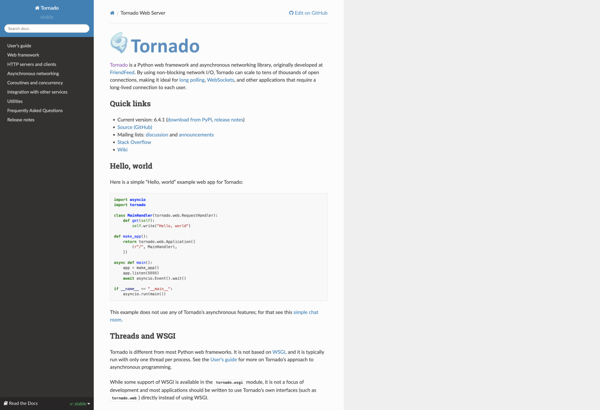
Tornado is a powerful and open-source web server and web application framework developed in Python. It is designed to handle high concurrency and is particularly well-suited for scenarios where asynchronous and non-blocking operations are crucial. Tornado's architecture makes it suitable for building scalable and efficient web applications, real-time web services,...
LiteSpeed Web Server (LSWS) is an enterprise-grade web server that is designed for speed, reliability, scalability, and security. It utilizes the optimized LiteSpeed web server engine, which supports HTTP/2, HTTP/3, and QUIC protocols to deliver fast and efficient responses.Some key features of LiteSpeed Web Server include:High performance - Benchmarks show...
TinyWeb is a free, open source web server software designed for Windows platforms. It provides a simple way to host static HTML websites, basic PHP applications, and FTP servers on a Windows computer for testing or internal purposes.Some key features of TinyWeb include:Lightweight and easy to install, no complex configuration...
webfs is an open-source virtual file system that runs entirely in the browser using JavaScript and IndexedDB or WebSQL. It provides users with file storage, access, and sharing capabilities directly from the web browser without requiring a separate server.Some key features of webfs include:Store any type of files in the...
Cherokee is an open source web server that is designed to be very fast, flexible, and easy to configure. Some key features and characteristics of Cherokee include:High performance - Cherokee is optimized for speed and can handle thousands of concurrent connections with very low memory and CPU usage.Modular design -...
Nanoweb is an open-source website builder designed to allow anyone to create professional-quality websites without needing to know how to code. It features an intuitive drag-and-drop interface that makes building pages simple and straightforward.With Nanoweb's extensive template library, users can choose from hundreds of professionally-designed templates for blogs, portfolios, ecommerce...
Mongrel is an open source web server written in Ruby that is optimized for Ruby web frameworks like Ruby on Rails and Sinatra. It launched in 2007 and quickly became popular in the Ruby community for its speed, simplicity, and ease of scaling.Some key features of Mongrel include:Very fast -...
Mongrel2 is an open-source web server written in C and designed for high performance and concurrency. It builds on ideas from Mongrel 1 and other servers, focusing on ease of configuration, stability, and modern features.Some key features of Mongrel2 include:Asynchronous I/O for high throughput and low latencyZero-copy architecture to minimize...