
SocketCluster vs SockJS

Professional comparison and analysis to help you choose the right software solution for your needs. Compare features, pricing, pros & cons, and make an informed decision.

SocketCluster icon
SocketCluster
SockJS icon
SockJS

Expert Analysis & Comparison

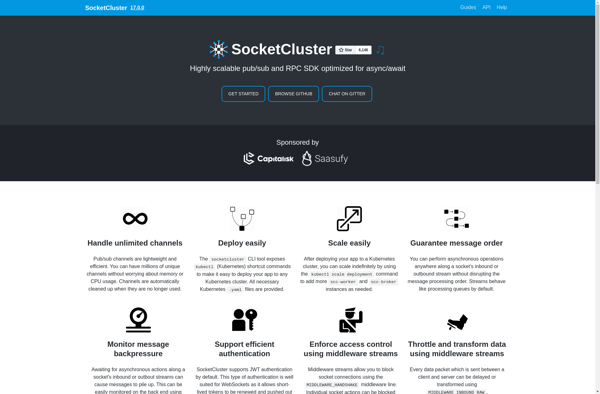
SocketCluster — SocketCluster is an open source realtime framework for Node.js that allows for fast and scalable realtime communication between servers and clients. It provides a distributed architecture out of the b

SockJS — SockJS is a JavaScript library that provides a WebSocket-like object in the browser. It automatically falls back to other transports like HTTP long-polling if WebSockets are not available.

SocketCluster offers Realtime communication between servers and clients, Fast and scalable architecture, Built-in distributed architecture, Supports WebSocket and HTTP transports, Auto-scaling and auto-recovery of processes, while SockJS provides WebSocket emulation - Provides a WebSocket-like object in the browser, Transparent fallback - Automatically falls back to other transports like HTTP long-polling if WebSockets are not available, Cross-browser - Works across all major browsers like Chrome, Firefox, Safari, etc, Multiple transports - Supports WebSocket, HTTP streaming, HTTP long-polling, etc, Heartbeats - Sends heartbeat messages to detect broken connections.

SocketCluster stands out for High performance, Scalable, Resilient; SockJS is known for Easy to use API, Good cross-browser support, Transparent fallback provides reliability.

Pricing: SocketCluster (Open Source) vs SockJS (not listed).

Why Compare SocketCluster and SockJS?

When evaluating SocketCluster versus SockJS, both solutions serve different needs within the development ecosystem. This comparison helps determine which solution aligns with your specific requirements and technical approach.

Market Position & Industry Recognition

SocketCluster and SockJS have established themselves in the development market. Key areas include realtime, communication, framework.

Technical Architecture & Implementation

The architectural differences between SocketCluster and SockJS significantly impact implementation and maintenance approaches. Related technologies include realtime, communication, framework, nodejs.

Integration & Ecosystem

Both solutions integrate with various tools and platforms. Common integration points include realtime, communication and websocket, realtime.

Decision Framework

Consider your technical requirements, team expertise, and integration needs when choosing between SocketCluster and SockJS. You might also explore realtime, communication, framework for alternative approaches.

Feature SocketCluster SockJS
Overall Score N/A N/A
Primary Category Development Development
Target Users Developers, QA Engineers QA Teams, Non-technical Users
Deployment Self-hosted, Cloud Cloud-based, SaaS
Learning Curve Moderate to Steep Easy to Moderate

Product Overview

SocketCluster
SocketCluster

Description: SocketCluster is an open source realtime framework for Node.js that allows for fast and scalable realtime communication between servers and clients. It provides a distributed architecture out of the box to build chat, IoT and other realtime applications.

Type: Open Source Test Automation Framework

Founded: 2011

Primary Use: Mobile app testing automation

Supported Platforms: iOS, Android, Windows

SockJS
SockJS

Description: SockJS is a JavaScript library that provides a WebSocket-like object in the browser. It automatically falls back to other transports like HTTP long-polling if WebSockets are not available.

Type: Cloud-based Test Automation Platform

Founded: 2015

Primary Use: Web, mobile, and API testing

Supported Platforms: Web, iOS, Android, API
Key Features Comparison

SocketCluster
SocketCluster Features
  • Realtime communication between servers and clients
  • Fast and scalable architecture
  • Built-in distributed architecture
  • Supports WebSocket and HTTP transports
  • Auto-scaling and auto-recovery of processes
  • Load balancing and channel multiplexing
  • Pub/sub messaging pattern support
  • Works with any Node.js HTTP framework
SockJS
SockJS Features
  • WebSocket emulation - Provides a WebSocket-like object in the browser
  • Transparent fallback - Automatically falls back to other transports like HTTP long-polling if WebSockets are not available
  • Cross-browser - Works across all major browsers like Chrome, Firefox, Safari, etc
  • Multiple transports - Supports WebSocket, HTTP streaming, HTTP long-polling, etc
  • Heartbeats - Sends heartbeat messages to detect broken connections
  • Session multiplexing - Allows sharing a connection for multiple sessions

Pros & Cons Analysis

SocketCluster
SocketCluster
Pros
  • High performance
  • Scalable
  • Resilient
  • Flexible
  • Open source
Cons
  • Limited documentation
  • Steep learning curve
  • Not beginner friendly
SockJS
SockJS
Pros
  • Easy to use API
  • Good cross-browser support
  • Transparent fallback provides reliability
  • Actively maintained and updated
Cons
  • Can add complexity when not needed
  • Additional dependency
  • May have lower performance than raw WebSockets

Pricing Comparison

SocketCluster
SocketCluster
  • Open Source
SockJS
SockJS
  • Open Source

Get More Information

Learn More About Each Product

Ready to Make Your Decision?

Explore more software comparisons and find the perfect solution for your needs