Ansible Automation Platform is an open-source automation tool by Red Hat that automates IT tasks such as configuration management, application deployment, intra-service orchestration, and more. It uses human-readable YAML templates so automation can be defined as code.
Ansible Automation Platform automates IT tasks, configuration management, application deployment, intra-service orchestration and more using human-readable YAML templates
What is Ansible Automation Platform?
Ansible Automation Platform is an enterprise-grade, open source automation platform developed by Red Hat. It is designed to automate provisioning, configuration management, application deployments, intra-service orchestration, and other IT tasks. Ansible is agentless, using SSH or Windows Remote Management (WinRM) to connect to client machines.
Ansible represents automation tasks with Playbooks, which are YAML files written in an easy to understand language that describes automation tasks in a way that approaches plain English. This makes Ansible playbooks easily digestible by IT and development teams alike.
The Ansible Automation Platform includes:
Ansible Engine: the automation engine that runs playbooks
Ansible Tower: an enterprise solution for controlling, securing and managing Ansible
Hundreds of modules covering a wide variety of automation integrations for infrastructure, cloud, networking and more
API for integration with third party tools and customization
The Ansible automation platform aims to offer simple yet powerful capabilities for automating entire application lifecycles and IT infrastructure. With its agentless architecture and use of existing SSH or Windows Remote Management connections, Ansible can be easy to integrate into existing environments without calling for a massive architectural overhaul.
Ansible Automation Platform Features
Features
Configuration management
Application deployment
Intra-service orchestration
Infrastructure orchestration
Security and compliance automation
IT automation analytics
Pricing
Open Source
Subscription-Based
Pros
Agentless architecture
Uses human-readable YAML templates
Large library of modules and plugins
Supports a wide range of systems and environments
Open source and backed by Red Hat
Scalable automation
Cons
Steep learning curve
Complex debugging
Limited error handling capabilities
Not ideal for large, complex environments without additional tools
RunDeck is an open source automation server used to run jobs, processes, and workflows across multiple machines. It allows you to schedule all kinds of tasks, including:Ad hoc scriptsSystem administrationBig data workflowsKey features include:Job scheduling and dispatchResource modeling (create an inventory of nodes)Role-based access controlIntegrations (SSH, LDAP, Active Directory)Remote execution...
Foreman is an open source systems management and IT automation tool. It helps system administrators automate repetitive tasks, gain visibility into their infrastructure, deploy applications, and manage servers throughout their lifecycle.Some key features and capabilities of Foreman include:Agentless monitoring and inventory of serversAutomated provisioning of physical and virtual serversConfiguration management...
Relinx is an open-source email marketing and automation platform that can be used as an alternative to Mailchimp. It provides many similar features for managing email campaigns, subscribers, and analytics at no cost.Some key features of Relinx include:Building and sending email campaigns - Create beautiful, responsive email templates and campaigns....
Cobbler is an open-source Linux installation server and provisioning system designed to help automate setup and management of Linux systems across large networks of servers. It streamlines the installation of Linux distributions by allowing an administrator to set up a provisioning system from which a large number of machines may...
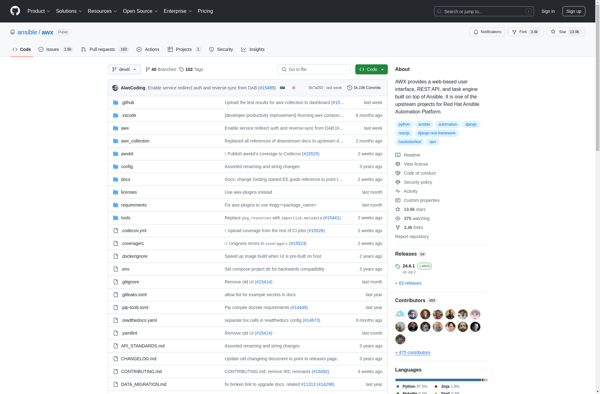
Ansible AWX is an open source community project that provides a web-based user interface, REST API, and task engine built on top of Ansible. It enables users to more easily manage Ansible playbooks and inventories.Some key capabilities and features of AWX include:Web-based user interface for managing inventories, projects, job templates,...
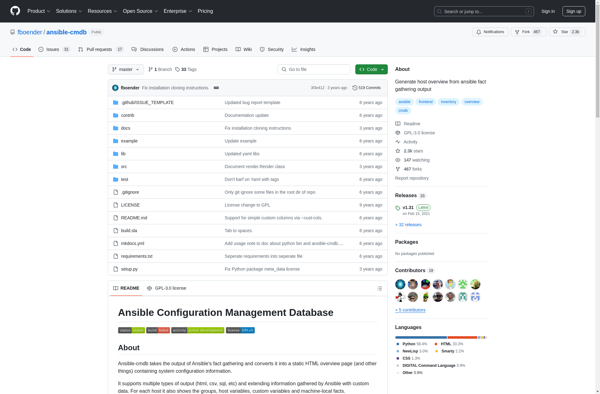
Ansible-cmdb is an open source tool for IT infrastructure documentation and auditing. It takes Ansible inventory files as input and generates static HTML pages and documentation based on the inventory data. Some key features include:Automatic documentation of system configuration, networking information, installed packages, filesystem layouts, and moreVisualization of infrastructure relationships...
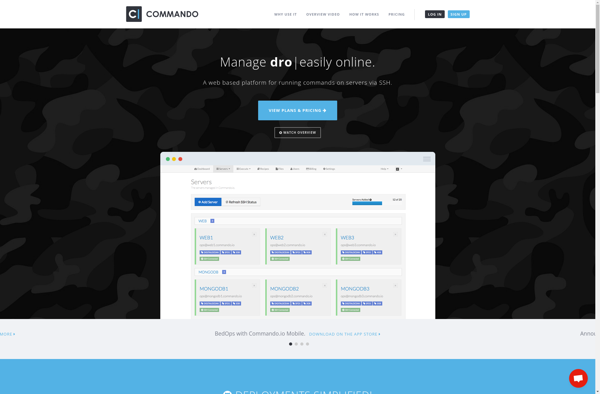
Commando.io is a robust workflow automation platform designed to help teams automate repetitive, manual work between apps and services. With an easy-to-use, drag-and-drop interface, Commando.io empowers anyone to build, run and manage workflows without coding.Key features include:Connectors for over 100 apps including Salesforce, Slack, Gmail and moreVisual workflow builder with...
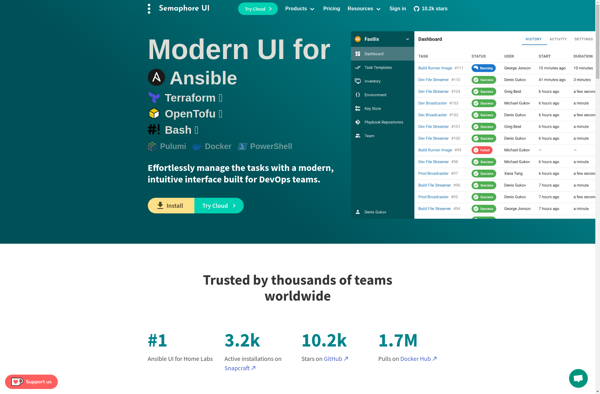
Ansible Semaphore is an open source web-based graphical front-end for managing Ansible playbooks. It provides a user-friendly interface for running playbooks on remote servers without needing direct access to the Ansible command-line tools.Key features of Ansible Semaphore include:Web-based UI for kicking off Ansible playbooks and viewing execution logs in real...