RunDeck is an open source automation server used to run jobs, processes, and workflows across multiple machines. It schedules and dispatches commands, scripts, and jobs to run on any number of nodes.
RunDeck: Open Source Automation Server for Multi-Machine Job Scheduling
An open source automation server used to run jobs, processes, and workflows across multiple machines, scheduling and dispatching commands, scripts, and jobs to run on any number of nodes.
What is RunDeck?
RunDeck is an open source automation server used to run jobs, processes, and workflows across multiple machines. It allows you to schedule all kinds of tasks, including:
Ad hoc scripts
System administration
Big data workflows
Key features include:
Job scheduling and dispatch
Resource modeling (create an inventory of nodes)
Role-based access control
Integrations (SSH, LDAP, Active Directory)
Remote execution of commands
Job chaining
Workflow engine
Extend functionality with plugins
RunDeck provides a single console to help streamline and automate routine operational procedures across your infrastructure or application environments. It schedules and dispatches commands, scripts, and jobs to run on any number of nodes, provides visibility into logs and output, and generates notifications on success or failure.
With RunDeck you can automate ad hoc and routine procedures in data centers or other environments. It's designed for self servicing and automation of infrastructure components such as load balancers, firewalls, switches, storage, DNS services, cloud infrastructure, and application components deployed across public or private clouds.
RunDeck Features
Features
Job scheduling and dispatching
Resource modeling
Access control and policy enforcement
Integrations with cloud providers and configuration tools
Ansible, developed by Red Hat, is a powerful and open-source automation tool designed to simplify IT tasks ranging from configuration management to application deployment and task orchestration. Leveraging a simple and human-readable language, Ansible enables users to automate complex workflows, ensuring consistency, efficiency, and scalability across their IT infrastructure. At...
Ansible Automation Platform is an enterprise-grade, open source automation platform developed by Red Hat. It is designed to automate provisioning, configuration management, application deployments, intra-service orchestration, and other IT tasks. Ansible is agentless, using SSH or Windows Remote Management (WinRM) to connect to client machines.Ansible represents automation tasks with Playbooks,...
Apache Airflow is an open-source workflow management platform created by Airbnb in 2015. It is used to programmatically author, schedule and monitor workflows. Airflow provides a graphical interface to visualize pipelines, dependencies between tasks, and monitor the workflow.Some key features and benefits of Apache Airflow include:Directed Acyclic Graphs (DAGs) -...
Airplane is a free and open source web browser that focuses on speed, simplicity, and privacy protection. Based on Chromium, Airplane strips away unnecessary features and clutter, resulting in a clean interface where webpages load swiftly without getting bogged down by ads, trackers, and other cruft.Out of the box, Airplane...
Cfengine is an open source configuration management software designed to automate IT infrastructure operations and tasks. It takes a policy-based approach, allowing system administrators to define the desired state of their infrastructure and servers through declarative policies.Key capabilities and uses of Cfengine include:Server configuration management - Cfengine can automatically set...
Cobbler is an open-source Linux installation server and provisioning system designed to help automate setup and management of Linux systems across large networks of servers. It streamlines the installation of Linux distributions by allowing an administrator to set up a provisioning system from which a large number of machines may...
au2mator is an open-source robotic process automation (RPA) tool for automating repetitive and mundane tasks. It allows you to build automation workflows visually without the need for programming or scripting.Some key features of au2mator include:Visual interface to build automation workflows by demonstrationSupport for automating tasks on web applications, Windows apps,...
Metaflow is an open-source Python library that helps data scientists build and manage real-life data science projects. It provides an easy-to-use abstraction layer for data scientists to develop robust and reproducible pipelines, track experiments, visualize results, and deploy machine learning models to production.Some key features of Metaflow include:Simplified pipeline construction...
Ctfreak is an open-source CTF (Capture The Flag) platform designed specifically for hosting cybersecurity competitions and challenges. It provides all the necessary features and tools to create an engaging CTF event.With Ctfreak, users can create various categories and types of challenges including reverse engineering, web exploitation, cryptography, forensics, binary exploitation,...
pyinfra is an open source automation and deployment tool written in Python. It provides infrastructure automation capabilities similar to popular tools like Ansible, Salt and Terraform, but with a focus on simplicity, flexibility and user-friendliness.Some key features and benefits of pyinfra include:Code-based infrastructure definitions written purely in Python. No need...
cdist is an open source configuration management and deployment tool written in Python. It takes a different approach from other tools like Ansible, Chef or Puppet in that the configuration logic is written in Python instead of a custom domain-specific language.Some key features and capabilities of cdist include:Configuration defined through...
Bcfg2 is an open-source configuration management system created to help system administrators maintain consistent configurations across a large number of computers. It was originally developed to manage Linux/UNIX systems but also supports managing Windows, Mac OS X, network devices and more.Bcfg2 allows administrators to define the desired configuration states for...
Crowbar is an open source software lifecycle management tool originally developed by SUSE for Linux and cloud environments. It provides automated, unattended operating system installation, configuration and maintenance on bare metal systems.Some key capabilities and features of Crowbar include:Automated discovery, provisioning and monitoring of physical serversDeployment of operating systems including...
StackStorm is an open-source event-driven automation platform for auto-remediation, security responses, troubleshooting, and more. It provides integration with common infrastructure components and easy ways to trigger automated workflows based on system events. Key features include:Flexible workflow engine based on automation actions to trigger responses and remediationsIntegration with monitoring tools, infrastructure,...
(R)?ex is a feature-packed text editor for Windows that balances powerful editing tools with an accessible interface. It works well for both code and prose, making it a flexible option for developers, writers, and anyone who works extensively with text.As a code editor, (R)?ex supports syntax highlighting for over 200...
Sprinkle is a lightweight, easy-to-use web application monitoring and performance tracking tool designed for developers. It allows you to monitor the real-user performance of your web apps by tracking key metrics like page load times, JavaScript errors, failed requests, and more.Some key features of Sprinkle include:Easy integration with modern JavaScript...
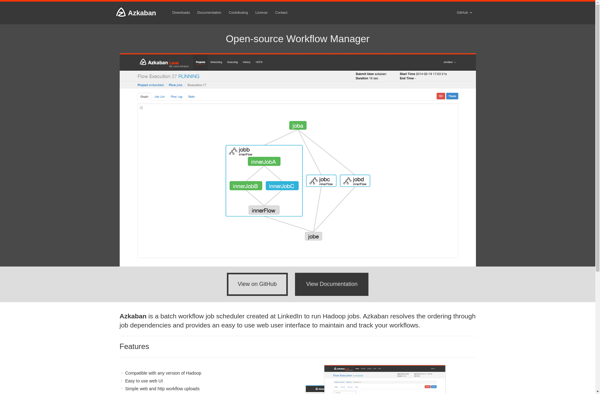
Azkaban is an open source batch workflow job scheduler created at LinkedIn in 2012. It is used to schedule and run Hadoop jobs, manage dependencies between jobs and prevent jobs from failing or running simultaneously. Azkaban provides an easy to use web user interface to create and schedule workflows and...
Propellor is an open source configuration management and deployment tool written in the Haskell programming language. Unlike traditional imperative configuration management tools like Ansible, Puppet or Chef, Propellor uses a declarative domain-specific language to define desired system configurations and state.Some key features and benefits of Propellor include:Declarative syntax - Specify...