DevSpace Hosting is a platform for developers to deploy, manage, and scale web applications easily. It offers automated CI/CD pipelines, multi-cloud support, team collaboration features, and more.
DevSpace Hosting: Deploy, Manage, Scale Web Apps Easily
Automated CI/CD pipelines, multi-cloud support, team collaboration features, and more - DevSpace Hosting makes it simple for developers to deploy, manage, and scale their web applications.
What is DevSpace Hosting?
DevSpace Hosting is a developer-friendly platform for deploying, managing, and scaling web applications and services across multiple clouds. Some key features include:
Automated CI/CD pipelines - Set up continuous integration and deployment workflows to build, test, and deploy your code changes automatically.
Support for Kubernetes - Deploy and run your applications on Kubernetes clusters across various cloud providers.
Collaboration tools - Share your projects with team members, control permissions, track activity logs and code changes.
Multi-cloud support - Deploy to major cloud platforms like AWS, GCP and Azure from a single workflow.
Global edge network - Low-latency content delivery to end users across the globe.
Developer-centric UI - Simple and intuitive UI tailored specifically for dev workflows.
Generous free-tier - Free resources for testing small projects to compliment paid tiers for production.
Overall, DevSpace Hosting aims to provide developers with a streamlined platform encompassing the complete application development lifecycle - from coding to deployment, collaboration to observation. Its flexibility across clouds and sharp focus on developer productivity makes it an attractive choice for teams looking to simplify and accelerate their workflows.
DevSpace Hosting Features
Features
Automated CI/CD pipelines
Multi-cloud support
Team collaboration features
Easy deployment and scaling of web applications
Pricing
Subscription-Based
Pros
Streamlined development and deployment workflow
Flexibility to deploy on multiple cloud providers
Collaborative features for teams
Scalable infrastructure for growing applications
Cons
Potential learning curve for users unfamiliar with DevOps practices
Dependency on the platform's reliability and uptime
Limited customization options compared to self-hosted solutions
What Is WordPress?WordPress is the world's most popular content management system, powering over 40 percent of all websites on the internet. Originally created as a blogging platform in 2003, it has evolved into a full website builder and application framework used for everything from personal blogs to enterprise websites and...
Blogger is a popular free blog publishing service run by Google. It allows anyone to easily create and manage a blog for free without needing to know any coding. Blogger has an easy-to-use WYSIWYG editor interface that allows users to create blog posts containing text, images, videos, links, and more.Some...
Tumblr is a microblogging and social networking website and application that was created in 2007. It allows users to post multimedia and other content to a short-form blog. Users can follow other users' tumblelogs, as well as like and reblog posts.Some key features of Tumblr include:Tumblelogs - short-form blogs that...
What Is Squarespace?Squarespace is a website builder and hosting platform known for its design-forward templates and all-in-one approach. It provides everything needed to build and run a website — hosting, domains, templates, e-commerce, email marketing, and analytics — without requiring any coding.Key FeaturesSquarespace offers over 100 professionally designed templates that...
Apostrophe CMS is an open-source content management system based on Node.js and MongoDB. It provides an intuitive content editing experience, enterprise-grade scalability, and extensive front-end flexibility.Some key features of Apostrophe CMS include:In-context editing with widgets to build pages and arrange contentPowerful content types, pages, and pieces to model any type...
ZeroBlog is an open-source, self-hosted blogging platform designed with simplicity in mind. Unlike more complex platforms like WordPress, ZeroBlog aims to provide a clean, ad-free blogging experience without overwhelming users with endless options and settings.At its core, ZeroBlog is focused purely on facilitating the writing and organizing of blog content....
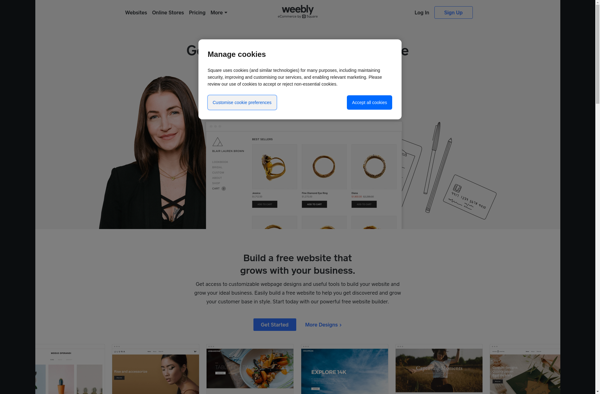
Weebly is a popular website builder and hosting platform ideal for small businesses, online stores, portfolios, and more. With an easy-to-use drag-and-drop interface, Weebly makes it simple for anyone to create a professional-looking website without needing to know HTML or CSS.Some key features of Weebly include:Intuitive drag-and-drop site builder -...
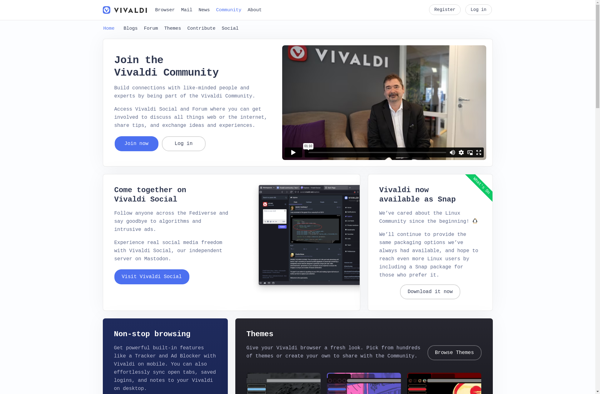
Vivaldi Community is a relatively new community-driven web browser focused on customization and privacy. It is based on open web technologies like Chromium, similar to browsers like Google Chrome and Microsoft Edge. Vivaldi Technologies develops it with input from its user community.Some key features of Vivaldi Community include:Tab Stacking -...
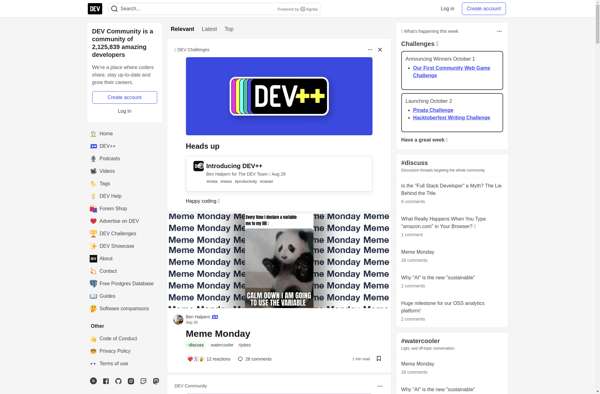
DEV Community is a free and open source software development community platform launched in 2019. It allows software developers and programmers to publish technical articles, take part in discussions, ask questions, and generally connect with other developers.Some key features of DEV Community include:Article publishing - Developers can publish articles on...
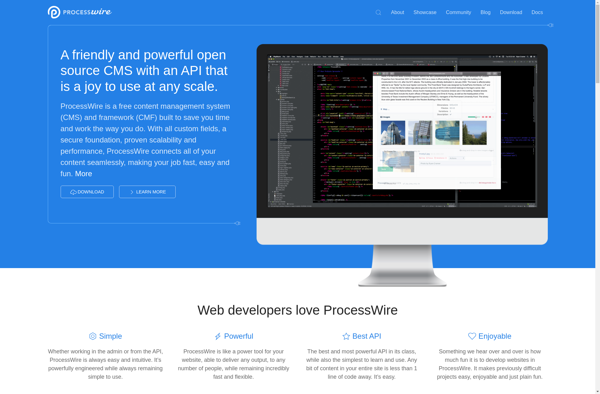
ProcessWire is an open-source content management system (CMS) and web application framework aimed at the needs of designers, developers and their clients. It is built on PHP and has a strong focus on flexibility, modularity, customization, and ease of use.Some key features and characteristics of ProcessWire include:Clean, modular codebase allowing...
Pillowfort is a free and open-source social media platform launched in 2017 as an alternative to Tumblr after concerns over Tumblr's policy changes. It is focused on providing a platform for artists, creators, and fans to share their work, connect with each other, and build online communities.Some key features of...