Distri.js is an open-source JavaScript framework for building distributed web applications. It provides utilities for peer-to-peer networking, data synchronization, and real-time collaboration between users.
What is Distri.js?
Distri.js is an open-source JavaScript framework for building distributed web applications. It allows developers to create peer-to-peer architectures rather than relying on centralized servers.
Some of the key capabilities of Distri.js include:
Peer-to-peer networking - It handles connecting web browsers together into a mesh network for sharing data and communicating directly without intermediary servers.
Data synchronization - It synchronizes data between peers automatically, ensuring each peer has the latest updates even if they connect and disconnect intermittently.
Real-time collaboration - It enables real-time cooperative experiences between users, allowing them to concurrently edit documents, draw on a shared whiteboard, chat, and more.
Offline support - Apps made with Distri.js work while offline by caching data and queueing updates for syncing when peers reconnect.
Modules and plugins - The framework is extensible via third-party modules for added capabilities like distributed file storage, cryptocurrency payments, and more.
Distri.js aims to provide a simple API and flexible building blocks for crafting decentralized apps and websites. It handles the complex peer-to-peer aspects so developers can focus on the end-user experience.
Distri.js Features
Features
Peer-to-peer networking
Data synchronization
Real-time collaboration
Pricing
Open Source
Pros
Open source
Built on WebRTC for peer-to-peer communication
Modular architecture
Cons
Limited documentation
Still in early development
Lacks some advanced features of commercial alternatives
Folding@home is a distributed computing project launched in 2000 by Vijay Pande and colleagues at Stanford University. It harnesses the unused processing power of personal computers owned by volunteers to simulate protein folding, computationally intensive molecular dynamics simulations of protein folding and misfolding.The simulations run when a person's computer would...
BOINC (Berkeley Open Infrastructure for Network Computing) is an open source software platform for distributed computing, which utilizes the unused processing power of personal computers owned by volunteers. It allows ordinary people to donate their spare computing power to help scientists solve important research problems in various fields such as...
ClusterKnoppix is a Linux distribution based on Knoppix that is specifically designed for setting up high availability and computing clusters. It includes the following key features:Easy cluster setup with automated configuration tools for common cluster software like OpenMPI, LAM/MPI, and more.Support for setting up high availability (HA) clusters with redundant...
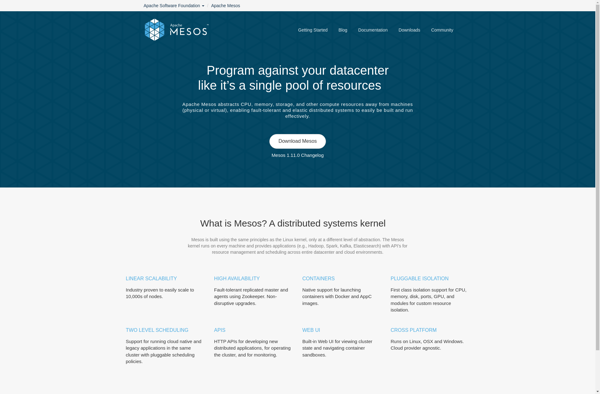
Apache Mesos is an open source cluster manager that provides efficient resource isolation and sharing across distributed applications or frameworks. It sits between the application layer and the operating system on a distributed system, and makes it easier to deploy and manage applications in large-scale clustered environments.Some key features of...
PelicanHPC is an open-source workload manager and resource manager designed for high performance computing (HPC) clusters. It provides sophisticated scheduling algorithms to optimize job throughput and resource utilization across complex HPC workloads.Key features of PelicanHPC include:Advanced scheduler supporting backfill, fairshare, and priority based algorithmsIntegrated node, job, and reservation monitoringSupport for...
JPPF is an open source distributed computing framework written in Java. It provides a simple API and software components that enable developers to parallelize execution of tasks across multiple machines, cores and clusters.Some key capabilities and benefits of JPPF include:Automatic partitioning and distribution of tasks across a network of computing...
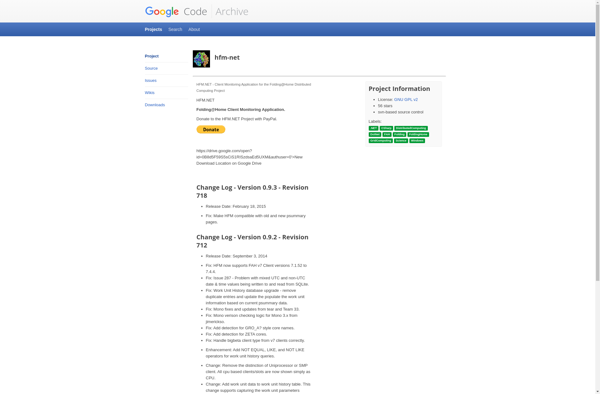
HFM-NET is an open source financial corporate performance management (CPM) application built on the .NET platform. It provides capabilities for financial consolidation, planning, reporting and analytics.Key features of HFM-NET include:Multi-GAAP and multi-currency consolidationWorkflow and task managementFinancial and management reportingBudgeting and forecastingAnalytics and dashboardsHFM-NET offers similar functionality to commercial solutions like...