GlusterFS is an open source, distributed file system that can scale out to store petabytes of data. It aggregates disk storage across servers into a single global namespace.
What is GlusterFS?
GlusterFS is an open source, distributed file system designed to handle large data sets and high traffic workloads. It aggregates disk storage resources from multiple servers into a single global namespace that can scale out to store petabytes of data.
Some key features of GlusterFS include:
Linear scalability - GlusterFS utilizes a distributed architecture that allows new servers and disks to be added to grow capacity and performance.
File replication and distribution - Files can be replicated across servers for high availability or distributed across servers to improve performance.
Strong consistency - GlusterFS maintains strong data consistency across the cluster to prevent corruption.
Automatic failover - Servers and network connections are monitored to failover file operations if hardware fails or connectivity is lost.
POSIX compatible client access - GlusterFS presents storage using FUSE through a POSIX-compatible file system interface.
GlusterFS is well suited for media streaming, content distribution, cloud storage, virtualization, and other high traffic storage needs. Its modular design runs on commodity hardware using InfiniBand RDMA or TCP/IP interconnects.
Ceph is an open source, software-defined storage platform designed for scalability, reliability, and cost-effectiveness. Here are some key things to know about Ceph:Provides block, object, and file storage in one unified system - Ceph supports traditional block device storage as well as object storage and scale-out file storage, allowing one...
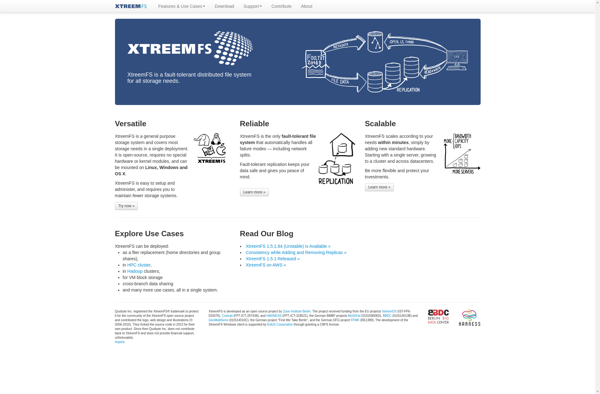
XtreemFS is an open-source distributed file system designed specifically for high availability, scalability and performance to store and access files across clusters of commodity servers. It provides interfaces for POSIX and HTTP access, allowing existing applications to use XtreemFS without any changes.Some key features of XtreemFS include:Scales to thousands of...
WekaFS is a parallel file system designed specifically to address the storage challenges of artificial intelligence, machine learning, and deep learning workloads. It delivers high performance and scalability for data-intensive workloads that access large numbers of small files.Key capabilities and benefits of WekaFS include:High throughput and IOPS specifically for small...
BeeGFS (short for 'Bee' Grid File System) is an open-source parallel file system designed for high-performance computing (HPC) environments. It runs on Linux clusters and helps improve I/O performance by distributing file data over multiple servers.Some key characteristics of BeeGFS:Designed for large-scale clusters and single Linux workstationsStripes data across multiple...
DRBD (Distributed Replicated Block Device) is an open-source software application that provides disk replication and failover clustering functionality for Linux systems. It allows mirroring of block devices between servers to provide high availability, increased redundancy, and disaster recovery capabilities.DRBD works by mirroring the content of a block device from one...
Lustre is an open-source, parallel file system designed for high-performance computing environments that require extremely fast I/O across large storage volumes. It delivers parallel access to files across clustered storage for supercomputing, machine learning, and other big data applications that need to process vast datasets efficiently.A key advantage of Lustre...
StorPool is a software-defined block storage platform optimized for storage performance, efficiency, and high availability. It is designed to deliver predictable low latency, high IOPS, and increased storage efficiency for demanding workloads.StorPool uses a distributed architecture and runs on standard hardware, eliminating proprietary hardware lock-in. It utilizes advanced data placement...
SeaweedFS is an open-source, distributed file system designed for storing and serving billions of large files fast and efficiently. It spreads files over many servers, allowing for automatic scaling and parallel streaming of data.Some key features and benefits of SeaweedFS include:Automatic scaling - new servers can be added easily to...
MooseFS is an open-source distributed file system optimized for storing very large data sets while providing high throughput access to the data. Unlike traditional file servers which store files on a single machine, MooseFS splits files into chunks and distributes them across multiple commodity servers. This allows it to scale...
LizardFS is an open-source distributed file system designed for very large storage environments that need to scale to handle exponentially growing amounts of unstructured data. It is optimized to store big data such as multimedia files, VM images, Docker containers, log files, and more.Some key capabilities and benefits of LizardFS...
Quobyte is an open-source software-based distributed file system that provides scalable and fault-tolerant storage for containers, virtual machines, and bare metal servers. It allows organizations to build a high-performance storage cluster out of commodity hardware like off-the-shelf servers or cloud instances.Some key capabilities and benefits of Quobyte include:Scalability - Quobyte...
LVM2 (Logical Volume Manager 2) is an open-source logical volume manager for the Linux kernel that manages disk drives and similar mass-storage devices. LVM provides a layer of abstraction over physical storage, allowing administrators to create logical storage volumes that can be easily resized and moved as needed.Some key capabilities...
ScaleIO is an enterprise-grade software-defined storage platform developed by Dell EMC. It provides highly scalable and flexible storage management by abstracting storage resources into unified pools that can scale capacity and performance on demand.Some key capabilities and benefits of ScaleIO include:Creates a virtualized storage pool from existing local or attached...
Explore2fs is an open source graphical utility for exploring and troubleshooting Linux ext2, ext3, and ext4 filesystems. It provides an intuitive graphical interface for visualizing key filesystem metadata and content to help diagnose issues or recover deleted files.Some key features of Explore2fs include:Browsing inodes and directory structuresViewing file and directory...
Skylable Sx is a distributed file system and data platform designed specifically for managing large unstructured data workloads across distributed infrastructure. It provides a global namespace to store and access file-based and object data from multiple data centers, public or private clouds.Key capabilities and benefits of Skylable Sx include:Scale-out architecture...