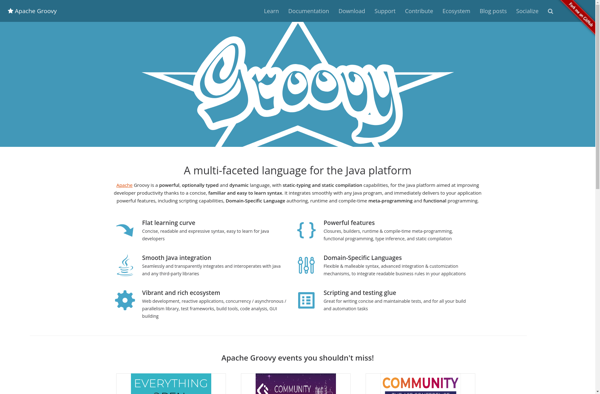
Groovy is a powerful, optionally typed and dynamic language, with static-typing and static compilation capabilities, for the Java platform aimed at improving developer productivity thanks to a concise, familiar and easy to learn syntax. It integrates smoothly with any Java progra
A powerful, optionally typed and dynamic language with static-typing and static compilation capabilities for the Java platform, designed to improve developer productivity.
What is Groovy?
Groovy is an object-oriented programming language for the Java platform. It builds upon the strengths of Java but has additional power features inspired by languages like Python, Ruby and Smalltalk. Groovy nicely integrates with Java, allowing you to leverage existing Java libraries and frameworks.
Some of the key benefits and features of Groovy include:
Dynamic and Duck Typing Support - Type inference, defers type checking until runtime.
Closures - Simple and powerful anonymous functions with storage of enclosing environment.
Meta Programming and DSL Support - Build DSLs, modify and extend Groovy by itself.
Functional Programming Features - Supports map, filter, collect transformations etc.
Seamless Java Integration - Integrates with existing Java code, libraries and frameworks.
Simplified and Familiar Syntax - Easy to learn syntax with reduced boilerplate.
Powerful Build System (Gradle) - Out of the box support for project automation tasks.
Improved Productivity - Concise and powerful language features allow faster development.
Embeddable and Lightweight - Can be embedded in a Java application.
Overall, Groovy reduces the verbosity of Java, adds powerful programming features and provides an easier and more productive experience while still integrating seamlessly with Java ecosystem. It makes Java development enjoyable and provides a solid foundation for building modern applications.
Groovy Features
Features
Optional typing
Dynamic language
Static typing and compilation
Concise and familiar syntax
Seamless Java integration
Scripting capabilities
Domain-Specific Language authoring
Runtime and compile-time meta-programming
Functional programming
Pricing
Open Source
Pros
Increases developer productivity
Simpler and less code than Java
Powerful meta-programming capabilities
Supports both dynamic and static typing
Seamless interoperability with Java code and libraries
Cons
Can be slower than statically compiled Java
Not as widely used as Java or other JVM languages
Less support and smaller community than Java
Not always an improvement over Java for large systems
Python is a high-level, general-purpose programming language that emphasizes code readability and rapid application development. It was created by Guido van Rossum in 1991 and has since become one of the most popular programming languages.Some key features of Python include:Easy to learn syntax that resembles everyday EnglishInterpreted language that can...
C# is an object-oriented, general-purpose programming language developed by Microsoft. It was first released in 2002 as part of the .NET framework, and since then has become one of the most popular programming languages used for building a wide range of applications.Some key features of C# include:Object-oriented - Supports concepts...
Kotlin is a statically typed programming language that runs on the Java virtual machine and can also be compiled to JavaScript. It is designed by JetBrains to be a better alternative to Java for modern application development.Some key features and advantages of Kotlin include:Null safety - Variables in Kotlin can't...
JavaScript is a lightweight, interpreted programming language with first-class functions that allows you to implement complex features on web pages. When JavaScript runs in a browser, it can:Access and modify a web page's content and markupRespond to user actionsCommunicate asynchronously using callback functionsAlter a web page's stylingAnimate page elementsJavaScript has...
Nim is an open-source, general-purpose, statically typed, compiled programming language developed by Andreas Rumpf. It combines successful concepts from mature languages like Python, Ada and Modula, offering flexibility and efficiency. Here are some of its key features: Statically typed – Types are checked during compilation which helps catch errors early.Compiles...
Swift is a general-purpose, multi-paradigm, compiled programming language developed by Apple Inc. It was first released in 2014 as the successor to Objective-C for Apple's iOS, macOS, watchOS, and tvOS operating systems. Some key features and characteristics of Swift include:Fast and efficient: Swift code compiles extremely quickly and the resulting...
F# is a strongly typed, multi-paradigm programming language that encompasses functional, imperative, and object-oriented programming methods. It runs on .NET and is developed by Microsoft.As a functional language, F# helps developers write succinct, robust code. It has full support for first-class functions and object programming, along with scalable type inference....
Nashorn is a JavaScript engine integrated into the Java Virtual Machine (JVM). It was introduced in Java Development Kit (JDK) 8 as a replacement for the older Rhino JavaScript engine.Nashorn enables developers to embed JavaScript code into Java applications and run client-side JavaScript code natively on the JVM without going...
jRuby is an implementation of the Ruby programming language that runs on the Java virtual machine (JVM). It was created in 2001 by Jan Arne Petersen and was later adopted in 2006 by the Sun Microsystems-sponsored Ruby community. jRuby allows developers to use Ruby syntax and libraries while running on...
BeanShell is a small, free, embeddable Java source interpreter with object scripting language features, written in Java. It runs in the Java Virtual Machine and dynamically executes Java code fragments and scripts.Some key features of BeanShell include:Supports scripting Java syntax and APIs, in addition to basic scripting commandsLightweight and embeddable,...