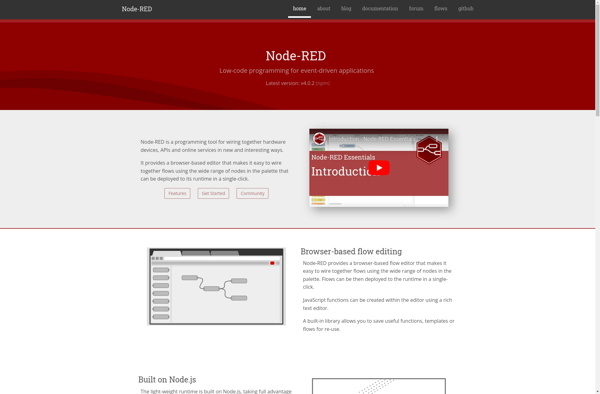
Node-RED is an open-source visual programming tool for wiring together hardware devices, APIs, and online services. It provides a browser-based flow editor that makes it easy to wire together flows using a wide range of predefined nodes.
What is Node-RED?
Node-RED is an open-source visual programming tool built on Node.js for wiring together hardware devices, APIs, and online services. It provides a browser-based flow editor that makes it easy to wire together flows using a wide range of nodes that can be deployed to its runtime in a single click.
Some key capabilities and features of Node-RED include:
Browser-based flow editor - Easy to create flows by dragging and dropping nodes and wiring them together
Wide range of nodes - Prebuilt nodes for APIs, databases, web services, hardware devices, and more
Open source - Built on open standards and extends through open-source contributed nodes
Cross-platform - Runs on Raspberry Pi, cloud, enterprise environments, and more
Built-in package manager - Easily install third party nodes
Works with both code and no-code approaches
Integrations - Connect with services like Twitter, Weather APIs, Arduino, Raspberry Pi, and more
Active community - Community forums and slack for support
Node-RED enables wiring together flows in new and interesting ways very quickly. It bridges together gaps between devices, APIs, events and services. The wide range of nodes helps integrate new devices and services into overall systems and workflows.
Node-RED Features
Features
Flow-based programming
Browser-based flow editor
Large library of predefined nodes
Connects APIs and online services
Integrates with hardware devices
Open-source and extensible
Pricing
Open Source
Pros
Visual programming is easy to learn
Active open-source community
Integrates well with JavaScript and Node.js
Can be deployed locally or to the cloud
Extensive documentation and tutorials
Cons
Steep learning curve for advanced features
Basic flows are easy but complex logic can get messy
n8n.io is an open source workflow automation server that allows you to connect different services together through a visual interface. It provides over 250 pre-built nodes for services like Twitter, Gmail, Dropbox, Salesforce and more that you can easily connect together to automate tasks and workflows.Some key features and benefits...
IFTTT (If This Then That) is a free automation platform that connects various web services, SaaS platforms and IoT devices via conditional statements to trigger actions between them. The basic structure of these connections on IFTTT consists of two parts:- This - This part defines the trigger event that will...
iot-dashboard is an open-source Internet of Things (IoT) data visualization and monitoring web application. It provides an intuitive graphical interface that allows users to easily create customizable dashboards to visualize and monitor data from IoT devices, sensors, and other data sources in real-time.Some key features of iot-dashboard include:Support for connecting...
Relay is a flexible and powerful workflow automation platform for streamlining business operations and improving efficiencies. With an intuitive drag-and-drop interface, Relay makes it easy for anyone to build custom workflows that connect data, apps, and teams across the organization.Key capabilities and benefits of Relay include:Connects seamlessly to popular business...
NoFlo is an open-source flow-based programming framework for JavaScript. It allows developers to build applications by connecting components that exchange data, similar to building data pipelines or workflows. The visual programming model makes it easy to see the overall logic and data flow of an application.Some key features of NoFlo...
SiteWhere.io is an open-source Internet of Things (IoT) application enablement platform designed specifically for industrial IoT and location tracking use cases. It provides capabilities for real-time location processing, data management and analytics focused on spatial/location-based data from industrial assets.Some key capabilities and features of SiteWhere.io include:Ability to connect IoT devices...
Zenaton is an open-source workflow orchestration platform that allows developers to code any complex business process in code. It handles asynchronous tasks, priorities, scheduling, errors and more out-of-the-box allowing developers to focus on implementing the business logic rather than building custom workflow engines.Key features of Zenaton include:Model workflows in code...
Corezoid is a low-code process automation and integration platform designed to help organizations improve operational efficiency. It provides a visual interface to model complex business processes that connect enterprise applications, data sources, APIs and more.Some key capabilities and benefits of Corezoid include:Drag-and-drop workflow designer to visually map out processes without...
AWS IoT is a managed cloud platform from Amazon Web Services that enables connected devices to securely interact with cloud applications and other devices. Some key capabilities of AWS IoT include:Device connectivity and messaging - AWS IoT supports HTTP, MQTT, and WebSocket protocols for connected devices to publish telemetry data,...
ioBroker is an open source home automation platform designed to integrate various smart home systems and technologies into one centralized system for control and automation. Here is an overview of key details about ioBroker:It can connect to and control devices using standards and protocols like Z-Wave, Philips Hue, MQTT, HTTP...
OPC Router is an industrial connectivity software designed to enable seamless data exchange between diverse OPC systems in automation environments. It functions as a communication bridge between OPC clients and servers from various vendors, allowing them to share real-time data and interact despite having different underlying technologies.The key benefit of...