REBOL
REBOL: A Compact and Flexible Programming Language
REBOL is a programming language and environment designed for distributed and networked applications. It's known for its small size, flexibility, and easy readability.
What is REBOL?
REBOL is an open-source programming language first released in 1997 by Carl Sassenrath. It stands for Relative Expression-Based Object Language.
Some key features of REBOL include:
- Simple, terse syntax that is easy to learn and read
- Language flexibility - can be used for many different task types
- Cross-platform, able to run on many devices and operating systems
- Small interpreter size, under 1MB
- Built-in Internet protocols and datatypes for network/distributed programming
- Interpreted language with run-time binding gives high flexibility
- Module library for database access, GUI, encryption and more
REBOL is well suited for applications like distributed computing, cross-platform utilities, communications protocols, data exchange, and lightweight user interfaces. Its small footprint makes it good for embedded systems.
Some key weaknesses include slower performance than compiled languages, less support for heavy numeric processing or advanced algorithms compared to tools like R or Python.
Overall, REBOL occupies a fairly unique niche. Its flexibility and orientation for distributed, networked communication applications help differentiate it from more mainstream languages.
REBOL Features
Features
- Functional programming language
- Cross-platform - runs on many operating systems
- Small size - compact interpreter and code
- Built-in networking and protocols
- Can create graphical user interfaces
- Can access databases and web services
- Can create executables and installers
Pricing
- Open Source
Pros
Cons
Official Links
Reviews & Ratings
Login to ReviewThe Best REBOL Alternatives
View all REBOL alternatives with detailed comparison →
Top Development and Programming Languages and other similar apps like REBOL
Here are some alternatives to REBOL:
Suggest an alternative ❐
Python

Go (Programming Language)
C#

C (programming language)

Node.js

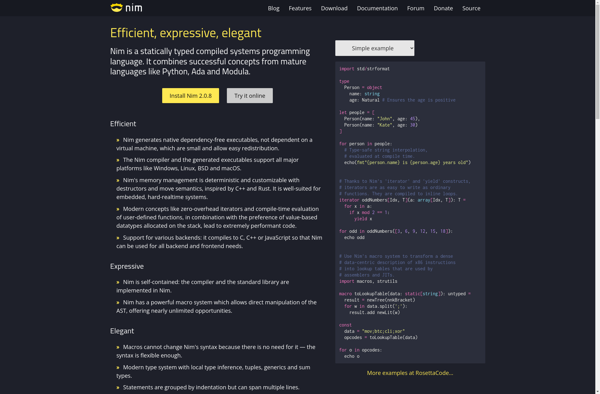
Nim (programming language)

Red (Programming Language)

Luvit