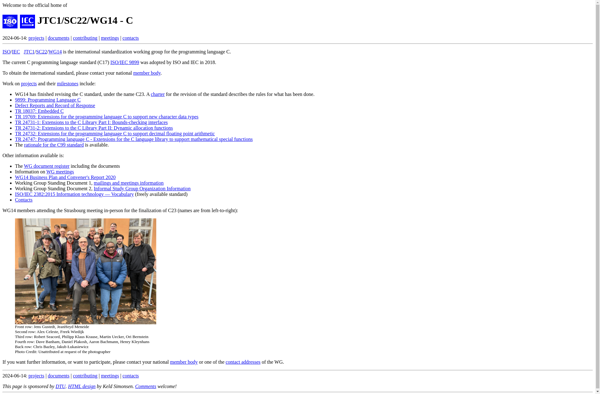
C is a general-purpose, procedural programming language originally developed by Dennis Ritchie between 1969 and 1973 at Bell Labs. It is a very popular language, particularly for systems programming due to its flexibility, speed, and minimal runtime requirements.
A general-purpose, procedural programming language originally developed by Dennis Ritchie between 1969 and 1973 at Bell Labs, popular for systems programming due to its flexibility, speed, and minimal runtime requirements.
What is C (programming language)?
C is a general-purpose, procedural programming language originally developed by Dennis Ritchie between 1969 and 1973 at Bell Labs. It was originally implemented on the Unix operating system and its availability on a wide variety of platforms has made C one of the most widely used programming languages.
Some key features of C include:
Procedural programming language with a static type system
Provides low-level memory access and language constructs that map closely to underlying hardware
Supports structured programming with functions and control constructs like if-else statements, loops, etc.
Rich library of standard functions for common programming tasks
Highly flexible and portable - C compilers are available for practically every platform
C is a very popular language, particularly for systems programming due to its flexibility, speed, and minimal runtime requirements. It formed the base for development of operating systems like Unix/Linux, Windows, and Mac OS. It is also extensively used for developing embedded systems, device drivers, databases, games, and desktop/mobile applications. Almost every popular programming language available today is implemented using C or has a C interface available.
C (programming language) Features
Features
Procedural programming model
Statically typed language
Low-level memory management
Portable across multiple platforms
Widely used for system programming
Supports structured programming constructs
Provides direct access to hardware resources
Supports modular programming through functions
Pricing
Open Source
Pros
Efficient and high-performance
Widely adopted and supported
Portable across different systems
Provides low-level control over hardware
Supports modular and structured programming
Large and active community with extensive resources
Cons
Prone to memory-related errors
Requires more manual memory management
Steeper learning curve compared to some high-level languages
Limited built-in data structures and abstractions
Potential for security vulnerabilities if not used carefully
Go, also known as Golang, is an open source programming language first developed in 2007 by Robert Griesemer, Rob Pike, and Ken Thompson at Google. It combines the speed and efficiency of a compiled language like C or C++ with the ease of use and productivity of dynamic languages like...
C# is an object-oriented, general-purpose programming language developed by Microsoft. It was first released in 2002 as part of the .NET framework, and since then has become one of the most popular programming languages used for building a wide range of applications.Some key features of C# include:Object-oriented - Supports concepts...
Zig is an open-source programming language designed for robustness, optimality, and clarity. It is a system programming language intended to be an alternative to C that addresses some of C's perceived flaws like undefined behavior. Some key features of Zig include:Memory safety without garbage collection or overheadCompile time evaluation and...
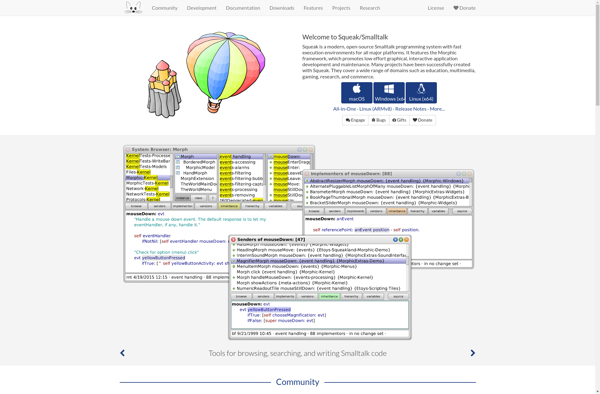
Smalltalk is an object-oriented, dynamically typed, reflective programming language. It was created in the 1970s at Xerox PARC by a team led by Alan Kay. Smalltalk was designed to explore object-oriented programming and create a highly interactive programming environment. Its key characteristics include:Everything in Smalltalk is an object. All code...
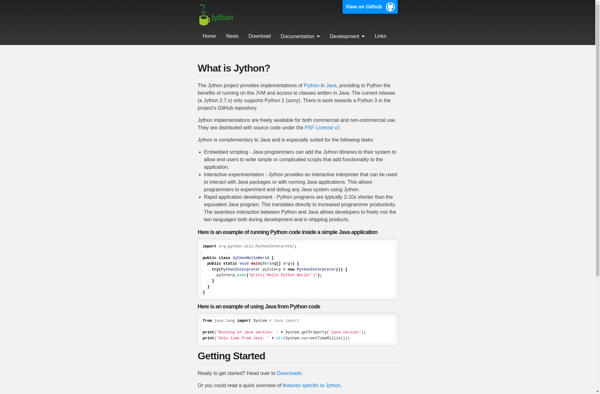
Jython is an implementation of the Python programming language that is designed to run on the Java platform. It allows developers to write Python code that leverages the wide range of Java libraries available. Jython compiles Python code into Java byte code which can then be executed by the Java...
Red is an open source, homoiconic programming language strongly inspired by Rebol. Red is designed for 'full stack' programming, meaning it aims to cover all aspects of computing, from low-level to high-level programming.Key features of Red include:A REPL environment for interactive programming'Homogen' syntax where code and data have the same...
Haxe is an open-source high-level multi-platform programming language and compiler that allows developers to build cross-platform applications and source code for several different platforms from a single codebase.Some key features of Haxe include:Compiles to JavaScript, Flash, C++, C#, PHP, Python, Lua and moreStrongly typed with static typingOOP support with interfaces...
Haskell is a statically typed, purely functional programming language that was designed to have very few implementation dependencies. It has a strong static type system with type inference and non-strict (lazy) evaluation by default. Some key features of Haskell include:Purity - Functions have no side effects, offering referential transparency and...
Fortran is a general-purpose, procedural, imperative programming language that is especially suited for numeric computation and scientific computing applications. Originally developed by IBM in the 1950s, Fortran was one of the first high-level programming languages and quickly came to dominate programming in the areas of numeric analysis and computational science.The...
V (pronounced 'vee') is an open source programming language designed for building maintainable and performant software. It was created by Alexander Medvednikov and first released in 2017.Some key features and goals of V include:Simplicity - easy to learn syntax similar to Go, Python, and TypeScriptFast compile times - compiles extremely...
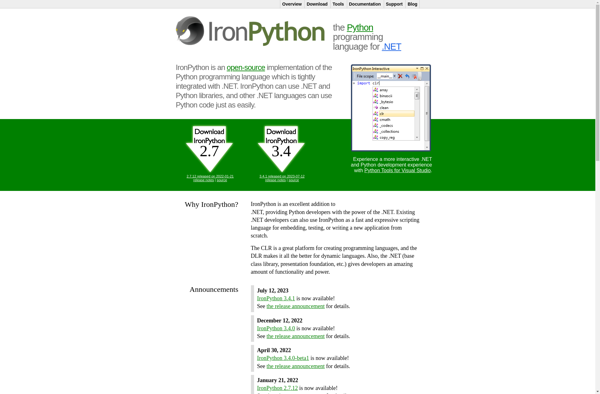
IronPython is an open-source implementation of the Python programming language that runs on the .NET Framework. It was first released in 2006 by Jim Hugunin, one of the original creators of JPython (later Jython).The key difference between IronPython and standard CPython implementation is that IronPython is integrated with the .NET...
REBOL is an open-source programming language first released in 1997 by Carl Sassenrath. It stands for Relative Expression-Based Object Language.Some key features of REBOL include:Simple, terse syntax that is easy to learn and readLanguage flexibility - can be used for many different task typesCross-platform, able to run on many devices...
Ceylon is an open source programming language that can run on the Java Virtual Machine or in JavaScript runtimes. It was created by Red Hat and aims to improve upon Java's shortcomings in areas like verbosity, boilerplate code, and lack of modularity.Some key features of Ceylon include:Strong and static type...
sdlBasic is an open-source BASIC programming language that uses the SDL (Simple DirectMedia Layer) library for handling graphics, sound, input, and other multimedia functionality. It provides an easy way to create 2D games, applications, simulations, and more that can run on Windows, Linux, MacOS, iOS, and Android.Some key features of...
Pike is a dynamic programming language originally developed in the early 1990s by Fredrik Hübinette and others at the Royal Institute of Technology in Sweden. The syntax and general style of Pike is heavily influenced by C, meaning Pike programmers find it easy to get started if they have experience...
SMX is an open-source systems management and monitoring application designed for Linux and other Unix-like operating systems. It provides a centralized interface for administrators to monitor and manage multiple servers simultaneously.Some of the key features of SMX include:Monitoring system metrics like CPU, memory, disk, and network usageManaging system services and...
Object Pascal is an object-oriented version of the Pascal programming language. It was initially developed by Apple Computer in consultation with Niklaus Wirth, the creator of Pascal, in the early 1980s. The main goal was to add object-oriented programming capabilities to the existing Pascal language.Object Pascal builds on traditional procedural...
L2 is a new systems programming language developed by Microsoft as an alternative to C and C++. The key goals of L2 are to improve security, safety, and concurrency support compared to those languages while maintaining high performance.Some of the key features of L2 include:Memory safety - L2 eliminates entire...
The P programming language is a general-purpose, procedural systems programming language originally designed by Dennis Ritchie in the early 2010s. It was envisioned as a potential successor to the C programming language that would address some of C's perceived flaws while maintaining its efficiency and control over hardware.Some key features...
Pony is an open-source, actor-model, capabilities-secure, high performance programming language. It features several key characteristics:Ultra lightweight concurrency based on the actor model for high performance and scalabilityObject capabilities for security - Pony has no undefined behavior or unsafe operationsAlgebraic data types and pattern matchingGarbage collection out of the boxEasy to...
Objective-C is a general-purpose, object-oriented programming language that adds Smalltalk-style messaging to the C programming language. It was originally developed in the early 1980s by Brad Cox and Tom Love at Stepstone. It later became popularized through its usage by NeXT for the NeXTSTEP operating system in the late 1980s.When...
Beef is an esoteric, interpreted programming language created in 2007 for entertainment rather than practical use. Inspired by the cow programming language COW, Beef uses cow-related terms and syntax to allow programmers to write code that looks like English sentences.Some key features of Beef include:Use of cow-related terminology like moo,...
X10 is an object-oriented programming language developed at IBM Research in the early 2000s for productive, performance-portable parallel programming on high-end computing systems. The key goals and features of X10 include:Productivity - X10 aims to improve programmer productivity through a simple programming model and strong typing.Performance portability - Programs written...
Jabaco is an open-source project management and bug tracking software that serves as an alternative to Atlassian's Jira. It provides similar features for agile development teams to plan, track, and release software projects.Some of the key features of Jabaco include:Kanban boards for visualizing work status and tracking progressCustom workflows to...
GDscript is a high-level, dynamically typed programming language used to create video games, applications, and tools inside the Godot game engine and development environment. It was specifically designed by the Godot team to be integrated with the engine and enable high flexibility and functionality for 2D and 3D game development.GDscript...
Cobra is an open-source computer-aided design (CAD) and computer-aided manufacturing (CAM) software application. It focuses on 3D modeling for product design and development as well as preparation for 3D printing.Some key features and capabilities of Cobra include:User-friendly and intuitive 3D modeling tools for creating simple to complex designsSupport for common...