Haxe is an open-source high-level multi-platform programming language and compiler that can produce applications and source code for many different platforms from a single codebase.
Haxe: Open-Source Multi-Platform Programming Language & Compiler
High-level, multi-platform language for producing applications and source code across various platforms from a single codebase
What is Haxe?
Haxe is an open-source high-level multi-platform programming language and compiler that allows developers to build cross-platform applications and source code for several different platforms from a single codebase.
Some key features of Haxe include:
Compiles to JavaScript, Flash, C++, C#, PHP, Python, Lua and more
Strongly typed with static typing
OOP support with interfaces and generics
Great for both client-side and server-side code
Large standard library with support for common data structures, algorithms and file formats
Macros for meta-programming
Good integration with common IDEs and editors via plugin
Active and helpful developer community
Haxe allows developers to share the same code across multiple platforms very easily, reducing development and maintenance costs compared to platform-specific languages. The compiled output is highly optimized and Haxe has been used to build many popular games, enterprise applications and client-side web and mobile apps.
Haxe Features
Features
Compiles to multiple platforms like JavaScript, Flash, C++, C#, PHP, Python, Lua and Java
Strongly typed language with static typing
Supports object-oriented, imperative and functional programming styles
Fast compilation times
Powerful macro system
Good IDE support
Pricing
Open Source
Pros
Write once, compile to many platforms
Fast compilation for rapid development
Strong typing catches errors early
Powerful language features
Active community support
Cons
Smaller ecosystem than other languages
Limited IDE options compared to other languages
Not as widely used or known as other cross-platform options
Python is a high-level, general-purpose programming language that emphasizes code readability and rapid application development. It was created by Guido van Rossum in 1991 and has since become one of the most popular programming languages.Some key features of Python include:Easy to learn syntax that resembles everyday EnglishInterpreted language that can...
Go, also known as Golang, is an open source programming language first developed in 2007 by Robert Griesemer, Rob Pike, and Ken Thompson at Google. It combines the speed and efficiency of a compiled language like C or C++ with the ease of use and productivity of dynamic languages like...
C# is an object-oriented, general-purpose programming language developed by Microsoft. It was first released in 2002 as part of the .NET framework, and since then has become one of the most popular programming languages used for building a wide range of applications.Some key features of C# include:Object-oriented - Supports concepts...
C is a general-purpose, procedural programming language originally developed by Dennis Ritchie between 1969 and 1973 at Bell Labs. It was originally implemented on the Unix operating system and its availability on a wide variety of platforms has made C one of the most widely used programming languages.Some key features...
Haskell is a statically typed, purely functional programming language that was designed to have very few implementation dependencies. It has a strong static type system with type inference and non-strict (lazy) evaluation by default. Some key features of Haskell include:Purity - Functions have no side effects, offering referential transparency and...
Script# is an open-source, multi-platform scripting language created by Anthon van der Neut in 2002. It is influenced by languages like JavaScript, Python, Ruby, and C# while focusing on simplicity, efficiency, and integration.Some key features and aspects of Script#:Lightweight, interpreted language for general scripting usesStrongly typed but uses type inference...
CoffeeScript is a programming language that compiles into JavaScript. It was created in 2009 by Jeremy Ashkenas as a way to allow developers to write cleaner, more concise JavaScript code.Some of the key features of CoffeeScript include:Optional parentheses and semicolons - semicolons and parentheses are optional in most cases, allowing...
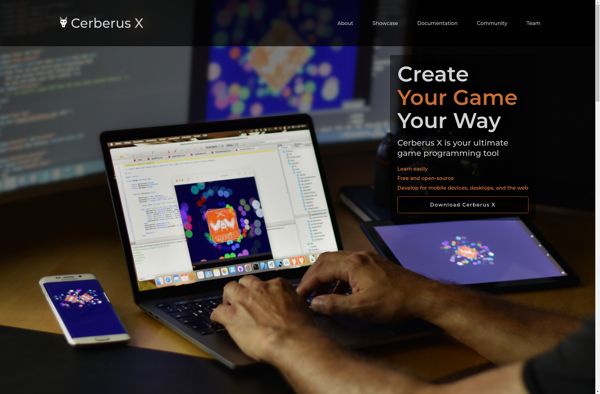
Cerberus X is an open-source remote access and remote administration software used as an alternative to proprietary solutions like TeamViewer. It provides secure remote control of computers and mobile devices in order to facilitate remote IT support, online meetings, collaboration, and more.Some key features of Cerberus X include:Cross-platform support -...
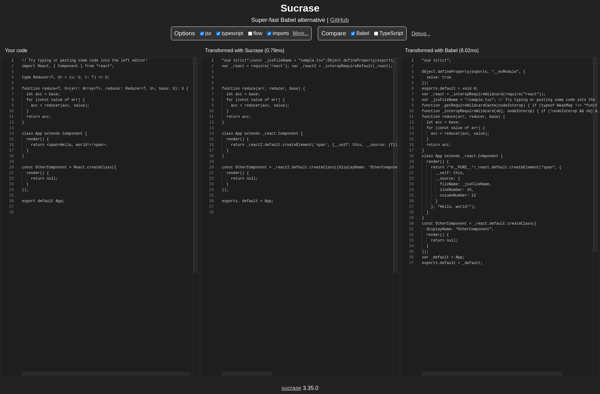
Sucrase is a fast alternative compiler for Babel that allows developers to use the latest JavaScript features in their applications without the performance overhead of transpiling. It focuses specifically on supporting TypeScript, JSX, and Flow out of the box.Some key features and benefits of Sucrase include:Faster than Babel at converting...
LiveScript is an open-source programming language that compiles to JavaScript. It was created by George Zahariev in 2012 and is influenced by languages like Python, CoffeeScript, and Ruby.Some key features of LiveScript include:Python-inspired syntax that is designed to be cleaner and more readable than regular JavaScriptOptional static typing for added...
Kaffeine JS is an open-source JavaScript library for building user interfaces and web applications. It was created to provide developers with an easy way to build high-performance sites and apps without having to write a lot of boilerplate code.Some key features of Kaffeine JS include:Reusable UI components like buttons, cards,...
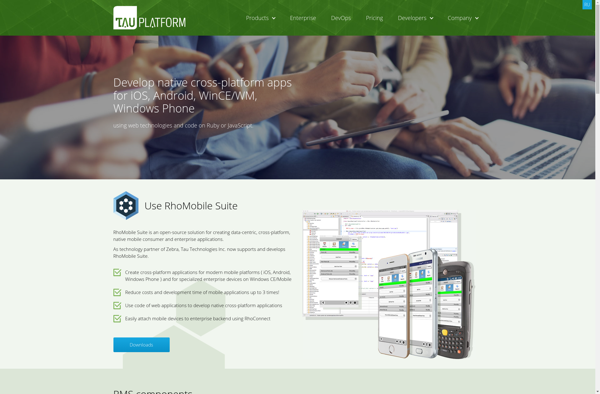
RhoMobile is an open-source mobile application development framework created by Motorola for building native apps for multiple platforms, including iOS, Android, Windows Mobile, and Blackberry. It uses Ruby as the programming language and Rhodes as the Ruby-based framework.Some key features of RhoMobile:Write apps in Ruby code and deploy to native...
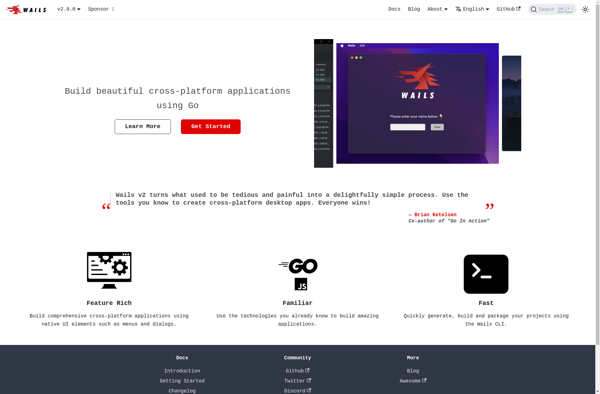
Wails is an open-source framework that enables developers to build desktop applications using web technologies like HTML, CSS, JavaScript, and web frameworks like React, Vue, and Angular. It bundles web apps in a wrapper that enables native OS integrations.Some key highlights of Wails:Build native apps for Windows, Mac, and Linux...
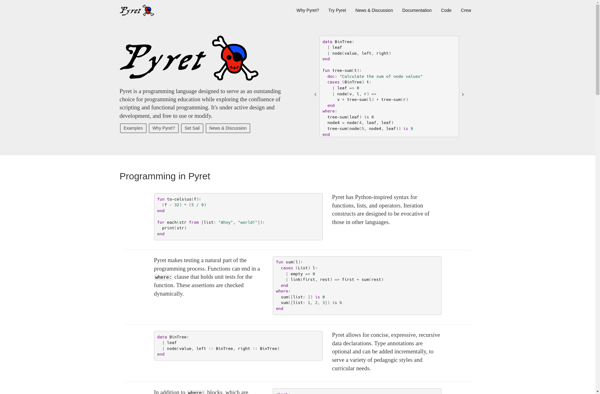
Pyret is a programming language and environment designed primarily for learning programming concepts and building small-scale software projects. It focuses on readability, simplicity, and providing good error messages to help novice programmers.Some key features of Pyret include:Python-inspired syntax designed to be clean, consistent, and easy to read/writeStrong static typing with...
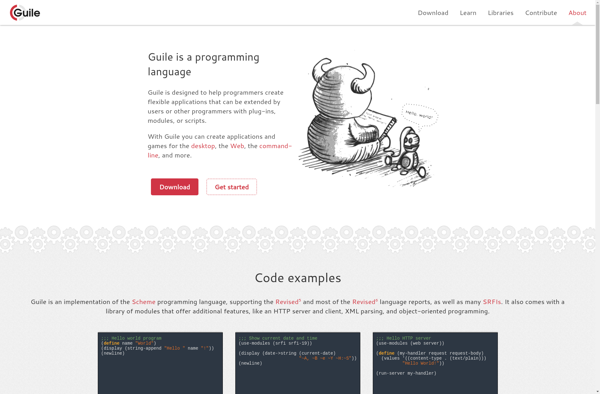
Guile is an open source interpreter and compiler for the Scheme programming language. It was developed by the GNU Project to serve as a user-extensible extension and scripting language for other programs.Some key features and characteristics of Guile include:Implements R5RS and R7RS standards for SchemeCompiles to bytecode to improve performanceCan...