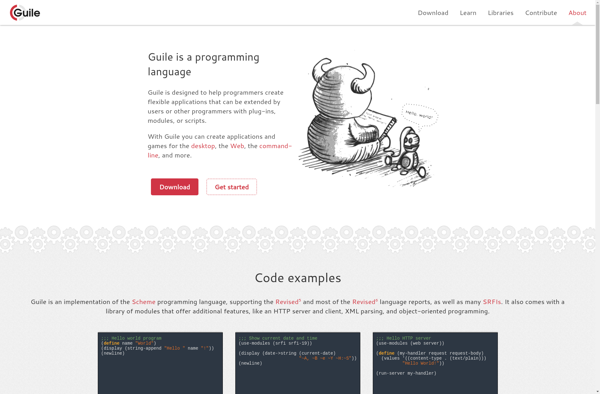
Guile is an open source interpreter for the Scheme programming language, developed by the GNU Project. It aims to make Scheme more accessible as an extension language, allowing developers to embed Scheme into applications to enable scriptability and extensibility.
Guile: Open Source Scheme Interpreter for Scriptability and Extensibility
Guile is an open source interpreter for the Scheme programming language, developed by the GNU Project. It aims to make Scheme more accessible as an extension language, allowing developers to embed Scheme into applications to enable scriptability and extensibility.
What is Guile?
Guile is an open source interpreter and compiler for the Scheme programming language. It was developed by the GNU Project to serve as a user-extensible extension and scripting language for other programs.
Some key features and characteristics of Guile include:
Implements R5RS and R7RS standards for Scheme
Compiles to bytecode to improve performance
Can be embedded into host programs as an extension language
Provides a foreign function interface for calling C code
Supports concurrent programming features
Includes an IDE and debugger for development
Licensed under the GNU LGPL
Works across many platforms including Linux, macOS, and Windows
Guile allows developers to easily extend and customize applications by writing scripts using the elegant Scheme language. It can be embedded into programs written in C, C++, Objective-C, and other languages. Some well-known applications that use Guile include the GIMP image editor, the GNUCash financial manager, and the XEmacs text editor.
Overall, Guile aims to provide a flexible, capable, and user-friendly platform for adding scripting capabilities to software projects using the power and productivity of the Scheme language.
Guile Features
Features
Interpreter for Scheme programming language
Supports multiple versions of Scheme
Can be embedded in applications as a scripting language
Good for extending and customizing applications
Includes debugger, profiler and other developer tools
Pricing
Open Source
Pros
Open source and free
Mature and stable
Good performance
Widely portable
Good documentation and community support
Cons
Not as full-featured as some Scheme implementations
Python is a high-level, general-purpose programming language that emphasizes code readability and rapid application development. It was created by Guido van Rossum in 1991 and has since become one of the most popular programming languages.Some key features of Python include:Easy to learn syntax that resembles everyday EnglishInterpreted language that can...
Go, also known as Golang, is an open source programming language first developed in 2007 by Robert Griesemer, Rob Pike, and Ken Thompson at Google. It combines the speed and efficiency of a compiled language like C or C++ with the ease of use and productivity of dynamic languages like...
C# is an object-oriented, general-purpose programming language developed by Microsoft. It was first released in 2002 as part of the .NET framework, and since then has become one of the most popular programming languages used for building a wide range of applications.Some key features of C# include:Object-oriented - Supports concepts...
Kotlin is a statically typed programming language that runs on the Java virtual machine and can also be compiled to JavaScript. It is designed by JetBrains to be a better alternative to Java for modern application development.Some key features and advantages of Kotlin include:Null safety - Variables in Kotlin can't...
JavaScript is a lightweight, interpreted programming language with first-class functions that allows you to implement complex features on web pages. When JavaScript runs in a browser, it can:Access and modify a web page's content and markupRespond to user actionsCommunicate asynchronously using callback functionsAlter a web page's stylingAnimate page elementsJavaScript has...
Nim is an open-source, general-purpose, statically typed, compiled programming language developed by Andreas Rumpf. It combines successful concepts from mature languages like Python, Ada and Modula, offering flexibility and efficiency. Here are some of its key features: Statically typed – Types are checked during compilation which helps catch errors early.Compiles...
Swift is a general-purpose, multi-paradigm, compiled programming language developed by Apple Inc. It was first released in 2014 as the successor to Objective-C for Apple's iOS, macOS, watchOS, and tvOS operating systems. Some key features and characteristics of Swift include:Fast and efficient: Swift code compiles extremely quickly and the resulting...
Haxe is an open-source high-level multi-platform programming language and compiler that allows developers to build cross-platform applications and source code for several different platforms from a single codebase.Some key features of Haxe include:Compiles to JavaScript, Flash, C++, C#, PHP, Python, Lua and moreStrongly typed with static typingOOP support with interfaces...
Haskell is a statically typed, purely functional programming language that was designed to have very few implementation dependencies. It has a strong static type system with type inference and non-strict (lazy) evaluation by default. Some key features of Haskell include:Purity - Functions have no side effects, offering referential transparency and...
Allegro CL is a Common Lisp implementation developed by Franz Inc. that focuses on high performance and robust software delivery. Some key features of Allegro CL include:An advanced optimizing compiler that generates efficient native codeA high performance garbage collectorSupport for multiprocessing and multithreadingAn open source project called AllegroGraph that provides...
UCBLogo is a free, open-source implementation of the Logo programming language developed at UC Berkeley. It is primarily designed for education to teach concepts like computer programming, mathematics, and geometry to students of all ages.Some key features of UCBLogo include:2D and 3D turtle graphics using a virtual turtle that can...
Pyret is a programming language and environment designed primarily for learning programming concepts and building small-scale software projects. It focuses on readability, simplicity, and providing good error messages to help novice programmers.Some key features of Pyret include:Python-inspired syntax designed to be clean, consistent, and easy to read/writeStrong static typing with...