ScaleGrid
ScaleGrid is a database-as-a-service platform that provides fully managed MySQL, PostgreSQL, Redis, and MongoDB databases in the cloud. It enables developers to deploy, monitor, and scale database clusters with just a few clicks.
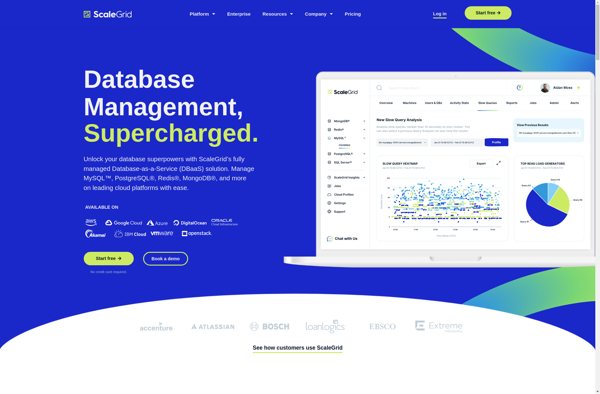
ScaleGrid: Fully Managed Database-as-a-Service
A cloud-based platform for deploying, monitoring, and scaling MySQL, PostgreSQL, Redis, and MongoDB databases with ease
What is ScaleGrid?
ScaleGrid is a database-as-a-service platform designed to help developers deploy, manage, and scale database infrastructure more efficiently. Some key features of ScaleGrid include:
- Fully managed MySQL, PostgreSQL, Redis, and MongoDB database clusters available with high availability, auto backups, monitoring, and alerting capabilities built-in.
- Intuitive web-based console and RESTful APIs to deploy, monitor, and scale both SQL and NoSQL database clusters on demand.
- Support for public, private, and hybrid cloud infrastructure across platforms like AWS, Azure, DigitalOcean and more.
- Pre-configured database clusters available to accelerate development and shorten time-to-market.
- Security capabilities like automated patches, upgrades, SSL support, IP whitelisting, role-based access control to safeguard databases.
- Simple hourly pricing with the ability to only pay for what you use and scale resources up or down on demand.
Overall, ScaleGrid is designed for developers looking to deploy database infrastructure in the cloud without getting locked into complex and expensive alternatives. Its mission is to provide an easy, scalable, and reliable database-as-a-service for the modern application stack.
ScaleGrid Features
Features
- Fully managed database clusters
- Support for MySQL, PostgreSQL, Redis and MongoDB
- Automatic scaling and load balancing
- Built-in monitoring and alerts
- Backups and point-in-time recovery
- High availability with auto-failover
- Security features like SSL and IP whitelisting
- CLI and API for automation
- Integrations with CI/CD pipelines
Pricing
- Pay-As-You-Go
Pros
Easy to deploy and manage databases
Flexible scaling to handle traffic spikes
High availability architecture
Automated backups and disaster recovery
Saves time compared to managing own servers
Pay-as-you-go pricing model
Cons
Can be more expensive than self-hosted for large deployments
Limited configuration compared to managing own servers
Vendor lock-in
Official Links
Reviews & Ratings
Login to ReviewThe Best ScaleGrid Alternatives
View all ScaleGrid alternatives with detailed comparison →
Top Development and Database Management and other similar apps like ScaleGrid
Here are some alternatives to ScaleGrid:
Suggest an alternative ❐
MongoDB
What Is MongoDB?MongoDB is a document-oriented NoSQL database that stores data in flexible, JSON-like documents instead of traditional rows and columns. It is one of the most popular databases for modern application development, particularly for applications that need flexible schemas and horizontal scaling.Key FeaturesMongoDB stores data as BSON (Binary JSON)...

MySQL Community Edition
What Is MySQL Community Edition?MySQL is the world's most popular open-source relational database management system, powering millions of websites and applications including WordPress, Facebook, and Twitter. The Community Edition is the freely downloadable version available under the GPL license.Key FeaturesMySQL provides ACID-compliant transactions (with InnoDB engine), full-text search, replication, partitioning,...
Oracle Database
Oracle Database is a powerful, enterprise-level database management system developed and supported by Oracle Corporation. It is used by organizations across industries to store, organize, and process large amounts of data efficiently and securely.Some key features of Oracle Database include:Support for both relational and non-relational database structures like JSON, XML,...

OrbitDB
OrbitDB is a decentralized peer-to-peer database built on top of IPFS, the InterPlanetary File System. It provides an easy-to-use API for storing and managing data in decentralized networks and applications.Some key features of OrbitDB include:Peer-to-peer - Data is replicated directly between peers rather than relying on central serversDistributed and decentralized...