SceneKit is a 3D graphics framework developed by Apple for macOS and iOS. It allows developers to easily render high-quality 3D animated graphics, combining a high-level API with a low-level graphics rendering engine.
SceneKit is a 3D graphics framework developed by Apple for macOS and iOS, allowing developers to easily render high-quality 3D animated graphics with its high-level API and low-level graphics rendering engine.
What is SceneKit?
SceneKit is a high-level 3D graphics framework developed by Apple for macOS and iOS. It allows developers to easily incorporate 3D graphics and animations into their apps without needing to learn complex 3D programming or graphics APIs.
Some key capabilities of SceneKit include:
Simple, intuitive API for 3D scene management, lighting, cameras, materials, physics, and animations
Integrated physics simulation using the Bullet physics engine
Support for importing 3D assets in standardized formats like .dae and .scn
Advanced lighting, shadows, and effects
Integration with other iOS frameworks like ARKit and RealityKit
Optimized for high performance 3D graphics on Apple platforms
Developers can use SceneKit along with Xcode's built-in tools like the Scene Editor to preview and build out intricate 3D scenes and animations right inside their apps. Apps that benefit from 3D graphics like games, CAD, visualization, training simulators, and more can leverage SceneKit to easily bring high-quality 3D and animations to life.
Overall, SceneKit makes integrating 3D graphics, animations, and physics much simpler for any developer working on the Apple ecosystem, lowering the barrier to incorporating great 3D experiences in apps.
SceneKit Features
Features
3D scene rendering
Physics simulation
Animation support
Integration with ARKit
Node-based scene management
Materials and lighting
Cameras and point of view
Geometry support
Particle systems
Pricing
Free
Pros
Integrated with Apple platforms
Performs well on Apple devices
Easy to learn and use
Good documentation
Large developer community
Powerful graphics capabilities
Cons
Only available on Apple platforms
Less flexible than some cross-platform options
Limited support for some advanced graphics features
Unity is a cross-platform game engine developed by Unity Technologies that is primarily used to develop video games and simulations for computers, consoles, mobile devices, and websites. Some key features of Unity include:Integrated editor for scene creation, scripting, asset pipeline, and building gamesSupports both 2D and 3D game development with...
Godot Engine is a feature-packed, cross-platform game engine designed for 2D and 3D game development. It is completely free and open source under the MIT license.Some key features and capabilities of Godot Engine include:Intuitive and easy-to-use interface for quick development iterationsComprehensive set of 2D and 3D nodes for crafting game...
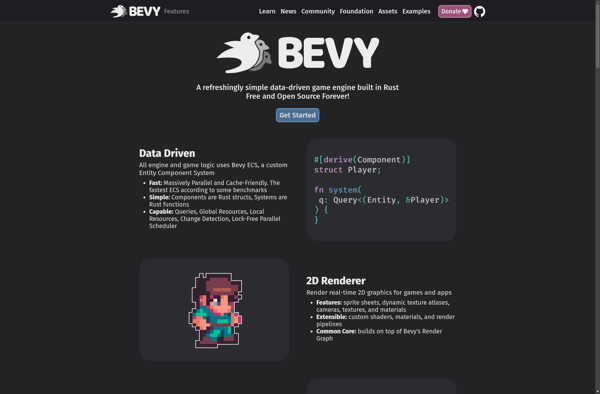
The Bevy Game Engine is an open-source game engine written in Rust that is focused on usability, performance, and productivity. Some key things to know about Bevy:It utilizes the Entity Component System pattern which provides a flexible and extensible architecture for game development.Bevy is written in Rust which gives it...
Upbge (Uchronia Project Blender Game Engine) is an open-source 3D game engine that is a fork of the Blender Game Engine integrated into the Blender 3D modeling and animation software. Upbge aims to improve and extend the original Blender Game Engine by fixing bugs, adding new features, and enhancing overall...
Wicked Engine is an open-source 3D game engine written in C++ that is designed for high-performance real-time rendering. It supports Windows and Linux platforms and can utilize modern low-level graphics APIs like Vulkan, DirectX 12, and Metal to take advantage of modern GPU capabilities.Some key features of Wicked Engine include:Real-time...
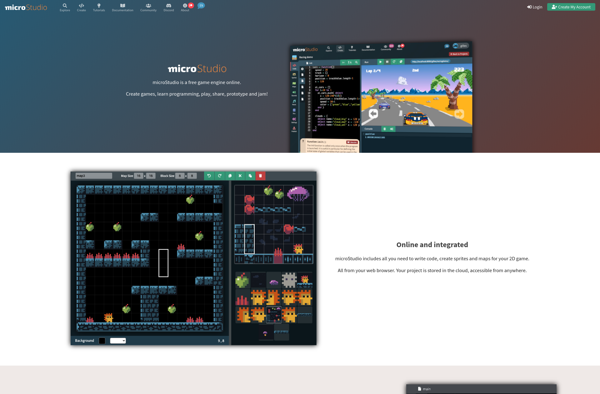
microStudio is a versatile graphics and animation software designed for hobbyists, indie developers, students, and other artists interested in 2D and 3D content creation. It comes packed with an intuitive and accessible toolset focused on key artwork and animation capabilities.Some of the core features of microStudio include:Powerful 2D vector and...
Panda3D is a robust, flexible, cross-platform open-source 3D rendering and game development engine and framework. Developed in C++, it allows developers to create 3D games and applications using Python and C++ programming languages.Some key features and capabilities of Panda3D include:Advanced 3D graphics rendering engine powered by OpenGL, DirectX, and VulkanBuilt-in...
Babylon.js is an open source 3D game engine developed with web technologies in mind. It was created in 2012 and allows developers to create 3D graphics with JavaScript with a focus on performance and power.Some key features of Babylon.js include:WebGL 2 support to leverage modern hardware acceleration of 3D graphicsA...
MonoGame is an open source implementation of the Microsoft XNA 4 Framework. It allows developers to create games that can run across multiple platforms including Windows, Mac, Linux, iOS, Android, as well as Xbox, PlayStation, and Nintendo consoles.Some key capabilities and benefits of MonoGame include:Open source MIT license so free...
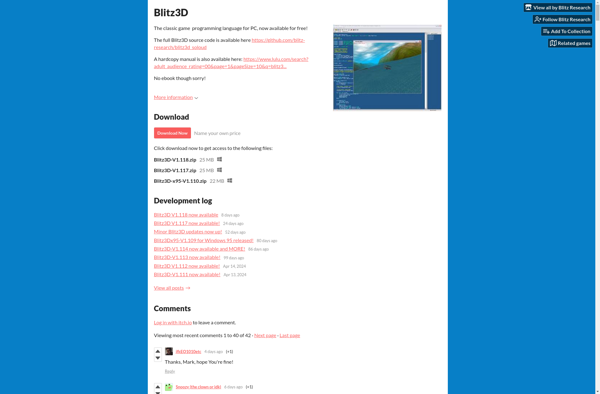
Blitz3D is a 3D game engine and programming language that is designed to allow for rapid game development. It uses a Basic-style syntax that is easy to learn, making it a good choice for beginner and indie game developers.Some key features of Blitz3D include:Integrated 3D graphics engine and SDK for...
FNA (F#/.NET for Applications) is an open source reimplementation of the Microsoft XNA Game Studio 4 libraries. It allows .NET developers to write games and other graphical applications that run cross-platform on Linux, macOS, and Windows.FNA aims to provide a clean API for media-rich applications without the need for binary...