The SDL Game Engine is a free, open source game development library that provides low-level access to graphics, audio, input, and other hardware via OpenGL and Direct3D. It is written in C and works across many platforms including Windows, Mac, Linux, iOS, and Android.
SDL Game Engine: Free, Open Source Game Development Library
A free, open source game development library providing low-level access to graphics, audio, input, and hardware via OpenGL and Direct3D, supporting Windows, Mac, Linux, iOS, and Android.
What is SDL Game Engine?
The SDL (Simple DirectMedia Layer) Game Engine is an open-source, cross-platform development library designed for providing low-level access to graphics, audio, and device input. It is written in C and supports multiple operating systems including Windows, macOS, Linux, iOS, and Android.
Some key capabilities and features of SDL include:
Hardware-accelerated 2D and 3D graphics via OpenGL and Direct3D
Support for multiple image file formats including BMP, JPEG, PNG, and TIFF
Audio output and capturing via drivers like DirectSound, CoreAudio, ALSA, OSS, and PulseAudio
Controller input support from keyboards, mice, gamepads, and joysticks
Portable C/C++ API for cross-platform development
Extensible through add-ons and plugins
Permissive Zlib licensing
The SDL Game Engine enables developers to build high-performance games and multimedia applications with native look and feel across platforms. It abstracts away low-level details of graphics APIs, input devices, and audio systems to provide a straightforward interface. Combined with a renderer like OpenGL or Direct3D, SDL can be used as the foundation for 2D and 3D games. Popular games built on SDL include Angry Birds and SuperTuxKart.
SDL Game Engine Features
Features
Cross-platform support for Windows, Mac, Linux, iOS, Android
Hardware accelerated 2D and 3D graphics rendering with OpenGL and Direct3D
Sprite support for 2D game development
Keyboard, mouse and gamepad input
Loading resources like images, sounds, music
Timing and framerate control
Math support like vectors and matrices
Audio mixing and playback
Networking for multiplayer games
Scripting support for Lua and other languages
Pricing
Open Source
Pros
Free and open source
Very portable and runs on many platforms
Good performance through hardware acceleration
Active community support
Lightweight and easy to integrate
Very customizable and extensible
Cons
Lower level than some game engines so more coding needed
Limited built-in tools like scene editors
Less documentation and samples than commercial engines
No built-in physics engine
Not as many advanced features as larger game engines
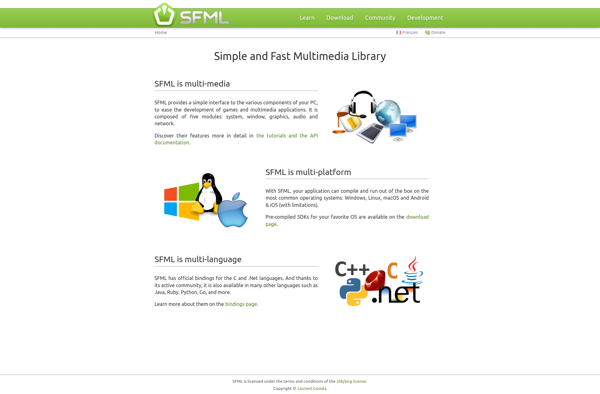
SFML (Simple and Fast Multimedia Library) is a free, open-source, cross-platform software development library designed to provide a simple application programming interface (API) to various multimedia components. It is written in C++ and has bindings available for various languages such as C, .NET, Python, and more.SFML aims to help developers...
Pyglet is a powerful, yet easy to use Python library for developing graphical user interface (GUI) applications and games. Here is an overview of some of its key capabilities:Cross-platform support - Pyglet works on Windows, Mac, and Linux with the same codebase.Hardware-accelerated graphics - It leverages GPUs for fast 2D...
Allegro is a cross-platform, open source game development library focused on 2D and 3D game creation. It provides pre-built functions for common game development tasks like graphics, sound, input, timers, and more to make developing games easier and faster.Some key features of Allegro include:Supports Windows, Mac, Linux, iOS, Android and...
Pygame is a free and open-source cross-platform library for the Python programming language specifically designed for writing video games. It includes computer graphics and sound libraries designed to be used with the Python programming language.Some key features of Pygame include:Hardware-accelerated 2D graphics including sprites and image/tilemap loading and manipulationPlaying MP3,...
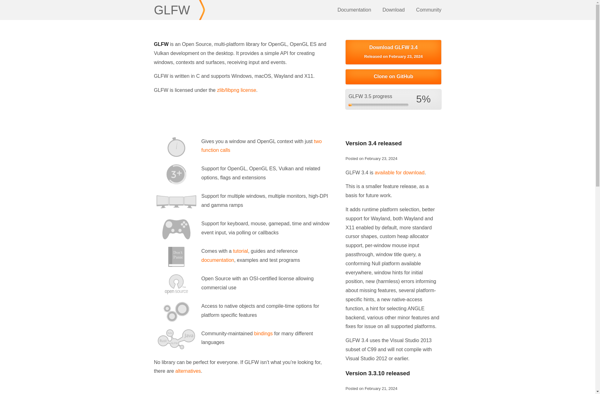
GLFW is an open-source, cross-platform library for OpenGL, OpenGL ES and Vulkan development on the desktop. It provides functions to create windows, contexts and surfaces, read input, handle events, and interact with the overall system. Some of the key capabilities of GLFW include:Creating and managing windows with OpenGL contextsReading keyboard,...
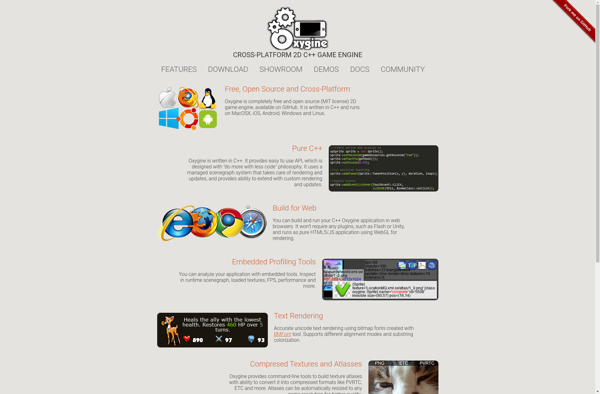
Oxygine is an open-source C++ game engine designed for developing high-performance 2D games and applications that can run across multiple platforms including mobile, desktop, web, and gaming consoles. It uses OpenGL and OpenGL ES for hardware-accelerated 2D graphics rendering.Some key features of Oxygine include:Cross-platform support - Games made with Oxygine...
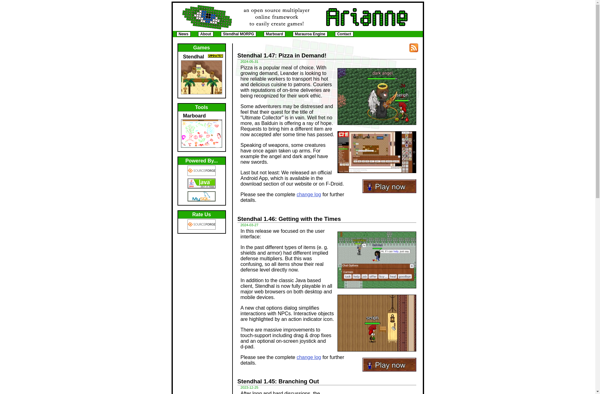
Arianne is an open source, cross-platform 3D virtual world engine and platform. Developed in C++, it allows users to create and connect to multi-user 3D environments and games.Some key features of Arianne include:Real-time 3D graphics and physics simulationSupport for 3D avatars, visual chat, and user interactionMultiplayer networking and social featuresCustomizable...