Chaino is an open-source blockchain platform that allows developers to build decentralized applications and smart contracts. It uses a proof-of-stake consensus model to validate transactions.
Chaino: Open-Source Blockchain Platform for Decentralized Apps & Smart Contracts
Discover Chaino, an open-source blockchain platform for building decentralized applications and smart contracts, utilizing a proof-of-stake consensus model for secure transaction validation.
What is Chaino?
Chaino is an open-source blockchain platform launched in 2018 that allows developers to build decentralized applications and smart contracts. It aims to provide a scalable, secure, and energy-efficient foundation for Web 3.0 applications.
Some key features of Chaino include:
Proof-of-stake consensus - Chaino uses a proof-of-stake model rather than proof-of-work, which is more energy-efficient.
Smart contracts - Developers can deploy Turing-complete smart contracts on Chaino to create DApps.
Scalability - Chaino employs sharding to increase transaction throughput and claims to be able to handle thousands of transactions per second.
Interoperability - The platform offers native interoperability between its own shards and supports cross-chain communication.
Developer tools - Chaino provides documentation, SDKs, APIs, and other tools to help developers build on the platform.
Use cases of Chaino include decentralized finance, supply chain tracking, digital identity solutions, gaming applications and more. It aims to provide the foundation for Web 3.0 and power the next generation of blockchain-based decentralized services.
Chaino Features
Features
Open-source blockchain platform
Allows developers to build decentralized apps and smart contracts
Uses proof-of-stake consensus model
Supports Ethereum Virtual Machine
Has native tokens
Has on-chain governance
Supports NFTs
Has interoperability features
Pricing
Open Source
Pros
Open source code enables transparency and community contribution
Low transaction fees
Fast transaction speeds
Energy efficient consensus mechanism
Supports smart contracts
Has its own native tokens
On-chain governance gives token holders voting rights
Cons
Lower adoption than more established platforms like Ethereum
Smaller developer community than other platforms
Proof-of-stake consensus is less decentralized than proof-of-work
What Is Facebook?Facebook is the world's largest social networking platform, connecting over 3 billion monthly active users. Owned by Meta Platforms, it enables users to share updates, photos, videos, and links with friends, family, and communities.Key FeaturesThe platform includes a news feed algorithm that surfaces content from friends and followed...
VK is a Russian online social media and social networking service based in Saint Petersburg. VK allows users to message each other, join groups and public pages, share and tag images, audio and video, and play browser-based games.VK was launched in 2006 as a Facebook-inspired social networking site. It quickly...
Gab is a social networking website launched in 2016 that bills itself as a free speech alternative to mainstream platforms like Twitter and Facebook. It has become popular among some conservative, alt-right, and far-right users who feel their views are censored on other sites.Gab's key features include:Minimal content moderation -...
Mastodon is an open-source, decentralized social networking platform launched in 2016. It operates as an alternative to commercial platforms like Twitter or Facebook by allowing a federated network of independently operated servers to exchange posts between one another.Rather than having a single central authority like Twitter or Facebook, Mastodon servers...
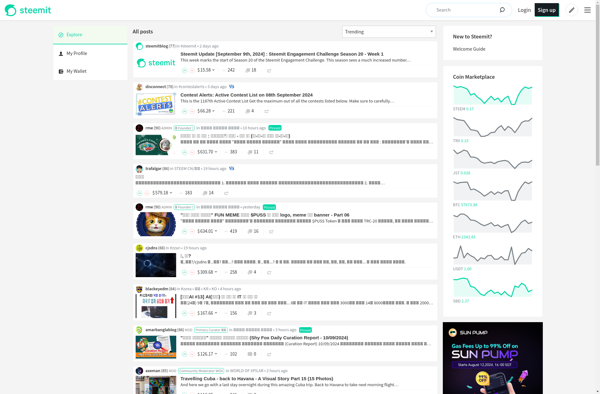
Steemit is a blockchain-based social media platform where anyone can earn rewards for creating and curating content. The platform uses its own cryptocurrency called Steem which has monetary value and can be traded on exchanges.On Steemit, users can post articles, photos, videos, and other content just like traditional social media....
Minds is an open-source, privacy-focused social networking platform launched in 2015. It emphasizes free speech and does not censor or filter content posted by users, except in cases of illegal content.Some key features of Minds include:Encryption - Content and conversations are encrypted for privacy.Anonymity - Users can browse anonymously without...
Diaspora is a decentralized, open source social networking platform launched in 2010. It emphasizes user privacy and control over data sharing.As a decentralized network, Diaspora allows users to host their profile and data on independently run servers called pods. This avoids a central entity having control over the network. Pods...
Friendica is an open-source, decentralized social networking platform launched in 2010. It is designed to be privacy-focused and ad-free, allowing users to have more control over their information and data.Some key features of Friendica include:Federated - able to connect with users on other Friendica servers or compatible platforms like Mastodon...
GNU social is a free, decentralized and open source social networking platform developed as part of the GNU Project. It allows users to control their own data and privacy instead of having it stored on corporate servers.Some key features of GNU social include:Decentralized federated structure - users can set up...
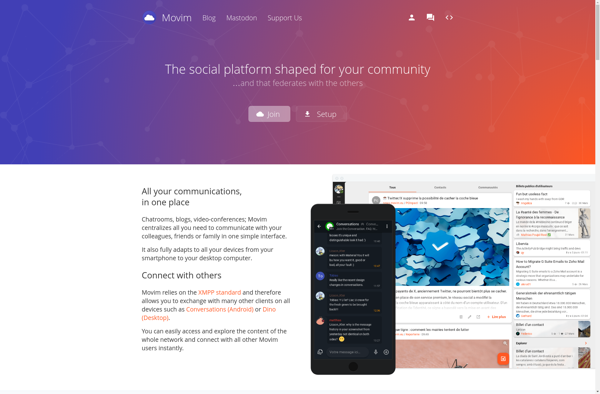
Movim is an open-source, decentralized social networking and communication platform. It operates on a federated model, meaning users on different servers can communicate with each other seamlessly while each server remains independent. Some key features of Movim include:Decentralized architecture - No single entity controls the networkEnd-to-end encryption - Messages and...
Hubzilla is an open-source, decentralized social networking and communications platform built on a foundation of web server software called Elgg. Unlike traditional social networks like Facebook or Twitter that store user data on centralized servers controlled by a single company, Hubzilla allows users to have ownership and control over their...