CLC Main Workbench is a comprehensive bioinformatics software platform for analyzing, visualizing, and managing sequencing data. It provides tools for sequence alignment, variant detection, RNA-Seq analysis, metagenomics, and more.
CLC Main Workbench: Comprehensive Bioinformatics Software
CLC Main Workbench is a comprehensive bioinformatics software platform for analyzing, visualizing, and managing sequencing data. It provides tools for sequence alignment, variant detection, RNA-Seq analysis, metagenomics, and more.
What is CLC Main Workbench?
CLC Main Workbench is a user-friendly desktop application that serves as an integrated environment for analyzing and visualizing next-generation sequencing (NGS) data across a wide range of applications. It provides robust tools for de novo assembly, mapping reads to a reference, analyzing variations, differential expression for RNA-Seq, metagenomic analysis, and more.
Some key features of CLC Main Workbench include:
An intuitive graphical user interface for designing workflows and visualizing results
Support for all major NGS file formats and instruments
Reference-based and de novo sequence assembly
Comprehensive NGS data analysis tools for variant detection, RNA-Seq, metagenomics, and more
Visualization tools such as heatmaps, scatter plots, Circos plots
Ability to work with public databases and custom databases
Scalability to analyze large datasets on a single machine or compute cluster
CLC Main Workbench simplifies complex NGS data analysis so scientists without extensive bioinformatics expertise can go from raw reads to publication-ready figures and tables. The workflows make analysis transparent and reproducible. It can be easily integrated into existing pipelines or run as a stand-alone application.
CLC Main Workbench Features
Features
Sequence alignment
Variant detection
RNA-Seq analysis
Metagenomics analysis
Data visualization
Data management
Pricing
Subscription-Based
Pay-As-You-Go
Pros
Comprehensive suite of bioinformatics tools
User-friendly graphical interface
Integrates many analyses into one platform
Good support and training resources
Cons
Expensive licensing model
Some tools less optimized than standalone software
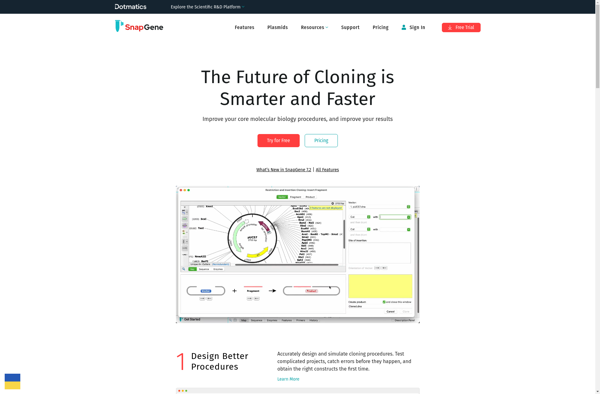
SnapGene Viewer is a free, standalone software application developed by GSL Biotech for visualizing and analyzing DNA sequences and genetic maps. It supports an extensive range of molecular biology file formats including GenBank, FASTA, ABI trace files, Vector NTI, DNA Star, ApE, and SnapGene files.Key features of SnapGene Viewer include:Intuitive...
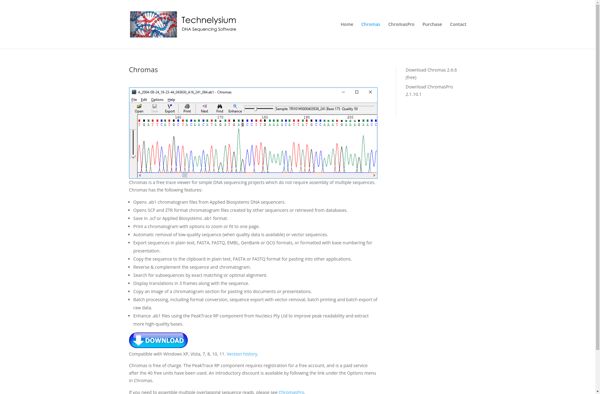
Chromas is a free, open-source spectral analyzer plugin released in 2017. It is lightweight software designed to work as an audio effect plugin in digital audio workstations like Ableton Live, Logic Pro, FL Studio, Reaper, and more.With Chromas added to an audio track, it displays a colorful graphical representation of...
BioEdit is a versatile biological sequence alignment editor and analysis software for Windows. First released in 1997 by Tom Hall, BioEdit has become one of the most widely used bioinformatics tools for molecular biology research.Key features of BioEdit include:User-friendly graphical interface for editing and analyzing DNA, RNA, and protein sequencesSpecialized...
RasMol is a popular free and open-source molecular visualization software used to visualize and analyze 3D molecular structures such as proteins, DNA, RNA, and small molecules. Originally developed in the early 1990s for computational molecular graphics teaching and research, RasMol has evolved into one of the most widely used tools...
Benchling is a leading cloud-based software platform used by over 200,000 scientists for managing and sharing biological data. It provides an intuitive interface and powerful tools to help research teams design DNA, clone genes, sequence genomes, and analyze data from anywhere with an internet connection.Key features of Benchling include:Molecular biology...
DNADynamo is a powerful DNA sequence design and optimization software tool developed by Blue Heron Biotech. It enables synthetic biologists and biological engineers to design novel DNA components and pathways such as promoters, transcription factors, genes, vectors, and more.Some key features of DNADynamo include:Intuitive drag-and-drop graphical user interface for visualizing...
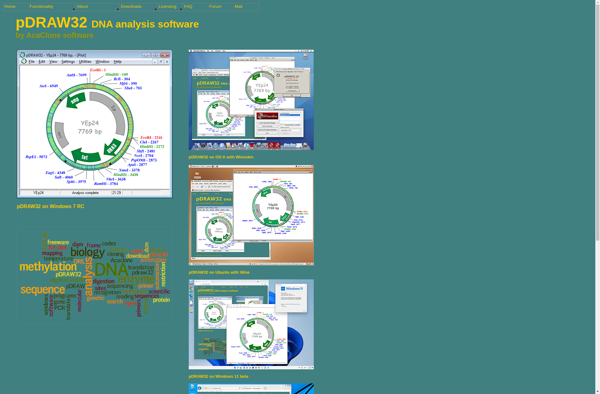
PDRAW32 is a basic computer-aided design (CAD) software application used for 2D drafting and drawing as well as simple 3D modeling. It provides a range of tools and features for creating and editing technical drawings, floor plans, illustrations, schematics, and other graphics.Key features of PDRAW32 include:Intuitive user interface for fast,...
Clustal X is a widely used software tool for multiple sequence alignment of both DNA and proteins. It was first released in 2000 as a graphical user interface frontend for the command line Clustal W software. Clustal X provides an easy-to-use graphical interface that allows users to align sequences and...
GeneDoc is a graphical tool designed for manipulating and editing genomic sequences. It enables users to efficiently view, edit, and annotate DNA or protein sequences up to 10Mb in length. Some of the key features of GeneDoc include:Six-frame translation - Automatically translate DNA sequences in all six reading framesORF finding...
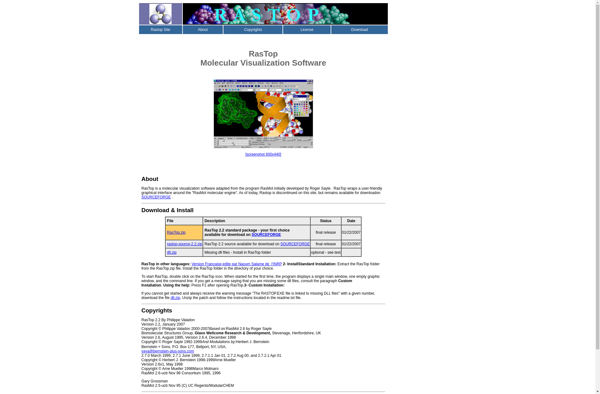
RasTop is an open source, free system monitoring tool for Linux operating systems. It provides a graphical interface to monitor various metrics and resources in real time, including:CPU usage and loadMemory and swap usageDisk I/O and file system usageNetwork bandwidth and packet statisticsSome key features of RasTop include:Interactive graphs and...
Ridom TraceEdi is a powerful Windows-based Electronic Data Interchange (EDI) software used by companies for processing and converting EDI documents. It supports translation and validation of various EDI formats including EDIFACT, X12, TRADACOMS, CSV, XML, and allows creation of custom EDI formats.Key features of Ridom TraceEdi include: Mapping and translation...