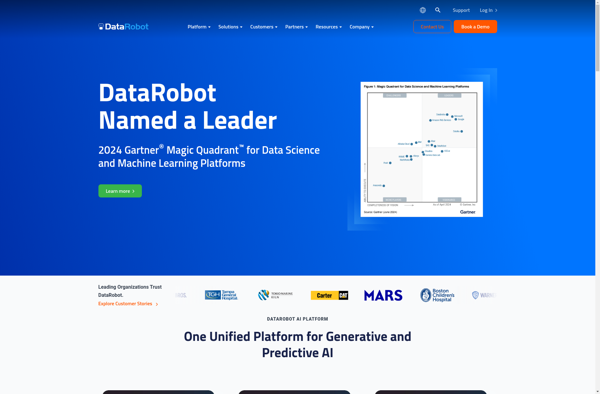
Datarobot is an automated machine learning platform that enables users to build and deploy predictive models quickly without coding. It provides tools to prepare data, train models, evaluate performance, and integrate models into applications.
Build and deploy predictive models quickly without coding with Datarobot's automated machine learning platform, providing tools for data preparation, model training, evaluation, and integration into applications.
What is Datarobot?
Datarobot is an end-to-end enterprise AI platform that aims to make machine learning more accessible for organizations. It provides a graphical user interface and automation tools that allow users without specialized data science skills to build, evaluate, and deploy machine learning models.
Some key capabilities of Datarobot include:
Automated machine learning - Datarobot can automatically test hundreds of modeling methodologies to determine the best algorithms and parameters for a given prediction problem.
Visual workflow - Datarobot uses a drag-and-drop interface to guide users through steps like data preparation, feature engineering, model training, evaluation, and deployment.
Explainable AI - Datarobot provides transparency into how models make predictions, helping to build trust in AI and satisfy regulations.
MLOps - Tools like model monitoring, retraining triggers, version control, and integration APIs operationalize models after deployment.
Vertical solutions - Datarobot offers tailored solutions and prebuilt models for industries like healthcare, financial services, retail, and more.
Overall, Datarobot aims to make advanced AI accessible to domain experts without specialized data science training. Its automation and MLOps capabilities allow faster development and responsible governance of AI applications.
Datarobot Features
Features
Automated machine learning
Drag-and-drop interface
Support for structured and unstructured data
Model management and monitoring
Collaboration tools
Integration with BI and analytics platforms
Deployment to cloud platforms
Pricing
Subscription-Based
Pros
Fast and easy model building without coding
Powerful automation frees up time for data scientists
Good for beginners with limited data science knowledge
Web-based so models accessible from anywhere
Monitoring tools help maintain model accuracy
Cons
Less flexibility and control than coding models yourself
Limited customization and access to underlying code
IBM SPSS Statistics is a comprehensive software platform for statistical analysis in business, science, and social science research. First released in 1968, SPSS Statistics helps users apply complex statistical analyses and predictive analytics to unlock impactful insights from data.Key features and capabilities of SPSS Statistics include:Descriptive statistics like means, standard...
H2O.ai is an open source artificial intelligence and machine learning platform used for building and deploying machine learning models at scale. It provides capabilities for automatic data preparation, feature engineering, model building, model validation, model deployment, and more.Some key capabilities and benefits of H2O.ai include:Automatic data preparation - data can...
R Caret is an open-source R package that provides a unified interface for machine learning algorithms in R. It stands for Classification and Regression Training. The package contains tools for:Splitting data into training and test setsData pre-processing like scaling and transformationsFeature selection algorithmsHyperparameter tuning for model selectionFlexible metrics for model...
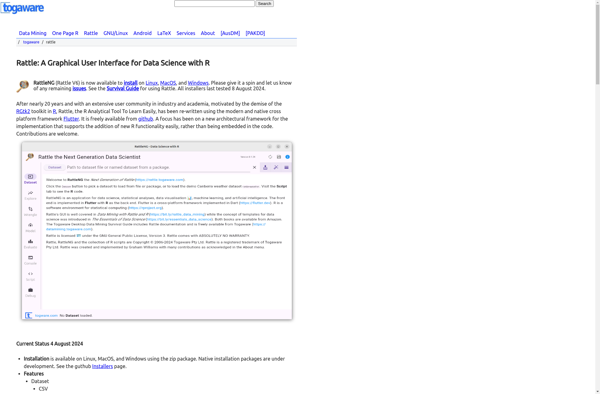
Rattle (the R Analytical Tool To Learn Easily) is an open-source graphical user interface for data mining that runs on the R statistical programming language. It allows users to visually create, evaluate, and refine data mining models without programming.Some key features of Rattle include:Interactive graphical interface for building workflows and...
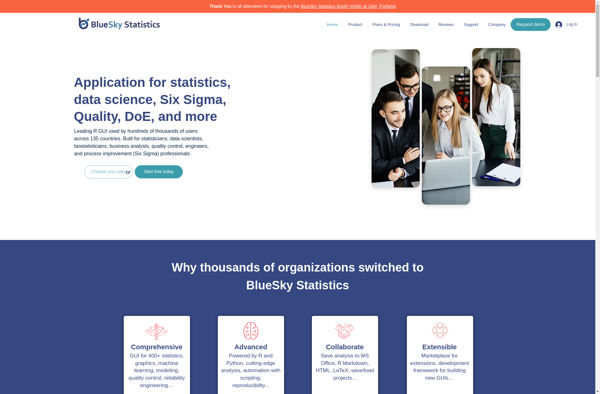
BlueSky Statistics is an open-source software application designed specifically for performing advanced data analysis and statistical modeling. It features a user-friendly graphical interface that allows users to easily explore, visualize, transform, and model their data without needing to know programming or statistical syntax.Some key capabilities of BlueSky Statistics include:Intuitive drag-and-drop...
Auto-sklearn is an open source machine learning library for Python that aims to make finding a good machine learning model as easy as possible. It builds on top of the popular scikit-learn library and automates the tedious tasks of hyperparameter tuning and model selection.Auto-sklearn uses Bayesian optimization to intelligently search...
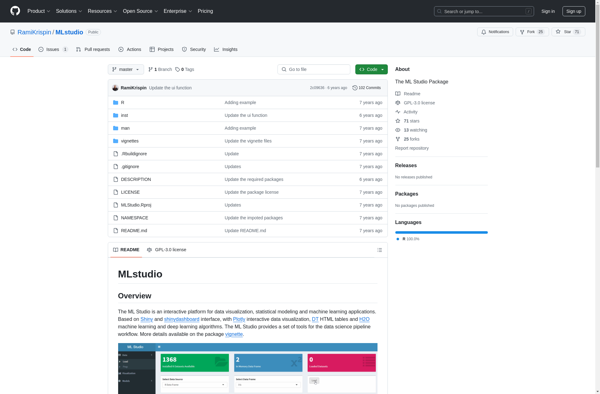
R MLstudio is an integrated development environment designed specifically for machine learning tasks in R. It provides a streamlined workflow that guides users through the end-to-end machine learning pipeline.Key features of R MLstudio include:Code editor with syntax highlighting, autocomplete, and other productivity enhancements for working with R codeData viewer for...
Neural Designer is a software that enables development, simulation, and deployment of neural networks models for creating intelligent systems. It uses deep learning algorithms and techniques for fast creating accurate predictive models from large amounts of data. Key capabilities and features:Intuitive visual interface to design neural networks with drag-and-drop using...
AdvancedMiner is a comprehensive Bitcoin and cryptocurrency mining software that supports ASIC, GPU, and CPU mining. It provides a simplified graphical user interface, allowing miners of all levels to easily configure optimal settings for their particular mining hardware and chosen mining pools to maximize profitability.Some key features of AdvancedMiner include:...
ML.NET is an open-source and cross-platform machine learning framework by Microsoft that allows .NET developers to develop and integrate custom machine learning models into their .NET applications using C# or F#. It supports a variety of machine learning tasks like classification, regression, clustering, anomaly detection, image classification, text analytics, recommendation...
R mlr is an R package that provides a unified interface for classification, regression, survival analysis and clustering. It features:Automated machine learning with hyperparameter tuning using various search strategies like grid search, random search, Bayesian optimization etc.Support for over 60 learners from regression, classification, survival analysis, cluster analysis etc.Flexible feature...
Prevision.io is a business intelligence and data visualization platform designed to help companies make data-driven decisions. It allows users to connect multiple data sources, clean and transform data, and create interactive dashboards and reports to gain valuable insights.Some key features of Prevision.io include:Data connectivity - Connect to databases, cloud apps,...
Actian is a database management and data integration software company that provides products to help organizations manage and analyze large volumes of varied data across hybrid cloud environments. Some key aspects of Actian's solutions include:Hybrid cloud data warehouse capabilities that allow businesses to access analytics from both on-premises and cloud-based...
Skyl.ai is an artificial intelligence-powered sales enablement platform designed to help sales teams have more effective customer conversations and close more deals. The software uses advanced NLP and machine learning to analyze sales calls in real-time and provide reps with contextual guidance, suggested talking points, and feedback to improve their...
Terrene is an innovative design collaboration platform built for modern product teams to simplify the complex design and development workflow. It allows teams to easily create, view, share, and collaborate on photorealistic 3D models from any device from any location.Some key features and benefits of Terrene include:Intuitive creation - Anyone...