The Fugu Modelling System is a 3D architectural design and BIM modeling software. It features tools for architectural design, MEP, structure, construction documentation, rendering, VR/AR, and collaboration.
Fugu Modelling System: 3D Architectural Design and BIM Modeling Software
The Fugu Modelling System is a 3D architectural design and BIM modeling software. It features tools for architectural design, MEP, structure, construction documentation, rendering, VR/AR, and collaboration.
What is Fugu Modelling System?
The Fugu Modelling System is a feature-rich 3D architectural design and building information modeling (BIM) software. It provides a wide range of tools for architectural design, MEP engineering, structural design, construction documentation, photorealistic rendering, VR/AR model visualization, and multi-discipline collaboration.
Key features include:
Intuitive modeling tools for rapid massing, architectural design, and detailing
Comprehensive MEP modeling and clash detection tools
Structural analysis integration with leading structural engineering software
Automated creation of construction documents like floor plans, sections, elevations, schedules, etc.
State-of-the-art rendering engine for photorealistic imagery and walkthroughs
Support for VR headsets and AR for immersive model interaction
Cloud-based Common Data Environment (CDE) for seamless multi-discipline and multi-site collaboration
The Fugu Modelling System allows architecture, engineering, and construction firms to create coordinated BIM models and high-quality deliverables for all project phases. With its full feature set and intuitive workflow, it can maximize productivity and minimize errors throughout the building design, documentation, and construction process.
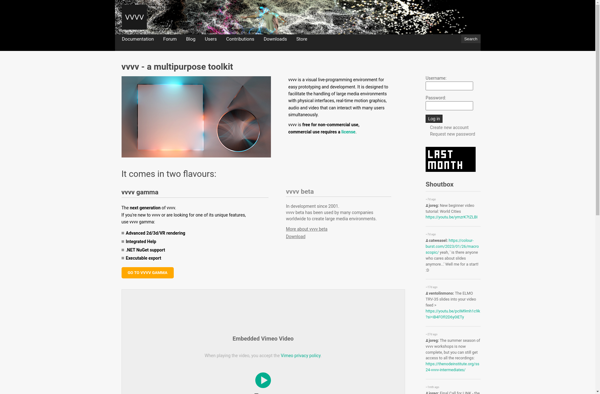
Vvvv is a flexible and versatile programming environment focused on real-time interactive media, installations, and performances. It uses a dataflow based visual programming language that allows users to connect modules for processing video, audio, graphics, and other types of data flows.Some key features of Vvvv include:Real-time video processing and effects3D...
Processing is an open-source computer programming language and integrated development environment (IDE) built for the electronic arts, new media art, and visual design communities with the purpose of teaching non-programmers the fundamentals of computer programming in a visual context.Processing uses a simplified syntax based on the Java language, but uses...
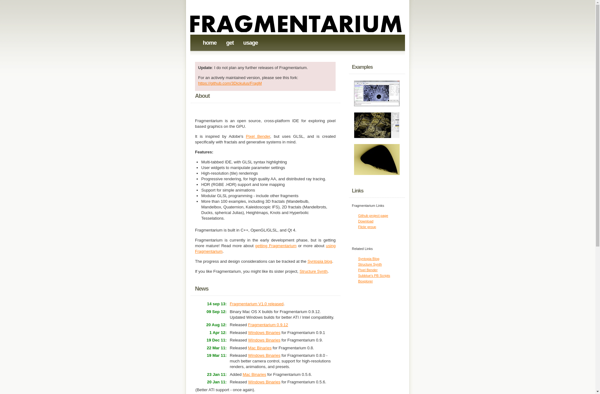
Fragmentarium is an open web-based platform developed for the study and publication of medieval manuscript fragments. Its purpose is to virtually reconstruct dismembered manuscripts by digitally reconnecting leaves, cuttings, and fragments that are physically divided between different holdings and collections.Features of Fragmentarium include:An image database where high quality images of...
Cinder is an open-source block storage platform designed to provide persistent block storage for OpenStack cloud computing environments. As a core OpenStack project, Cinder integrates with OpenStack compute and networking services to provide expanded storage capabilities for virtual machines running in an OpenStack deployment.Some key capabilities and features of Cinder...
NodeBox is an open-source application used to create generative design, data visualizations, animations and other 2D graphics using Python scripting. It allows designers, artists and programmers to quickly generate visual content through code rather than manual work.Some key features of NodeBox include:An intuitive node-based interface to create graphics by connecting...
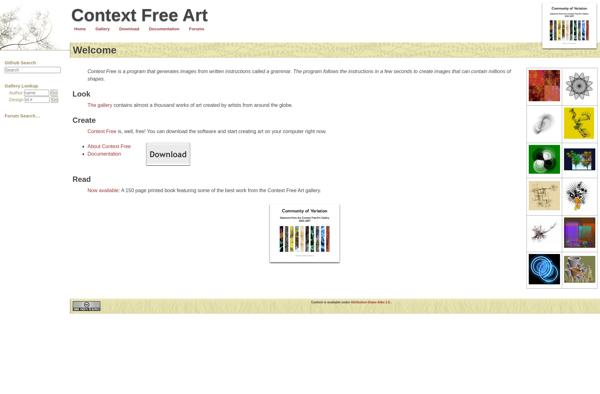
Context Free is a Windows and macOS application used to create recursive geometric images. It provides an accessible way for artists, designers, math enthusiasts, and programmers to create complex digital art based on geometric shapes and preset transformations.The program has an intuitive drag-and-drop interface that allows users to define rules...
Prismacode is a visual programming language that aims to make computer programming easier and fun to learn. It uses a graphical, puzzle-like interface and colorful visual blocks to represent code so beginners can learn without struggling with complex programming syntax.Prismacode covers the basics of computer programming such as variables, functions,...
Generativepy is an open-source Python library that allows developers and researchers to easily build and train generative machine learning models. It provides implementations of popular architectures like generative adversarial networks (GANs), variational autoencoders (VAEs), and autoregressive models.Some key features of Generativepy include:Intuitive model APIs - Quickly build models by combining...