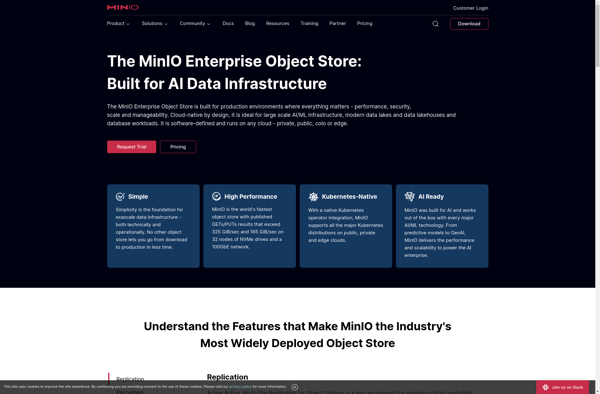
MinIO is an open source object storage server with Amazon S3 compatible API. It is lightweight, high-performance, and suitable for storing unstructured data such as photos, videos, log files, backups, and container images.
MinIO: Open Source Object Storage Server with Amazon S3 Compatible API
MinIO is an open source object storage server with Amazon S3 compatible API. It is lightweight, high-performance, and suitable for storing unstructured data such as photos, videos, log files, backups, and container images.
What is MinIO?
MinIO is an open source object storage server released under Apache License v2.0. It is compatible with Amazon S3 cloud storage service API, thus making it easy to migrate to from AWS S3.
MinIO is a lightweight, high-performance object storage system. Unlike other distributed storage systems, MinIO doesn't have a separate metadata layer. It treats both data and metadata equally thereby avoiding performance overhead of managing metadata separately.
MinIO has a simple design and works well across geographically distributed multi-tenant environments including containers and bare metal servers. It provides data protection capabilities like erasure coding and bitrot protection that handle silent data corruption.
Some key use cases of MinIO include:
Public and private cloud storage
VOD and media workflow
Machine learning and analytics pipelines
Edge caching and IoT
Backup and disaster recovery
MinIO is suitable for storing unstructured data such as photos, videos, log files, backups, and container images. It provides scalability, reliability and ease of operations at low cost.
MinIO Features
Features
Amazon S3 compatible API
High performance object storage
Lightweight and suitable for storing unstructured data
Open source software
Built-in encryption
Erasure coding for data protection
Multi-tenant access with role-based access control
Scalable distributed architecture
Pricing
Open Source
Free Trial
Pros
Easy to set up and use
Low resource usage
Cost effective compared to other object storage solutions
Ceph is an open source, software-defined storage platform designed for scalability, reliability, and cost-effectiveness. Here are some key things to know about Ceph:Provides block, object, and file storage in one unified system - Ceph supports traditional block device storage as well as object storage and scale-out file storage, allowing one...
Azure Blob Storage is a Microsoft cloud storage service optimized for storing massive amounts of unstructured data. Blob storage is designed for scalability, durability, and high availability.Key features of Azure Blob Storage include:Store anything from text to binary data, video, audio, images, documents in the cloudData is replicated for high...
StorPool is a software-defined block storage platform optimized for storage performance, efficiency, and high availability. It is designed to deliver predictable low latency, high IOPS, and increased storage efficiency for demanding workloads.StorPool uses a distributed architecture and runs on standard hardware, eliminating proprietary hardware lock-in. It utilizes advanced data placement...
SeaweedFS is an open-source, distributed file system designed for storing and serving billions of large files fast and efficiently. It spreads files over many servers, allowing for automatic scaling and parallel streaming of data.Some key features and benefits of SeaweedFS include:Automatic scaling - new servers can be added easily to...
ScaleIO is an enterprise-grade software-defined storage platform developed by Dell EMC. It provides highly scalable and flexible storage management by abstracting storage resources into unified pools that can scale capacity and performance on demand.Some key capabilities and benefits of ScaleIO include:Creates a virtualized storage pool from existing local or attached...
Artefactual AtoM is an open source web-based application for standards-based archival description and access. It allows archivists, librarians, and researchers to publish and share archival descriptions of physical and digital objects, making collections accessible online.Key features of AtoM include:Browser-based access, allowing users to contribute descriptions and content from anywhereSupport for...