mountall is a utility in Linux that handles the mounting of filesystems during system startup. It mounts all filesystems automatically based on the /etc/fstab configuration file.
Mountall is a utility in Linux that handles the mounting of filesystems during system startup. It mounts all filesystems automatically based on the /etc/fstab configuration file.
What is Mountall?
mountall is a utility program that is part of the Ubuntu, Debian, and other Linux distributions. It is responsible for mounting all filesystems automatically during system startup based on the configuration file /etc/fstab.
On system boot, mountall reads the /etc/fstab file to determine which filesystems need to be mounted. It will mount all the filesystems in parallel to speed up the boot process. mountall also cleanly unmounts filesystems on shutdown.
Some key features of mountall:
Mounts filesystems parallelly during startup to improve boot speed
Properly unmounts filesystems during shutdown
Uses /etc/fstab configuration to determine filesystem mount points
Able to mount network filesystems and handle failures/retries if the network is not ready
Integrates with init system like systemd to receive boot events
Overall, mountall handles the key task of managing filesystem mounts during startup and shutdown on Linux systems. It is reliable and speeds up boot by mounting filesystems in parallel.
Mountall Features
Features
Mounts filesystems automatically at boot time based on /etc/fstab
Parallelizes mounting filesystems to improve boot speed
Handles dependencies between mountpoints
Provides mount event notifications over D-Bus
Pricing
Open Source
Pros
Simplifies filesystem mounting during boot
Speeds up boot process by mounting filesystems in parallel
usbmount is a small and lightweight utility program for Linux operating systems that handles the mounting of USB mass storage devices automatically. When a USB drive, SD card, or other storage device is connected to the computer via USB port, usbmount will mount it and make it available for access...
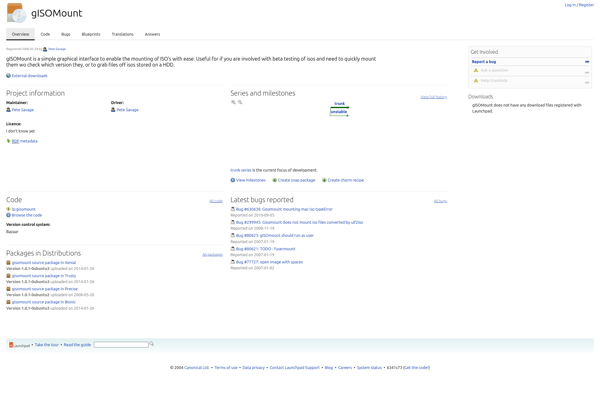
gISOmount is an open-source graphical user interface software application used for mounting and unmounting disk image files in Linux operating systems. It provides an easy way to virtually insert and access the contents of disk image files such as ISO, BIN, NRG, and various other formats.Some key features of gISOmount...
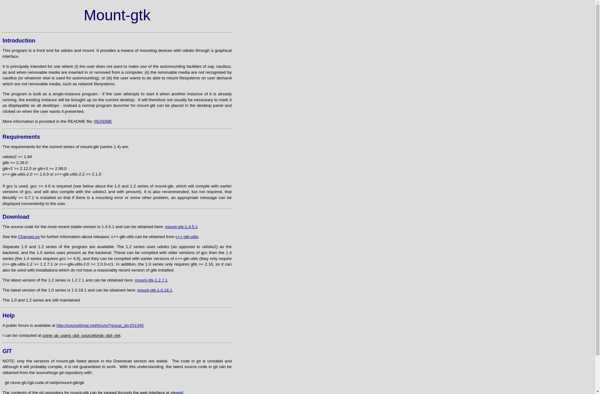
mount-gtk is a graphical tool for mounting and unmounting drives and partitions on Linux systems. It provides a user-friendly interface to the underlying udisks service, allowing you to easily mount and access removable media and disk partitions without using the command line.Some key features of mount-gtk include:Simple interface for mounting/unmounting...
mountpy is an open-source Python library focused on analyzing microscopy images. It provides a range of tools for common tasks in biological image processing:Reading and writing common microscopy image formats like TIFF, PNG, and OME-TIFFVisualizing images and segmentation resultsSegmenting images using thresholding, watershedding, active contours, and moreRegistering images using phase...
Pmount is a lightweight, command-line program that allows Linux users to easily mount and unmount removable storage devices such as USB drives, SD cards, smartphones, MP3 players, tablets, digital cameras, and more. It provides a simple interface to the pmount kernel functionality.When a removable device like a USB drive is...
udevil is a lightweight command line program for Linux operating systems that enables easy mounting and unmounting of external storage devices without requiring admin privileges or passwords. It works by wrapping common Linux utilities like mount, umount, and lsblk to provide a simpler and more user-friendly interface.Some key features of...