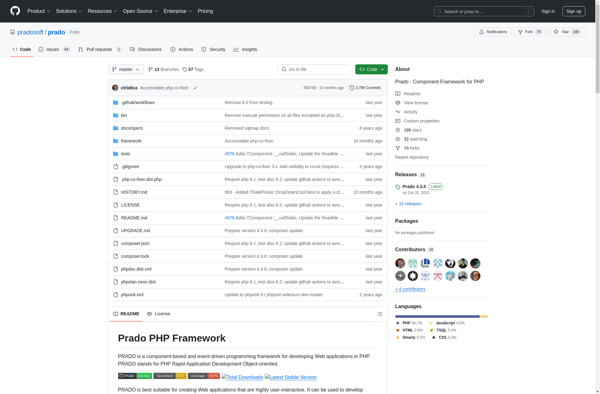
PRADO is an open source, object-oriented PHP framework for developing web applications. It promotes code reusability and speeds up development time using pre-built components.
What is PRADO?
PRADO is an open source PHP framework designed to streamline and accelerate web application development. It provides a rich set of reusable components and tools that handle common web development tasks like database access, authentication, templating, and more.
Key features of PRADO include:
MVC architecture - separates business logic from presentation
ORM - object-relational mapping to PHP classes
Components - pre-built tools for grids, forms, validation, etc.
Modularity - use only the components your app needs
Template engine - templatize the UI presentation layer
AJAX support - built in partial page updates
Theming - customize look and feel consistently
Localization - support for i18n and l10n
Access control system - manage users and permissions
By using PRADO's extensive class libraries and reusable components, developers can build feature-rich PHP apps rapidly without reinventing the wheel. The modular architecture allows focusing effort on the app-specific logic instead of infrastructure.
PRADO Features
Features
Model-View-Controller architecture
Built-in components for common functionality
Database abstraction layer
Form validation and processing
Localization and internationalization
Caching
Web services
Security features like access control, CSRF protection
Zend Framework is an open source, object-oriented web application framework implemented in PHP 7 and licensed under the New BSD License. It utilizes the model-view-controller (MVC) architecture and modular code to facilitate rapid application development and excellent performance.Some key features and benefits of Zend Framework include:Simple and streamlined object-oriented code...
Symfony is an open-source web application framework written in PHP for developing complex and enterprise-grade web applications. It utilizes and extends several existing PHP libraries to provide modular and reusable components for building modern web applications.Some key features of Symfony include:Routing system for mapping URLs to controllersTemplating engine (Twig) to...
The Yii Framework is an open source, object-oriented, model-view-controller (MVC) PHP web application framework. Since its initial release in 2008, Yii has gained a large following due to its efficient code structure, extensive documentation, and rich feature set.Some key advantages of using Yii include:Rapid application development through built-in code generation...
CakePHP is an open source web application framework written in PHP that follows the model–view–controller approach. It aims to make building web applications simpler and faster. Some key features of CakePHP include:Lightweight, extensible architecture based on the MVC patternBuilt-in libraries for commonly used tasks like database access, form validation, authentication,...
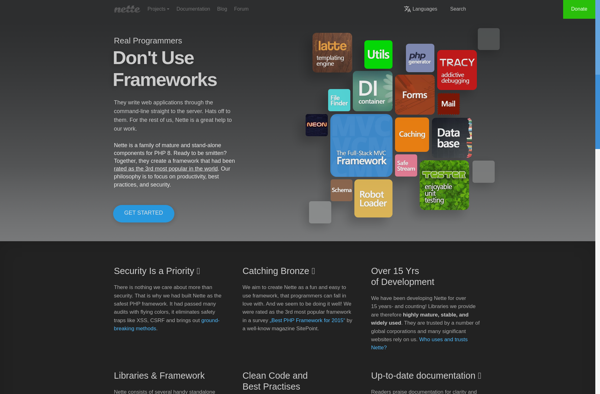
The Nette Framework is an open-source PHP web framework designed to simplify and accelerate web development. Some key features and characteristics of Nette include:Emphasis on speed and performance through caching and other optimizationsObject-oriented codebase supporting clean, reusable codeBuilt-in tools for security, validation, testing, debugging and moreEasy to learn and use,...
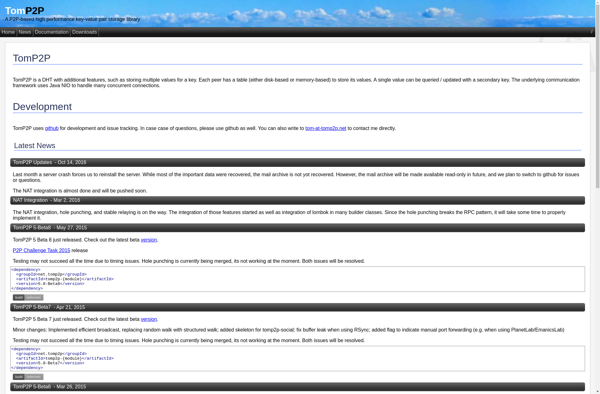
TomP2P is an open-source peer-to-peer (P2P) distributed hash table (DHT) designed for decentralized data storage, search, and messaging. Unlike centralized client-server models, TomP2P allows a network of peer nodes to self-organize and route data between each other without the need for a central server.Some key features of TomP2P include:Decentralized data...
Akelos is an open-source web application framework designed for building web applications and services on the .NET platform. It provides a Model-View-Controller (MVC) architecture that separates application logic from the user interface.Some key features of Akelos include:Automatic CRUD (Create, Read, Update, Delete) functionality for databases.Support for AJAX requests and JSON...