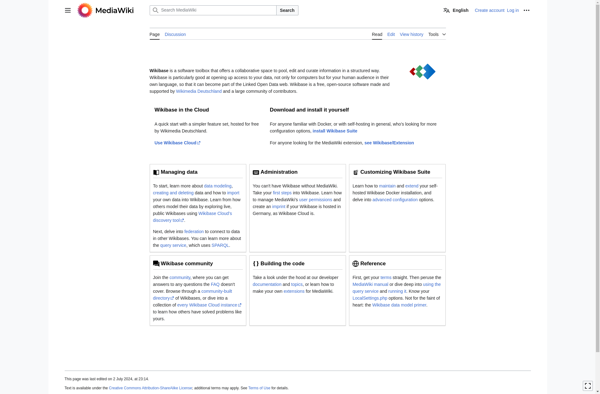
Wikibase is a free and open-source software developed by the Wikimedia Foundation to power Wikidata. It provides a collaborative knowledge base that supports structured data and linked data principles.
Wikibase: Free Open-Source Knowledge Base Software
A free and open-source software developed by the Wikimedia Foundation, Wikibase powers Wikidata with a collaborative knowledge base supporting structured data and linked data principles.
What is Wikibase?
Wikibase is a free and open-source software developed by the Wikimedia Foundation to power its Wikidata project. It provides the technical infrastructure and features for Wikidata, which is a collaboratively edited multilingual knowledge base that aggregates structured data from various sources.
Some key features of Wikibase include:
Support for multilingual data through interlanguage links
Structured data storage using Wikibase data model with items, properties, qualifiers and references
Querying capabilities using Wikibase query service and SPARQL
Interfaces for editing, importing, exporting data
APIs and RDF dumps to access the knowledge base
Extensive rights management and permissions model
History tracking including version control and updates monitoring
Technically, Wikibase consists of multiple software components written in PHP and JavaScript, built on top of MediaWiki. It incorporates concepts from semantic web technologies like RDF and OWL to represent entities and relationships between them linked across languages.
As open-source software under the GPL license, Wikibase can be customized and deployed for knowledge management applications by organizations and companies.
Wikibase Features
Features
Stores data in a graph database
Provides a query service and APIs for reading and modifying data
Supports multilingual data through interlanguage links
Has an extensible data model using properties and items
Allows defining schema constraints
Tracks provenance and sources for data
Has built-in support for RDF and SPARQL
Pricing
Open Source
Pros
Powerful and flexible data modeling capabilities
Scales to large knowledge bases
Integrates well with other systems through APIs and linked data
Collaborative editing model with change tracking
Free and open source software
Cons
Complex software with a learning curve
Limited tools and GUI for casual users
Requires expertise to fully utilize advanced features
Not as widely adopted as some other knowledge base platforms
Neo4j is an open-source NoSQL graph database implemented in Java and Scala. Unlike traditional relational databases, Neo4j stores data structured as graphs consisting of nodes, edges, and properties that connect those node entities.At its core, Neo4j leverages graph structures rather than tables to represent and store data. This allows the...
NetworkX is an open-source Python package for creating, manipulating, and studying the structure, dynamics, and functions of complex networks. It enables users to represent many types of networks and analyze their properties and behavior. Some key features of NetworkX:Represents many real-world network types like social networks, biological networks, infrastructure networks,...
TerminusDB is an open-source graph database optimized for collaboratively building interconnected knowledge graphs. It provides a flexible data modeling framework to capture the rich complexity of real-world systems and relationships.Key features of TerminusDB include:Collaborative knowledge graph construction enabling teams to build, extend, and refine shared data models over timeSupport for...
RedisGraph is an open-source graph database developed by Redis Labs and built on top of Redis. It allows storing property graphs in Redis by extending it with custom data structures and commands optimized for graph operations.Key features of RedisGraph include:Native graph storage - Stores nodes and relationships as first-class citizens...
LemonGraph is an open-source, schema-free graph database optimized for complex network analysis and AI projects. It provides high performance for traversing and querying highly connected graph data through its native graph storage and query engine.Key features of LemonGraph include:Schema-free data model that allows flexible property graphsNative graph storage for faster...
Trinity Graph Engine is an open-source, distributed graph database purpose-built for machine learning and deep learning workloads. It allows storing massive-scale graph structured data and running high-performance graph algorithms at scale.Key capabilities and benefits of Trinity Graph Engine include:Distributed architecture for scalability and high availabilityNative support for common graph operations...
Structr is an open-source content management system and application framework that makes it easy to build web and cloud applications without coding. It is built with Java on the backend and JavaScript on the frontend using modern web technologies.Key features of Structr include:Intuitive drag-and-drop interface for building sites and applications...