Lynx is a text-only web browser that runs in a terminal. It was one of the first web browsers created and allows users to browse the web from the command line. As a text-only browser, Lynx does not render images or HTML formatting.
Text-only web browser that runs in a terminal, allowing users to browse the web from the command line, without image rendering or HTML formatting.
What is Lynx?
Lynx is a text-only web browser that was first released in 1992 by a group of students at the University of Kansas. Unlike graphical browsers like Chrome or Firefox, Lynx does not render images, videos, or web page formatting. Instead, it displays web page content as plain text in a terminal or command prompt window.
As one of the earliest web browsers, Lynx pioneered many innovations of early browsers like supporting hypertext links between web pages. Its text-only nature allows it to run in terminal sessions and on systems with limited bandwidth or graphical capability like old hardware or embedded devices.
Some key features of Lynx include:
Lightweight text-only browsing that works over low bandwidth connections
Keyboard shortcuts for navigation and browser actions
Support for browsing online help, FTP sites, news feeds and other early online content
Options for saving or printing formatted content pages
Extensibility through an early browser extension system
As the web has advanced to focus heavily on multimedia content, Lynx has decreased in popularity among mainstream users but still fills an important niche for developers, system administrators, visually impaired users, and those interacting with simpler online content.
ELinks is an open-source, text-based web browser designed for use in terminals and text-only environments. Originally forked from the Links browser in 2002, ELinks focuses on providing a feature-rich browsing experience even without a graphical interface.Key features of ELinks include:Tabbed browsing, allowing multiple pages open at onceCompletely keyboard-driven interface with...
W3M is a free and open-source text-based web browser and terminal pager. It was originally developed in Japan and allows users to browse web pages from the Linux command line or terminal. Some key features of W3M include:Support for HTML tables, frames, HTTPS encryption, colors, bold text, and other formattingBuilt-in...
Dillo is an open-source web browser focused on being small, fast, and lightweight. Originally developed in 1999, it aims to provide good browsing performance even on older hardware or systems with limited resources.Some key features of Dillo include:Very small memory and disk space requirements compared to other browsersUses the fast...
Browsh is a terminal-based web browser that displays websites in text format. It renders web pages into text and ASCII art forms, allowing users to browse graphical sites from the command line interface without a graphical display.Some key features and benefits of Browsh include:Runs entirely in the terminal - No...
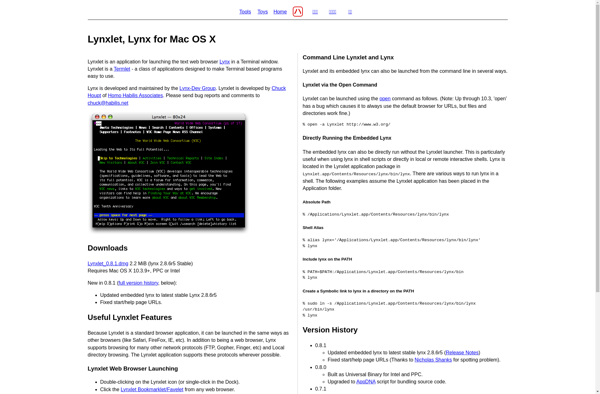
Lynxlet is a text-based web browser that focuses on speed and simplicity. As one of the earliest web browsers, Lynxlet was created in 1992 to allow users to browse the emerging World Wide Web even over low-bandwidth connections.Unlike graphical browsers, Lynxlet does not render images, video, or other multimedia content....
Arachne is an open-source web crawler framework developed by Internet Archive in 2018. It is designed specifically for building high-performance and scalable web crawlers that can efficiently download web pages and detect changes across periodic crawls.Some key features and capabilities of Arachne include:Built on Scala and Apache Spark to enable...
Surfraw is a command line interface for searching the web from the Unix/Linux terminal or shell. It serves as an interface to various search tools and information sources, providing fast access without needing to open a web browser.Some key features and information about Surfraw:Lets you search popular sites like Google,...