Meson is an open-source build system focused on speed and ease of use. It is designed to optimize the build process by detecting changes in projects faster and providing useful error messages. Meson supports many languages and build tools.
Meson: Open-Source Build System for Speed and Ease
Meson is an open-source build system focused on speed and ease of use, detecting changes in projects faster and providing useful error messages, supporting many languages and build tools.
What is Meson?
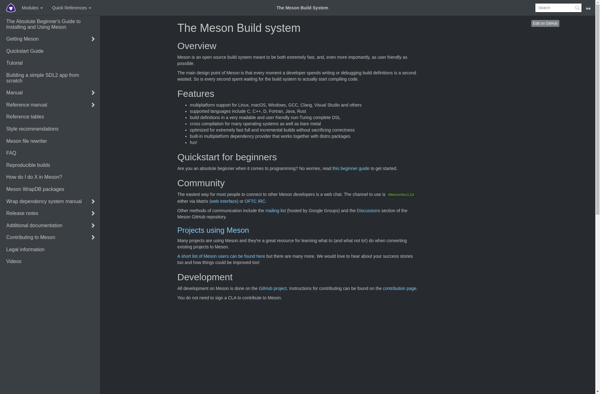
Meson is an open-source build system designed to be extremely fast and easy to use. It aims to improve upon existing build systems like Autotools and CMake by providing better defaults, intuitive syntax, and useful error messages that help developers debug issues faster.
Some key highlights of Meson include:
Very fast build times by only recompiling what is needed
Support for many languages like C, C++, Fortran, Java, Rust, and more
Integration with build tools like Ninja, Visual Studio, and Xcode
Easy to read configuration files written in an INI-like format
Cross-platform with support for Linux, macOS, and Windows
Dependency management through subprojects and wrap files
Customizable through templates, arguments, substitutions, and overrides
Meson aims to make the build process seamless so developers can focus on coding rather than debugging tricky build issues. Its speed, simplicity, and platform support have quickly made it a popular choice for many open-source projects.
Meson Features
Features
Fast build times
Intuitive syntax
Cross-platform support
Integration with popular build tools and languages
Dependency management
Support for tests and benchmarks
Customizable build configuration
Pricing
Open Source
Pros
Very fast compared to other build systems
Simple configuration using Python DSL
Easy to use and learn
Detects changes quickly to avoid unnecessary rebuilds
Good error messages
Lightweight with few dependencies
Cons
Limited adoption outside C/C++ projects
Less flexibility than some other build tools
Lacks some advanced features of tools like CMake
Less third-party integration compared to older systems
CMake is an open-source, cross-platform tool designed to build, test, and package software. It works by generating native makefiles and workspaces that can be used in the compiler environment of your choice.Some key features and benefits of CMake include:Compiler-independent build processes - CMake abstracts away compiler differences and allows you...
GNU Make is a build automation and compilation management tool that was created in 1976 and is now maintained by the GNU Project. It automates the process of building executable programs and libraries from source code using a file called a Makefile which specifies how the project is compiled.Makefiles contain...
Maven is a software project management and build automation tool used primarily for Java projects. It handles dependencies, builds, tests, reporting, and packaging for Java code in an automated fashion.Some key features of Maven include:Dependency Management - Maven downloads Java libraries and dependencies your project needs so you don't have...
Gradle is an open-source build automation tool focused on flexibility and performance. It builds upon the features of Apache Ant and Apache Maven, while providing a more flexible way to declare build logic through a Groovy-based domain-specific language (DSL), avoiding XML configuration.Some key features and advantages of Gradle include:Build scripts...
Bazel is an open-source build and test automation tool maintained by Google. It is designed for building large-scale, multi-language software projects efficiently and quickly by only rebuilding what needs to be changed after code changes.Some key features of Bazel include:Incremental builds - Bazel tracks code dependencies and builds only what...
Autoconf is an extensible package of M4 macros that produce shell scripts to automatically configure software source code packages. It was created in 1994 to simplify the compilation of GNU software on a variety of Unix and Unix-like systems.Autoconf generates a configuration script for a package from template files that...
Buildr is an open-source software build system and project automation tool. It is written in Ruby and is designed for building Java, C/C++, Ruby, Scala and other language projects with ease. Some key features of Buildr include:Handles compilation, packaging, testing, and deployment of software projectsCross-platform - works on Linux, macOS,...
Automake is a software development tool that assists in creating and maintaining portable Makefiles for projects that use Autoconf. It enforces the GNU coding standards for Makefiles and simplifies the process of creating standards-compliant Makefiles for complex software projects.Some key features of Automake include:Automatic generation of Makefile.am files from Automake...
Reggae is an open-source build system and task automation tool for Web development projects. It is written in JavaScript and runs on Node.js.Reggae aims to provide a simple, flexible, and easy-to-use build system that is optimized for performance. Some of the key features and benefits of Reggae include:Fast build times...
Jerkar is an open-source motion graphics and visual effects software. It can be used as an alternative to commercial products like Adobe After Effects.Some key features of Jerkar include:A node-based compositor that allows you to build complex effects by chaining together different nodesKeyframing and animation tools for creating motion graphicsSupport...
BuildAMation is an open-source build automation and devops platform designed to help developers automate their software build, test, and release pipelines. It provides a wide range of capabilities for continuous integration, delivery, and deployment.Key features of BuildAMation include:Declarative pipeline definitions using YAML for build, test, package, and deployment stepsBuilt-in support...