Protocol Buffers

Protocol Buffers

Protocol Buffers (Protobuf) is an open source serialization format developed by Google for serializing structured data. It is useful for communication protocols, data storage, and more. Protobuf is language-neutral, platform-neutral, extensible and a popular alternative to JSON a
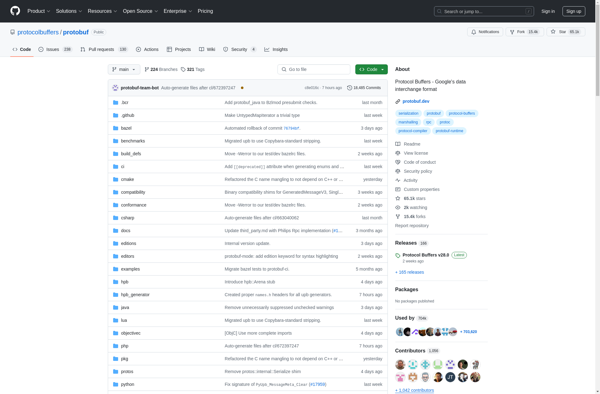
Protocol Buffers screenshot

Protocol Buffers (Protobuf)

Protocol Buffers (Protobuf) is an open source serialization format developed by Google for serializing structured data. It is useful for communication protocols, data storage, and more. Protobuf is language-neutral, platform-neutral, extensible and a popular alternative to JSON and XML.

What is Protocol Buffers?

Protocol Buffers (Protobuf) is an open source serialization format developed by Google for serializing structured data. It is useful for communication protocols, data storage, and more. Key features of Protobuf include:

  • Language-neutral and platform-neutral - Protobuf supports multiple languages like Java, C++, Python, Go, JavaScript, and more
  • Space-efficient - Serialized data is in binary format which takes up less space than text-based formats like JSON and XML
  • Extensible - New fields can be added to Protobuf messages without breaking backwards-compatibility
  • Fast to parse and process - The binary format provides better performance than JSON and XML
  • Built-in support for schema evolution
  • Supports optional and required fields
  • Integrates well with code generation to create language bindings

Protobuf is used extensively by Google internally and has been open sourced since 2008. Many open source projects and companies use Protobuf for their data storage and service communication needs. It is a popular alternative to formats like JSON and XML as it provides better performance and smaller payload sizes.

Protocol Buffers Features

Features

  1. Language-neutral interface description language
  2. Efficient serialization of structured data
  3. Support for multiple programming languages
  4. Backwards and forwards compatibility
  5. Code generation for multiple languages
  6. Smaller and faster than XML and JSON

Pricing

  • Open Source

Pros

Compact, efficient serialization

Faster than XML and JSON

Language-neutral interface descriptions

Backwards and forwards compatible

Wide language support

Cons

Limited adoption outside of Google

Steeper learning curve than JSON or XML

Lack of human-readability

Versioning can be complex

Limited tooling compared to XML/JSON

Reviews & Ratings

Login to Review
No reviews yet

Be the first to share your experience with Protocol Buffers!

Login to Review

The Best Protocol Buffers Alternatives

Top Development and Data Serialization and other similar apps like Protocol Buffers

Here are some alternatives to Protocol Buffers:

Suggest an alternative ❐

TOML icon
TOML

TOML (Tom's Obvious, Minimal Language) is a configuration file format that is designed to be minimal, easy to read, and map unambiguously to a dictionary. Some key features of TOML include:It uses key/value pairs for configuration dataSupports data types like strings, integers, floats, booleans, datetimes, arrays and nested tablesHas a...
TOML image
Avro icon

Avro

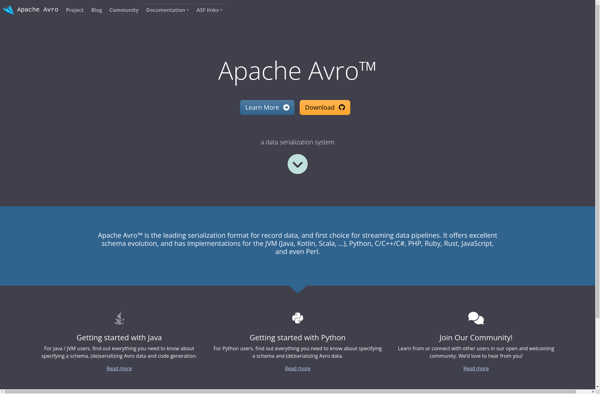
Avro is an open source data serialization system developed within Apache's Hadoop project. It uses JSON for defining data types and protocols, and serializes data in a compact binary format.Some key features of Avro include:Dynamic typing - no need to code up and compile data types ahead of timeUntagged data...
Avro image
Apache Thrift icon

Apache Thrift

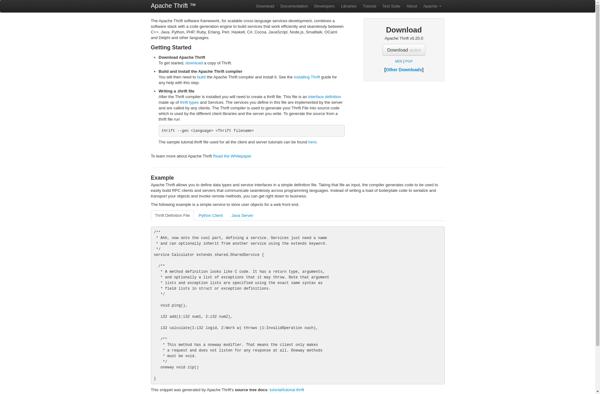
Apache Thrift is an open source software framework for scalable cross-language services development. It combines an interface definition language (IDL) with a code generation engine to build services that work across a variety of programming languages.Some key features and benefits of Apache Thrift include:Language and platform neutral - services built...
Apache Thrift image
MessagePack icon

MessagePack

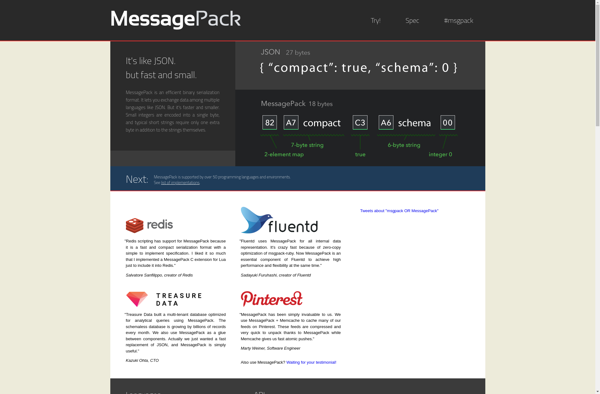
MessagePack is an efficient binary serialization format that allows exchanging data between applications and storing structured data in a compact way. Some key features of MessagePack include:Compact size - MessagePack serialized data is much smaller than JSONFast decoding/encoding - MessagePack performs serialization/deserialization significantly faster than JSONLanguage support - Libraries available...
MessagePack image