PTC Integrity is a software lifecycle management and application lifecycle management tool from PTC. It helps manage software configurations, requirements, quality, release, and change processes across the application lifecycle.
Manage software configurations, requirements, quality, release, and change processes with PTC Integrity, a comprehensive application lifecycle management tool from PTC.
What is PTC Integrity?
PTC Integrity is an end-to-end application lifecycle management (ALM) solution that enables software and systems engineering teams to implement, manage, measure, and analyze their software development processes. Key features include:
Requirements management - Capture, link, trace, measure, and track requirements
Configuration management - Manage changes, releases, baselines of code, documents
Process management - Customizable workflows for agile and waterfall processes
Change and release management - Request, review, approve/reject changes
Analytics and reporting - Visualize progress, identify issues, improve processes
Integration with other tools - Integrates with popular DevOps tools for a complete ALM solution
PTC Integrity helps development teams improve software quality, accelerate time-to-market, drive customer satisfaction, ensure compliance, and reduce development costs across the entire software development lifecycle. It is available both as an on-premise server or cloud-based SaaS solution.
PTC Integrity Features
Features
Lifecycle management for software development
Requirements management
Configuration management
Quality management
Release management
Change management
Traceability and impact analysis
Collaboration and workflow management
Reporting and analytics
Pricing
Subscription-Based
Pros
Comprehensive suite of ALM and SLCM capabilities
Supports multiple development methodologies (Agile, Waterfall, Hybrid)
Integrates with various development tools and platforms
Robust reporting and analytics features
Customizable workflows and processes
Cons
Can be complex to set up and configure for larger organizations
Steep learning curve for users
Pricing can be expensive, especially for larger teams or enterprises
IBM DOORS Next is a requirements management software that provides teams with a centralized platform to capture, trace, analyze, and manage changes to product information throughout the development lifecycle. Key features and benefits of DOORS Next include:Collaborative requirements management allowing multiple stakeholders to edit requirements simultaneouslyTraceability to link requirements, tests,...
Doorstop is an open source, cross-platform requirements management tool for software development teams. It takes a document-based approach, allowing requirements to be defined and tracked using text documents rather than a database.Some key features of Doorstop include:Traceability and coverage - Links allow requirements tracing among documents. Verification confirms and tracks...
rmtoo is an open source requirements management and traceability tool written in Python. It is designed to help manage software requirements through the entire development lifecycle.Some key features of rmtoo include:Defining requirements specifications with attributes like priority, owner, description etc.Organizing requirements in a hierarchical structureTracing requirements to other artifacts like...
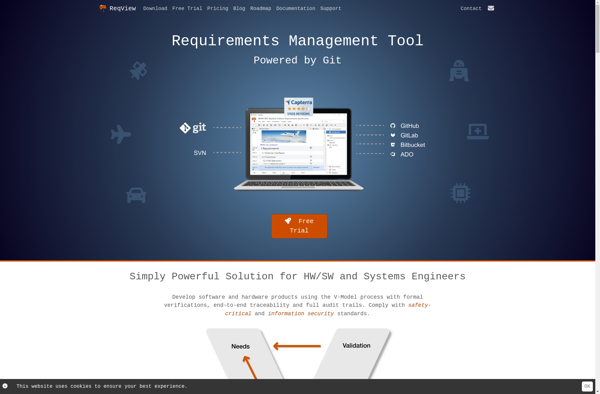
ReqView is a comprehensive requirements management solution designed to help organizations manage the entire requirements lifecycle for their software projects. It provides a central repository to capture, organize, trace, analyze, and track requirements from inception through implementation.Key features of ReqView include:Customizable forms and workflows to match each project's processTraceability matrices...
Traceable Requirement Management software provides a centralized platform to document, manage, and trace requirements from inception through implementation. Key features include:Robust requirements management with version control and change trackingTraceability matrices and visual traceability graphs to map relationships between requirements, design elements, code, and testsCustomizable workflows for requirements gathering, review/approval, change...
Requirements Quality Suite (RQS) is a comprehensive requirements management solution designed to help organizations effectively define, manage, and track requirements from initial planning through development, testing, and delivery.Key features of RQS include:Centralized requirements repository - Store all product and project requirements, user stories, business rules, etc. in one place.Requirements traceability...
Innoslate is a web-based requirements and process management software designed specifically for systems engineers and program teams to facilitate early lifecycle development. Key features of Innoslate include:Requirements management - Create, import, track, trace, and manage textual and graphical requirements throughout the development lifecycleProcess modeling - Visually map and simulate processes...