Traceable Requirement Management software helps teams manage, track, and trace requirements throughout the development process. It links requirements to test cases for improved traceability and compliance.
What is Traceable Requirement Management?
Traceable Requirement Management software provides a centralized platform to document, manage, and trace requirements from inception through implementation. Key features include:
Robust requirements management with version control and change tracking
Traceability matrices and visual traceability graphs to map relationships between requirements, design elements, code, and tests
Customizable workflows for requirements gathering, review/approval, change management
Integration with ALM tools like JIRA and version control systems
Real-time reporting and dashboards for visibility into requirement statuses and coverage
Compliance support for standards like ISO, SOX, HIPAA
By linking requirements to downstream artifacts like tests, Traceable Requirement Management gives cross-functional teams a comprehensive, up-to-date view of whether requirements are being properly implemented and verified. This improves communication, productivity, and quality across the development lifecycle.
Traceable Requirement Management Features
Features
Requirements management
Traceability matrix
Customizable workflows
Real-time collaboration
Reporting and analytics
Pricing
Subscription-Based
Pros
Improves requirements traceability
Enhances collaboration between teams
Provides audit trails and compliance reporting
Integrates with other development tools
Cons
Can be complex to set up and customize
Collaboration features may be lacking for distributed teams
IBM DOORS Next is a requirements management software that provides teams with a centralized platform to capture, trace, analyze, and manage changes to product information throughout the development lifecycle. Key features and benefits of DOORS Next include:Collaborative requirements management allowing multiple stakeholders to edit requirements simultaneouslyTraceability to link requirements, tests,...
rmtoo is an open source requirements management and traceability tool written in Python. It is designed to help manage software requirements through the entire development lifecycle.Some key features of rmtoo include:Defining requirements specifications with attributes like priority, owner, description etc.Organizing requirements in a hierarchical structureTracing requirements to other artifacts like...
PTC Integrity is an end-to-end application lifecycle management (ALM) solution that enables software and systems engineering teams to implement, manage, measure, and analyze their software development processes. Key features include:Requirements management - Capture, link, trace, measure, and track requirementsConfiguration management - Manage changes, releases, baselines of code, documentsProcess management -...
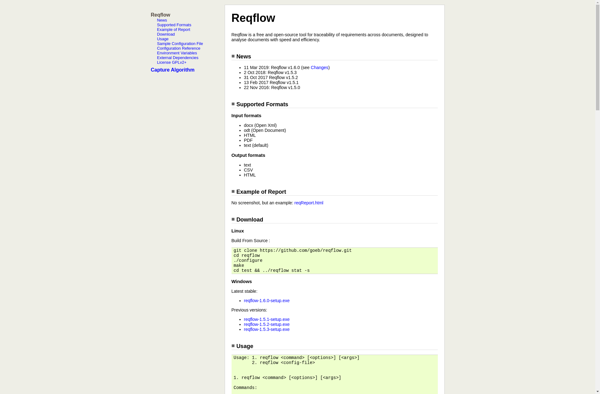
Reqflow is a comprehensive requirements management and test case management platform designed to improve collaboration and efficiency throughout the software development lifecycle. It provides the following key capabilities:Centralized requirements repository - Store all product and system requirements, user stories, acceptance criteria, wireframes, and other specifications in one place.Traceability and coverage...
Requirements Quality Suite (RQS) is a comprehensive requirements management solution designed to help organizations effectively define, manage, and track requirements from initial planning through development, testing, and delivery.Key features of RQS include:Centralized requirements repository - Store all product and project requirements, user stories, business rules, etc. in one place.Requirements traceability...
Innoslate is a web-based requirements and process management software designed specifically for systems engineers and program teams to facilitate early lifecycle development. Key features of Innoslate include:Requirements management - Create, import, track, trace, and manage textual and graphical requirements throughout the development lifecycleProcess modeling - Visually map and simulate processes...