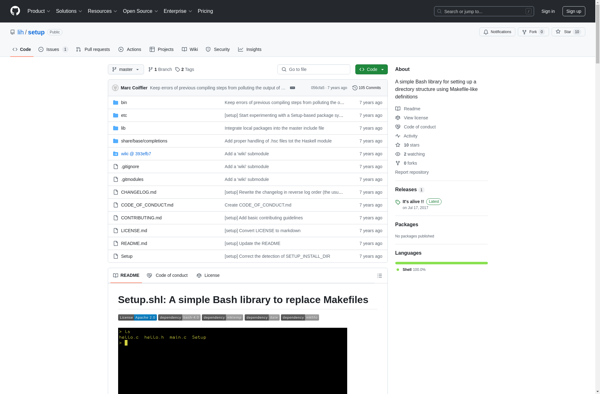
Setup.shl is a lightweight setup automation and configuration management tool for Linux and Unix systems. It allows administrators to easily define repeatable installation and configuration procedures in simple shell scripts.
Setup.shl: Lightweight Setup Automation and Configuration Management
A lightweight setup automation and configuration management tool for Linux and Unix systems, allowing administrators to define repeatable installation and configuration procedures in simple shell scripts.
What is Setup.shl?
Setup.shl is an open-source configuration management and automation tool designed specifically for Linux and Unix systems. It provides a simple framework for writing reusable, idempotent shell scripts to automate system configuration, installation, and maintenance tasks.
Key features of Setup.shl include:
Lightweight and dependency-free. Uses only native Unix shell commands and tools.
Easy to read/write configuration scripts using familiar shell scripting.
Powerful template processing for parameterization and customization.
Modular library of scripts to build up complex procedures.
Ideal for admins who prefer scripting over complex frameworks.
Some example uses cases of Setup.shl are:
Onboarding of new servers/instances to ensure consistent configuration.
Automated build of development, test, production environments.
Infrastructure-as-Code for cloud and on-prem environments.
Self-documented server build processes and requirements.
Compared to alternatives like Ansible, Chef, and Puppet, Setup.shl trades away some scale and advanced features for simplicity and transparency. It brings automation capabilities in a very lightweight package purpose-built for Linux/Unix environments.
Setup.shl Features
Features
Lightweight setup automation and configuration management
Shell scripting for defining installation and configuration procedures
Works on Linux and Unix systems
Allows repeatable and automated server provisioning
Idempotent configuration management
Agentless architecture
Pricing
Open Source
Pros
Simple and easy to use
Powerful functionality despite small footprint
Agentless so no agents to install or maintain
Great for automating repetitive tasks
Reliable and consistent server provisioning
Leverages existing shell scripting skills
Cons
Less robust than larger configuration management tools
CMake is an open-source, cross-platform tool designed to build, test, and package software. It works by generating native makefiles and workspaces that can be used in the compiler environment of your choice.Some key features and benefits of CMake include:Compiler-independent build processes - CMake abstracts away compiler differences and allows you...
GNU Make is a build automation and compilation management tool that was created in 1976 and is now maintained by the GNU Project. It automates the process of building executable programs and libraries from source code using a file called a Makefile which specifies how the project is compiled.Makefiles contain...
Maven is a software project management and build automation tool used primarily for Java projects. It handles dependencies, builds, tests, reporting, and packaging for Java code in an automated fashion.Some key features of Maven include:Dependency Management - Maven downloads Java libraries and dependencies your project needs so you don't have...
SCons is an open source software construction tool that can be used as an alternative to Make. It is used to build software applications and libraries from source code. Some key things about SCons:Written in Python and uses Python scripts for its configuration files, making SCons highly customizable and easy...
Ninja is an open-source build system designed to build software quickly. It is small and lightweight but very fast due to its focus on performance and speed of compilation. Some key highlights of Ninja:Ninja files are simple and easy to write to describe the build processIt can compile projects significantly...
Gradle is an open-source build automation tool focused on flexibility and performance. It builds upon the features of Apache Ant and Apache Maven, while providing a more flexible way to declare build logic through a Groovy-based domain-specific language (DSL), avoiding XML configuration.Some key features and advantages of Gradle include:Build scripts...
Premake is an open-source build configuration tool designed for C and C++ projects across Windows, MacOS, and Linux operating systems. It allows developers to define their project build configurations and rules in a portable script, which Premake then processes to generate the native project files and build scripts needed for...
Autoconf is an extensible package of M4 macros that produce shell scripts to automatically configure software source code packages. It was created in 1994 to simplify the compilation of GNU software on a variety of Unix and Unix-like systems.Autoconf generates a configuration script for a package from template files that...