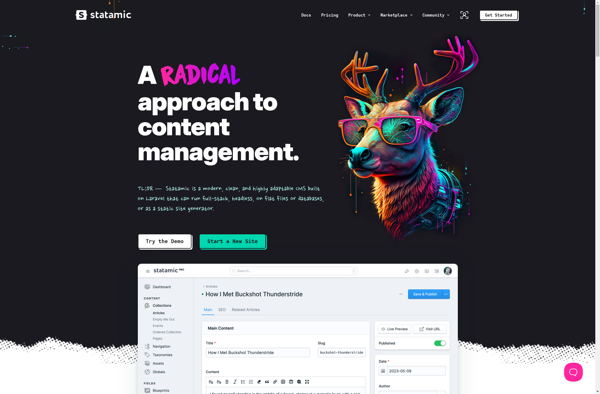
Statamic is a flat-file CMS that allows you to build websites and applications using content stored as Markdown, YAML, and JSON files instead of a traditional database. It's built with PHP and Laravel, and focuses on flexibility, speed, and ease of use.
Flat-file CMS for building websites and applications using Markdown, YAML, and JSON files, built with PHP and Laravel for flexibility, speed, and ease of use
What is Statamic?
Statamic is a flat-file content management system (CMS) built using PHP and the Laravel framework. Unlike traditional CMS platforms that rely on databases to store content, Statamic uses Markdown, YAML, and JSON files for content storage.
Some key features and benefits of Statamic include:
Easy and intuitive content editing interface for managing pages, blog posts, navigation menus, etc.
Uses files rather than databases for storage, improving performance and portability
Flexible fieldtypes allow you to create custom content structures
Tags for categorizing and displaying related content
Robust theming and templating capabilities
SEO tools like sitemaps, metadata, and link tagging
Built-in localization and multi-site management
Extendable via addons and headless APIs
Git integration for version control and team workflows
Statamic excels as a flat-file alternative to traditional SQL-based CMS platforms like WordPress and Drupal. It's a great fit for developers and agencies looking for a flexible Laravel-based system that keeps content portable and easy to manage through files.
Statamic Features
Features
Flat-file based CMS using Markdown, YAML, JSON instead of database
Built on Laravel and PHP
Modular architecture and extendable via addons
Front-end agnostic - works with any JS framework
Customizable templating and theming
Structured content and fieldtypes
Multi-site and multi-language support
SEO and performance optimization built-in
Pricing
Open Source
Subscription-Based
Pros
Fast and lightweight without database dependency
Very flexible and extensible
Great for developers with Laravel/PHP experience
Powerful templating and theming capabilities
Scales well for large and complex sites
Lots of documentation and community support
Cons
Steeper learning curve than some other CMSs
Not as beginner-friendly as database-driven systems
Can require more developer resources for customization
Addons can get expensive for more advanced features
Not as much 3rd party integration support out of the box
What Is WordPress?WordPress is the world's most popular content management system, powering over 40 percent of all websites on the internet. Originally created as a blogging platform in 2003, it has evolved into a full website builder and application framework used for everything from personal blogs to enterprise websites and...
Indexhibit is an open source content management system (CMS) that is designed for quickly setting up and managing simple websites. It is built in PHP and uses a file system to store content and templates, rather than a database.Some key features of Indexhibit include:Very easy to install and use, does...
Drupal is a free and open-source content management system (CMS) written in PHP. It allows users to easily create, manage, and publish content on websites. Some of the key features of Drupal include:Intuitive interface and workflow allows content editors to quickly create, review, edit, publish, and archive webpages with no...
Directus is an open-source headless content management system and API for managing SQL databases. It features:An intuitive admin app interface allowing non-technical users to manage content, users, permissions, flows, and more without codingA GraphQL and REST API for accessing and modifying dataSupport for PostgreSQL, MySQL, SQL Server, SQLite, and Oracle...
Joomla is an open source content management system (CMS) for building powerful websites and online applications. First released in 2005, Joomla is now one of the most popular CMS platforms with over 30 million downloads worldwide.Joomla has a wide range of features that make it an attractive platform for all...
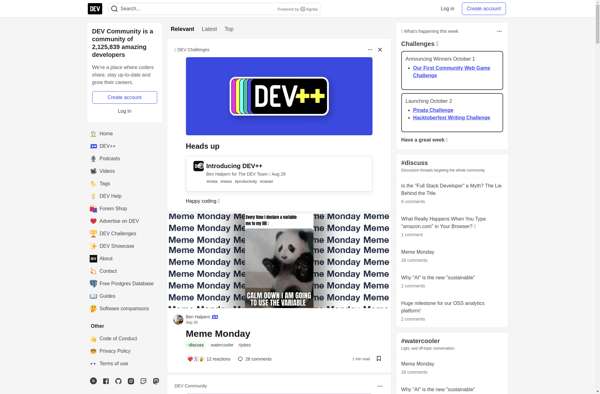
DEV Community is a free and open source software development community platform launched in 2019. It allows software developers and programmers to publish technical articles, take part in discussions, ask questions, and generally connect with other developers.Some key features of DEV Community include:Article publishing - Developers can publish articles on...
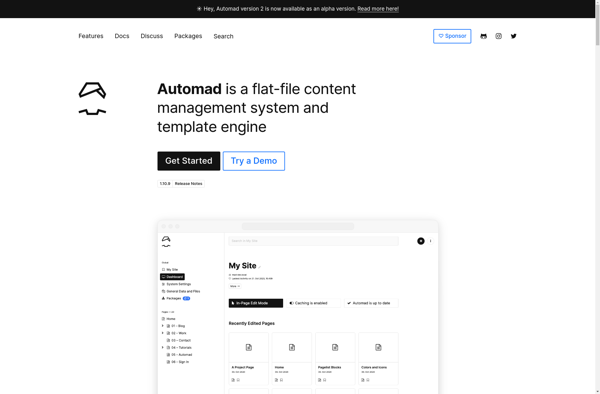
Automad is an open-source content management system (CMS) and website builder designed for flexibility, modularity and ease of use. It allows users without coding experience to easily create modern, responsive websites, blogs and web applications.Key features of Automad include:Modular, block-based layout engine that makes it easy to build custom page...
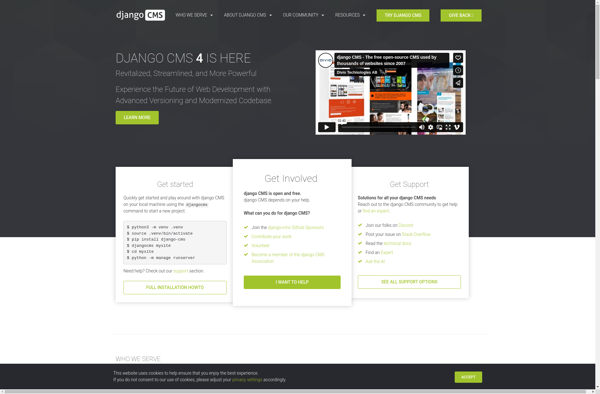
django CMS is an open source content management system based on the Python Django web framework. It was originally created in 2009 by Patrick Lauber and has since grown into a popular CMS with a vibrant open source community.Some key features and benefits of django CMS include:Intuitive interface and workflows...
GetSimple CMS is an open source content management system written in PHP. It is designed to be lightweight, simple to use, and very fast and efficient. Some key features of GetSimple CMS include:Very easy installation and setup - can usually be installed in under 5 minutesIntuitive and clean interface for...
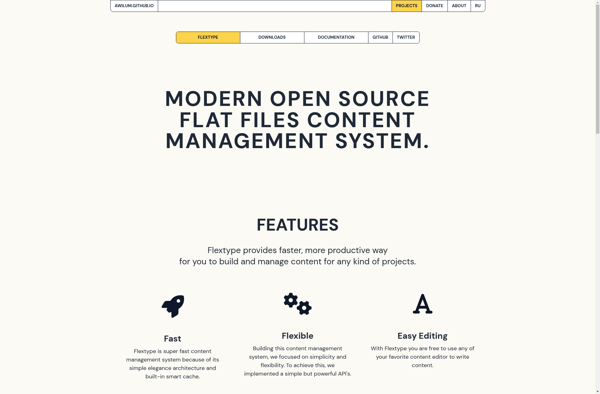
Flextype is an open-source content management system and web publishing platform built with PHP. It is designed to be lightweight, fast, and simple to use. Some key features of Flextype include:Easy installation - Flextype can be installed in under a minute through the admin dashboard.Minimal resource usage - It uses...
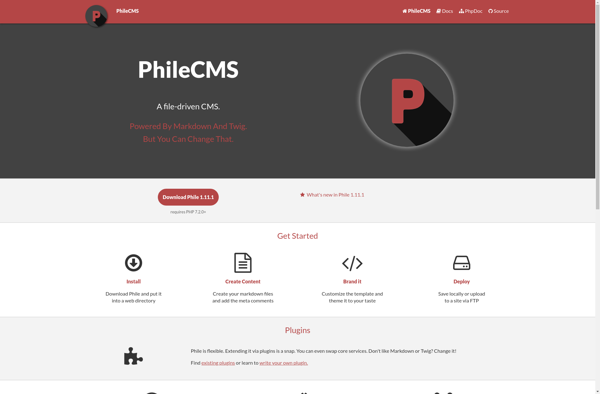
PhileCMS is an open-source content management system and application framework built with PHP. It adopts a simple yet extensible architecture that makes it easy for developers to build custom websites and applications.Some key features and highlights of PhileCMS:Lightweight - PhileCMS has a very small codebase and memory footprint, making it...
Sphido is a flexible, intuitive project management and collaboration platform tailored for agile development teams. Its key features include:Customizable kanban boards to visualize workflows and track progressSprint planning with backlogs to schedule iterationsTime tracking to monitor time spent on tasksResource management to allocate team membersCustom reports and analytics for insightsNative...
LotusCMS is an open-source content management system built with PHP and MySQL. It provides a user-friendly interface that allows non-technical users to easily create, edit, and publish webpages without needing to know HTML or code.Some key features of LotusCMS include:Intuitive WYSIWYG editor for creating and formatting web page contentTemplate system...
Leeflets is an open-source JavaScript library that can be used to build interactive map applications for the web. It provides an API and components for displaying tile-based maps, adding layers, markers, popups, and other map functionality.As an alternative to Leaflet, Leeflets offers similar capabilities for developing web mapping apps without...
FurryCMS is an open-source content management system built for small to medium-sized websites and applications. It focuses on providing a straightforward user interface and set of tools to manage website content and basic functionality without requiring extensive technical expertise.At its core, FurryCMS is built on JavaScript and Node.js, using MongoDB...
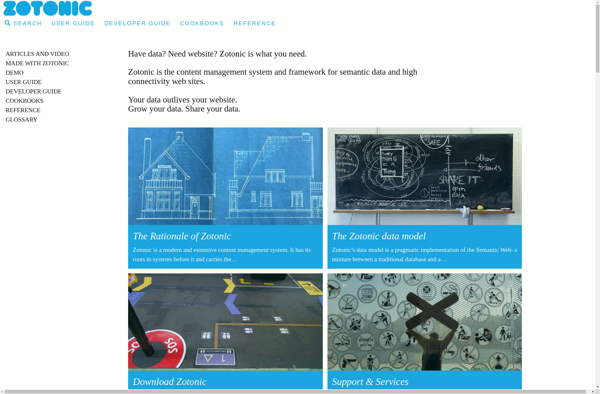
Zotonic is an open-source content management system and web framework written in the Erlang programming language. It is designed specifically for building large, complex websites and custom web applications.Some key features and benefits of Zotonic include:Flexible data modeling - Supports modeling any kind of data right inside the CMS using...