Swarm City is a decentralized peer-to-peer marketplace platform that allows users to create and operate decentralized commerce and sharing economy applications. It aims to provide an open infrastructure for commerce and collaboration.
A platform enabling users to create and operate decentralized commerce and sharing economy applications, providing an open infrastructure for commerce and collaboration.
What is Swarm City?
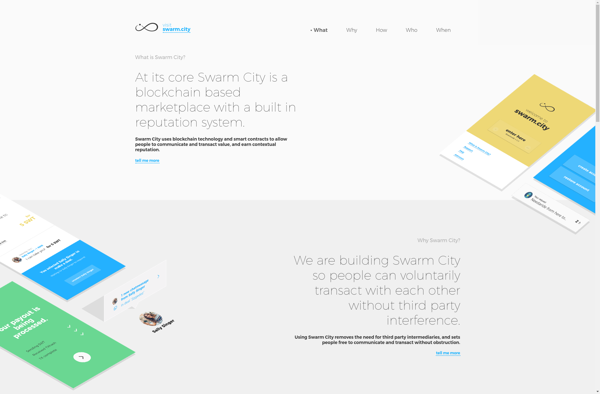
Swarm City is a decentralized peer-to-peer marketplace platform built on the Ethereum blockchain. It aims to enable a sharing economy without centralized control. The platform allows developers and entrepreneurs to build decentralized applications for commerce and collaboration.
Some key features of Swarm City include:
Decentralized governance - The platform uses blockchain technology and smart contracts for transparency and decentralized control instead of centralized intermediaries.
Peer-to-peer transactions - Transactions occur directly between peers through the Swarm City wallet app without middlemen.
Reputation systems - A reputation system allows buyers and sellers to rate each other to build trust in the marketplace.
Resilient infrastructure - The platform is built to be censorship-resistant and fault tolerant using blockchain and peer-to-peer connectivity.
Swarm City wants to provide the infrastructure layer for a decentralized sharing economy. Potential applications include ride sharing, freelancing marketplaces, short-term housing rentals, and more. The goal is to reduce fees, prevent censorship, and give more control to users through decentralization.
Swarm City Features
Features
Decentralized peer-to-peer marketplace
Allows users to create decentralized apps for commerce/sharing
Monero is an open-source, privacy-oriented cryptocurrency that was launched in 2014. It focuses on providing completely private, untraceable, and secure transactions using advanced cryptography.Some key features of Monero include:Ring signatures - Hide the identity of the sender by mixing it with other transaction outputsRing confidential transactions (RingCT) - Hide the...
Ripple is a real-time gross settlement system, currency exchange, and remittance network developed by Ripple Labs Inc. and released in 2012. Its platform is built around a distributed ledger database, blockchain technology and its cryptocurrency called XRP (ripples) that allows banks and payment providers to transfer money quickly, reliably and...
Litecoin (LTC) is a peer-to-peer cryptocurrency that was created in 2011 by Charlie Lee, an ex-Google employee, as an open source project on GitHub. Litecoin is one of the earliest alternative cryptocurrencies (altcoins) and is often referred to as the silver to Bitcoin's gold. Like Bitcoin, Litecoin is decentralized and...
Dogecoin is an open source peer-to-peer digital currency, favored by Shiba Inu enthusiasts worldwide. What started out as a joke in 2013 has grown into one of the world's most widely used and fastest growing cryptocurrencies.Dogecoin features the face of the popular Shiba Inu dog from the viral 'Doge' meme...
Cardano is an open-source, decentralized public blockchain and cryptocurrency project that started in 2015. It was founded by Ethereum co-founder Charles Hoskinson and built through academic rigor and peer-reviewed research by scientists and engineers around the world.The Cardano blockchain operates the Ada cryptocurrency and is designed to be scalable, interoperable,...
Bitcoin Cash (BCH) is a cryptocurrency that originated as a hard fork of Bitcoin in August 2017. It shares much of the same transaction history as Bitcoin up until the fork. The main difference is an increased block size limit which allows for more transactions to be processed per block.Some...
Ethereum is an open-source, public, blockchain-based distributed computing platform featuring smart contract (scripting) functionality. It provides a decentralized virtual machine, the Ethereum Virtual Machine (EVM), that can execute scripts using an international network of public nodes. Ethereum's internal currency is called Ether (ETH), and is used to pay for transaction...
Peercoin (PPC) is a pioneering cryptocurrency that was launched in 2012. It utilizes both proof-of-work and proof-of-stake protocols to secure its network. Peercoin aims to be an energy-efficient cryptocurrency as the proof-of-stake protocol allows coins to be minted, or generated, based on the number of coins a user holds, rather...