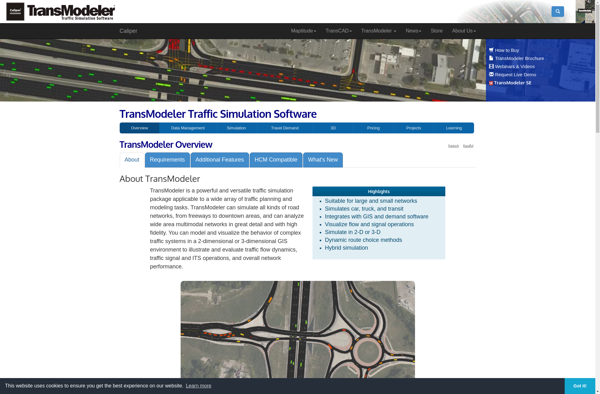
TransModeler is transportation modeling and simulation software used by transportation planners and engineers. It allows for the modeling and analysis of multimodal transportation networks including highways, transit, pedestrians, and bicycles.
TransModeler: Transportation Modeling and Simulation Software
TransModeler is transportation modeling and simulation software used by transportation planners and engineers. It allows for the modeling and analysis of multimodal transportation networks including highways, transit, pedestrians, and bicycles.
What is TransModeler?
TransModeler is a leading transportation modeling and simulation software used by transportation planners, engineers, and researchers to model and analyze transportation networks. It provides advanced mesoscopic, microscopic, and macroscopic modeling capabilities to accurately evaluate transportation projects and policies.
State-of-the-art mesoscopic and microscopic simulation
Integrated mode choice modeling capabilities
Sophisticated visualization and animation
Customizable reporting
Python scripting API
With its integrated architecture and workflow, TransModeler is designed to model entire multimodal transportation networks and simulate detailed traffic operations. It allows users to analyze various planning scenarios and impacts at a refined level of detail. TransModeler is used worldwide by leading transportation agencies to model and optimize network capacity, new infrastructure projects, transit systems, tolling strategies, and active transportation investments.
TransModeler Features
Features
Multimodal transportation network modeling
Traffic assignment and simulation
Public transit modeling and analysis
Pedestrian and bicycle network modeling
Microscopic, mesoscopic and macroscopic modeling
Demand modeling and forecasting
Environmental impact analysis
Pricing
Subscription-Based
Pros
Powerful and flexible modeling capabilities
Integrated modules for different analyses
Customizable user interface
Industry standard software with wide adoption
Cons
Steep learning curve
Requires large amounts of data
Limited capabilities for pedestrian and bicycle modeling
Can be computationally intensive for large networks
Anylogic is a versatile simulation software that enables organizations to model, simulate and analyze systems of any kind and complexity. It is based on the core simulation methodologies of agent-based modeling, system dynamics and discrete event modeling which can be combined within the same model.Key capabilities and benefits of Anylogic...
PTV Visum is a comprehensive transportation planning software package used by transportation agencies, consultants, and researchers to model, analyze, and optimize transportation systems. It enables users to:Build detailed multimodal transportation network models for roads, public transit, bikes, pedestrians, etc.Assign travel demand based on origin-destination matrices and route choice behaviorPerform traffic...
MATSim (Multi-Agent Transport Simulation) is an extensible, modular, open-source framework for implementing large-scale agent-based transport simulations. It allows researchers and planners to model real-world traffic scenarios with millions of individual agents, each with their own travel plans and behaviors.Some key features and capabilities of MATSim include:Microscopic mobility simulation of millions...
SUMO (Simulation of Urban MObility) is an open source, highly portable, microscopic and continuous road traffic simulation software package designed to handle large road networks. Originally developed at the Institute of Transportation Systems at the German Aerospace Center, SUMO allows for intermodal simulation that includes vehicles, public transport and pedestrians.Some...
Aimsun Next is an advanced transportation modeling and simulation software suite used for transport planning, traffic engineering, and research applications. It allows users to model all modes of transport including cars, trucks, public transit, pedestrians, and bicycles.Key capabilities and features of Aimsun Next include:Modeling transport demand based on activities, trips,...
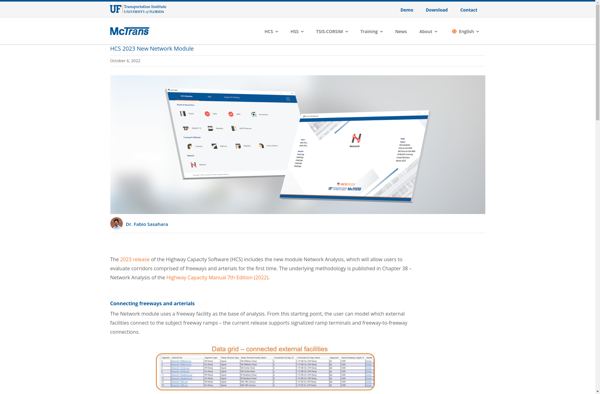
HCS (Healthcare Software) is a comprehensive solution designed to handle various operational aspects of healthcare facilities and organizations. It comprises of integrated modules for patient records, billing and invoicing, scheduling appointments, maintaining diagnostic reports, managing inventory and workflows.Key features of HCS include:Intuitive EHR (Electronic Health Records) to digitize and manage...
Quadstone Paramics is an advanced traffic modeling and simulation software used for a variety of transportation planning and traffic engineering applications. It allows users to create highly detailed microscopic traffic models to simulate the movement and behavior of individual vehicles as they travel through a road network.Key features and capabilities...
TRANSIMS (TRansportation ANalysis and SIMulation System) is an open source, multi-modal transportation planning software developed by the Los Alamos National Laboratory. It is designed to model travel demand at a microscopic level by simulating the movement and behavior of individual traveler entities.Unlike traditional transportation models that use aggregated data, TRANSIMS...
The Repast Suite is a mature, free, and open source agent-based modeling and simulation platform that has been under continuous development for over 20 years. It is used to model social agents and complex adaptive systems in domains like social science, ecology, biology, economics, manufacturing, military, and more.At its core,...
TSIS-CORSIM (Traffic Software Integrated System - Corridor Simulation) is an advanced traffic simulation software package developed by the Federal Highway Administration (FHWA) in the United States. It is used by transportation planners and engineers to model traffic operations of surface transportation systems such as freeways, highways, arterials, and urban streets.CORSIM...