Veracity is an open source data management platform designed for traceability and transparency. It allows organizations to securely store, share and govern valuable data assets.
An open source data management platform designed for traceability and transparency, Veracity allows organizations to securely store, share and govern valuable data assets.
What is Veracity?
Veracity is an open source data trust platform created by DNV for secure data sharing and governance. It establishes trust in data through traceability, provenance, security, and control over valuable data assets.
Key features of Veracity include:
Data provenance tracking to understand the origins and transformations of data
Access controls, permissions and audit logs for data security and governance
APIs and integrations for connecting data from diverse sources
Customizable dashboards and visualization tools to gain insights from data
Scalable and flexible data storage using blockchain and cloud infrastructure
Smart contracts and other trust mechanisms ensuring transparency and accountability
Veracity enables trusted data sharing across organizational boundaries. It has applications in sustainability reporting, supply chains, IoT sensor data management and more. With advanced data governance capabilities and ecosystem support, Veracity facilitates new opportunities for collaboration and innovation with data.
Mercurial is a free, distributed source control management system designed for efficient and reliable control of source code and other revision-controlled assets. Key features of Mercurial include:Distributed peer-to-peer architecture, allowing decentralized and collaborative developmentRobust branching and merging capabilities to support complex workflowsSecure, encrypted repositories with integrated access controlPowerful integrations with...
Perforce is a proprietary version control system developed by Perforce Software. It is popular among large enterprises, especially game studios, manufacturers, and semiconductor companies, to manage their digital assets and source code.Some key features of Perforce include:Excellent scaling for extremely large codebases with millions of files and revisionsAdvanced branching and...
Apache Subversion (often abbreviated SVN) is a software versioning and revision control system distributed as free and open source software. Software developers use Subversion to maintain current and historical versions of files such as source code, web pages, and documentation. Its goal is to be a mostly compatible successor to...
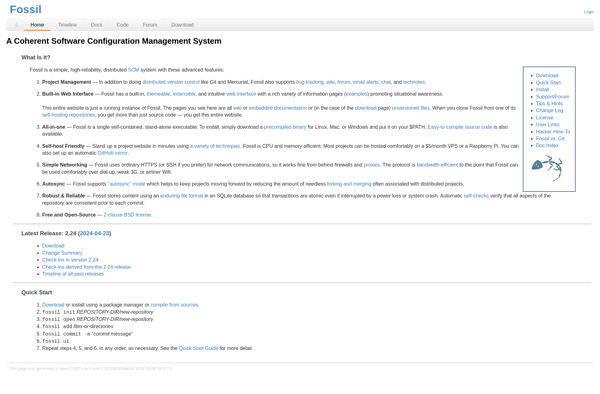
Fossil is an open-source, distributed version control system developed by D. Richard Hipp. It emphasizes simplicity, security, and data integrity over features commonly found in other version control systems.Some key features and capabilities of Fossil include:Distributed architecture - Allows geographically distributed teams to collaborate on a projectIntegrated bug tracking -...
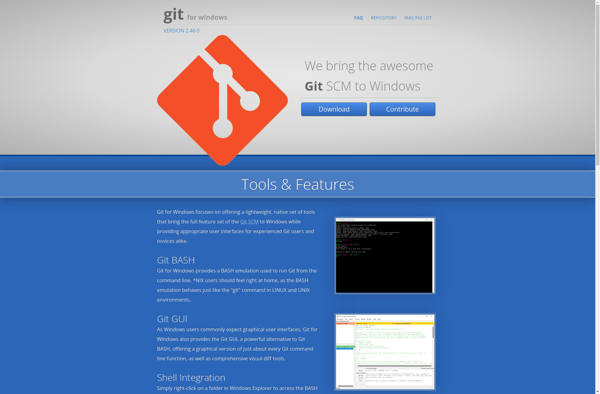
Git for Windows is a free and open source distributed version control system optimized for use on Windows systems. It provides Windows users with an easy way to install Git on their computers with minimal hassle.Some key features of Git for Windows include:Latest release of Git for seamless version controlPowerful...
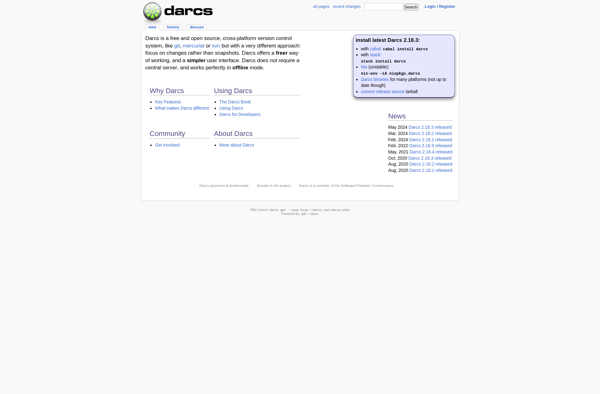
darcs is an advanced distributed revision control system that differs fundamentally from systems like Git and Mercurial in its underlying theory. While darcs shares common functionality with other version control tools like committing and branching/merging changes, it is built on a unique algebra of patches and provides innovative features like...
AccuRev is a software configuration management and version control system developed by Micro Focus. It uses a unique stream-based architecture that allows development teams to work in parallel on features or fixes without interference.Some key capabilities and benefits of AccuRev include:Stream-based architecture provides superior support for parallel and distributed development....
Surround SCM is a software configuration management and version control system designed for software development teams. It provides capabilities for:Version control - Track code changes, rollback to previous versions, branch code, merge changes from multiple developersWorkspace management - Developers can create personal workspaces to make code changes isolated from the...
Pijul is an open-source distributed version control system that offers an alternative approach to software like Git. Instead of Git's content-addressable storage model, Pijul is built on a theory of patches and solvers developed specifically for version control.The key difference with Pijul is in its merge capabilities. In systems like...