
XTDB
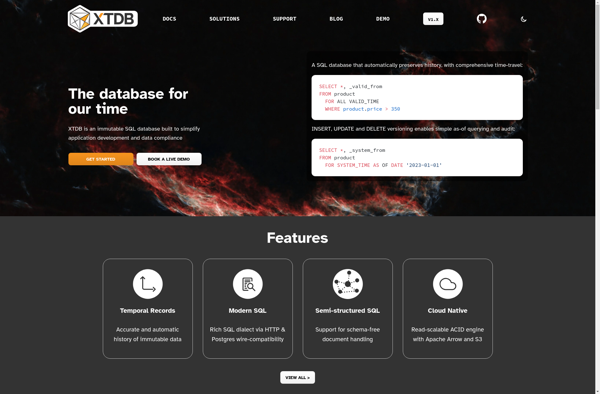
XTDB: Time Series Database for IoT and Time Series Data
A high-performance time series database designed for efficient ingestion, storage, and querying of large volumes of timestamped data, ideal for IoT applications.
What is XTDB?
XTDB is an open-source time series database purpose-built for managing IoT and time series data at scale. Unlike relational databases, XTDB organizes data by time stamp first rather than relations between tables. This specialized design delivers exceptional write throughput and compression ratios.
XTDB is optimized to efficiently handle high velocity writes of time series data such as sensor readings, application metrics, and device heartbeats. Data can be written to XTDB with millisecond timestamps and microsecond precision. Queries are also lightning fast thanks to XTDB's time-first architecture and ability to return data for specific time ranges without scanning everything.
In addition to speed, XTDB provides strong data compression (often 10x or better) along with data rollups and downsampling. These capabilities significantly reduce storage requirements and costs compared to other databases. XTDB also includes native support for time series forecasting and interpolation.
XTDB runs anywhere - on premises, in the cloud, or at the edge. It can ingest millions of data points per second on a single node. XTDB scales horizontally across nodes with a shared-nothing architecture and replication for high availability. The database includes connectors for apps and visualization tools.
XTDB Features
Features
- Native time series data model
- High ingestion rates
- Query optimization for time series
- ACID transactions
- Horizontal scalability
- Built-in aggregations
- Data compression
Pricing
- Open Source
- Freemium
- Subscription-Based
Pros
Cons
Official Links
Reviews & Ratings
Login to ReviewThe Best XTDB Alternatives
View all XTDB alternatives with detailed comparison →
Top Ai Tools & Services and Time Series Databases and other similar apps like XTDB
No alternatives found for XTDB. Why not suggest an alternative?