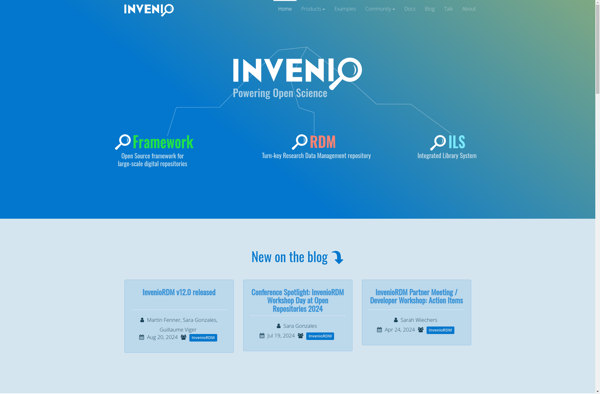
Invenio is an open-source repository software used for building and managing digital libraries and archives. It allows institutions to showcase and preserve their research outputs and other digital objects.
Build and manage digital libraries and archives with Invenio, a powerful open-source repository software showcasing and preserving research outputs and digital objects.
What is Invenio?
Invenio is an open-source repository software designed for building and managing institutional repositories, digital archives, and research data repositories. It enables institutions to showcase and preserve their digital collections and assets like research publications, datasets, multimedia files, and more.
Some key features of Invenio include:
Flexible metadata standards support including Dublin Core, MARCXML, DataCite
Advanced search and browse capabilities
Support for uploading and managing a wide variety of content types
Customizable submitter and editor portals
Usage statistics and reporting
Flexible access controls and permissions management
Integration with authentication systems like OAuth and ORCID
APIs for machine access and data exchange
Responsive interface optimized for desktop and mobile
Invenio is very modular and extensible, allowing institutions to easily customize and enhance it based on their specific needs. It has an active open source community behind it contributing code and extensions. Overall, Invenio provides a feature-rich platform for research repositories of all types and sizes.
Invenio Features
Features
Institutional repository
Research data management
Open access publishing
Metadata management
Advanced search and browse
Statistics and reporting
REST API
Multilingual support
Pricing
Open Source
Pros
Open source and free
Highly customizable and extensible
Active development community
Supports wide range of content types
Good documentation and support
Cons
Steep learning curve
Requires technical expertise to install and configure
Limited out-of-the-box features compared to commercial solutions
Lacks some common repository features like usage statistics
Ambra is an enterprise-grade, open-source medical image management system developed by Ashley Holman and other contributors. It provides a vendor-neutral archive for storing medical images and reports generated by medical imaging devices such as CT scanners, MRIs, and X-ray machines.Some key features of Ambra include:Scalable cloud-based storage for medical images...
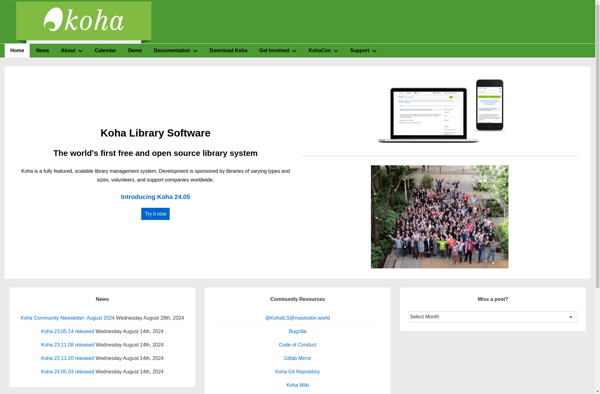
Koha is a full-featured open-source integrated library system that provides libraries with the essential tools they need to manage their resources efficiently. Originally developed in New Zealand, Koha has been adopted by thousands of libraries across the globe and is translated into dozens of languages.Some of the key features of...
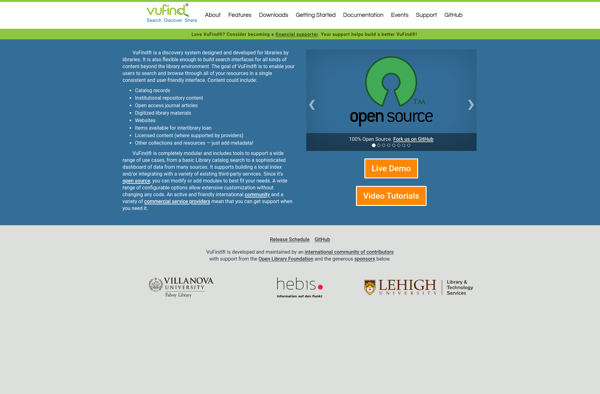
VuFind is an open source library resource discovery system that was developed at Villanova University. It enables users to search and browse through library collections and resources with a single search interface. VuFind provides discovery of physical and digital content such as books, journals, articles, audio, video and more.Some key...
Evergreen ILS is an open source integrated library system developed by the Georgia Public Library Service in 2006. It is designed to help libraries manage their collections and circulating materials more efficiently. Some key features of Evergreen ILS include:Online public access catalog for patrons to search and request library materialsCirculation...
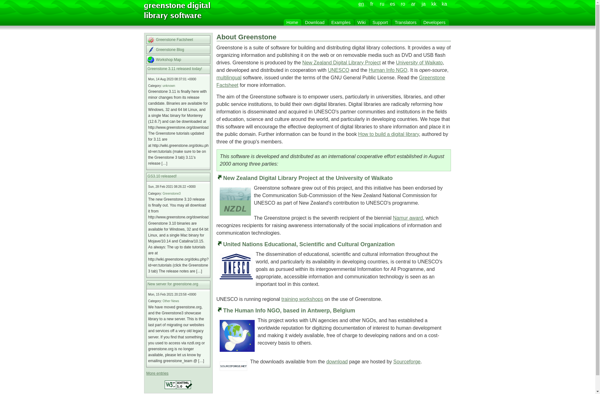
Greenstone Digital Library is an open source software system designed for creating full-text searchable collections of digital documents. It was produced by the New Zealand Digital Library Project at the University of Waikato and has been developed and distributed in cooperation with UNESCO and the Human Info NGO.Greenstone provides a...
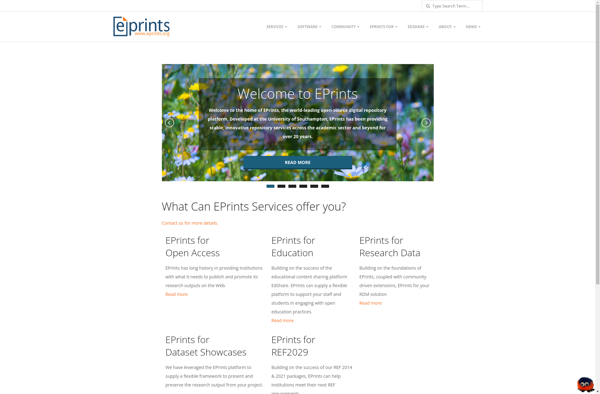
E-Prints is an open source software application used to build open access digital repositories of scholarly and scientific research. It allows researchers to deposit, manage, preserve and provide access to their research output. Developed by the University of Southampton, E-Prints is widely used by hundreds of institutions worldwide to run...
FedoraCommons is an open-source, modular repository system for managing, preserving, sharing and providing access to digital content. It is commonly used by universities, libraries, archives, museums and other cultural heritage institutions to store and manage their digital collections.Some key features of FedoraCommons include:Flexible support for a wide variety of digital...