E-Prints is an open source software platform used to build open access repositories for scholarly and scientific research. It allows researchers to self-archive their work to promote broader access.
E-Prints: Open Source Platform for Open Access Repositories
E-Prints is an open source software platform used to build open access repositories for scholarly and scientific research. It allows researchers to self-archive their work to promote broader access.
What is E-Prints?
E-Prints is an open source software application used to build open access digital repositories of scholarly and scientific research. It allows researchers to deposit, manage, preserve and provide access to their research output. Developed by the University of Southampton, E-Prints is widely used by hundreds of institutions worldwide to run OA repositories and electronic publishing platforms.
Key features of E-Prints include:
Builds highly configurable and interoperable OA repositories
Supports green and gold open access publishing models
Compatible with global interoperability standards
Handles a wide range of digital file formats including text, images, audio, video
Provides comprehensive usage and citation metrics
Implements preservation tools and metadata standards
Offers advanced user and group access management
Mobile-friendly interface
With robust tools for system interoperability, preservation, reporting and self-archiving, E-Prints enables researchers, institutions and funding agencies to manage, share and measure the impact of a wide range of research outputs online.
E-Prints Features
Features
Self-archiving and open access repository
Supports various publication types like articles, books, theses
Flexible metadata support
Full-text and metadata indexing
Usage statistics and reporting
Access control and permissions
Integration with research profiles and ORCID
Multi-language support
Responsive interface
Customizable look and feel
APIs for integration and automation
Pricing
Open Source
Pros
Free and open source
Active development community
Highly customizable and extensible
Good for long-term preservation
Promotes open access to research
Supports standard protocols like OAI-PMH
Large user base and community support
Cons
Steep learning curve
Requires technical expertise to install and manage
Ambra is an enterprise-grade, open-source medical image management system developed by Ashley Holman and other contributors. It provides a vendor-neutral archive for storing medical images and reports generated by medical imaging devices such as CT scanners, MRIs, and X-ray machines.Some key features of Ambra include:Scalable cloud-based storage for medical images...
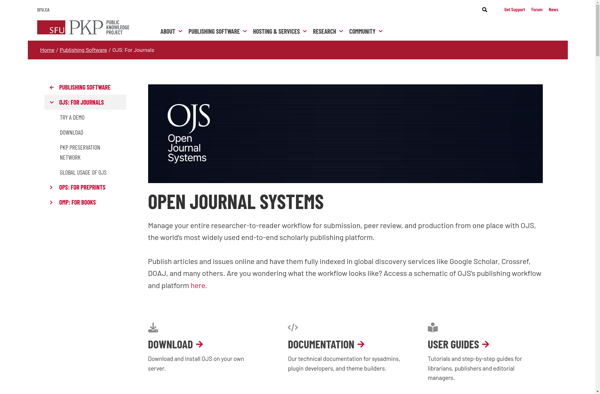
Open Journal Systems (OJS) is an open source journal management and publishing software developed by the Public Knowledge Project. It is designed to make it easier for academic journals to manage their submission, peer review, editing, and publication processes online.Some key features of Open Journal Systems include:Online submission system for...
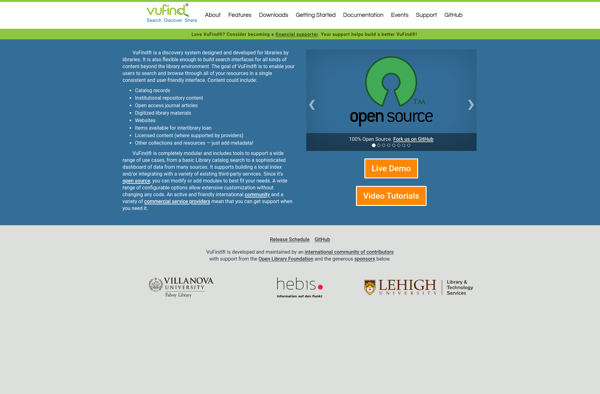
VuFind is an open source library resource discovery system that was developed at Villanova University. It enables users to search and browse through library collections and resources with a single search interface. VuFind provides discovery of physical and digital content such as books, journals, articles, audio, video and more.Some key...
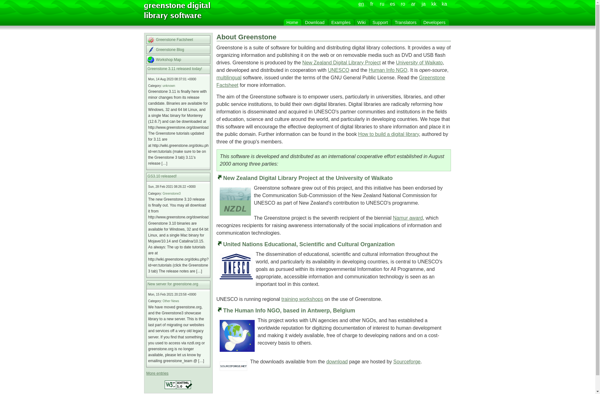
Greenstone Digital Library is an open source software system designed for creating full-text searchable collections of digital documents. It was produced by the New Zealand Digital Library Project at the University of Waikato and has been developed and distributed in cooperation with UNESCO and the Human Info NGO.Greenstone provides a...
Invenio is an open-source repository software designed for building and managing institutional repositories, digital archives, and research data repositories. It enables institutions to showcase and preserve their digital collections and assets like research publications, datasets, multimedia files, and more.Some key features of Invenio include:Flexible metadata standards support including Dublin Core,...
FedoraCommons is an open-source, modular repository system for managing, preserving, sharing and providing access to digital content. It is commonly used by universities, libraries, archives, museums and other cultural heritage institutions to store and manage their digital collections.Some key features of FedoraCommons include:Flexible support for a wide variety of digital...